
Levelling for refits in the Lansdowne and at Castlepoint
Commercial floors are often levelled against a deadline. When an office in the Lansdowne Business District changes tenant, or a unit at Castlepoint, the 41 acre shopping complex north of the centre, is fitted out, the new finish can only go down once the base is flat, clean and primed. Fast drying compounds keep that stage short so the shopfitters and flooring fitters can follow on without waiting.
Flatness targets come from BS 8204. Lay a 2m straightedge on the floor: SR1 means no gap over 3mm beneath it, SR2 no more than 5mm, SR3 up to 10mm. Thin sheet finishes often call for SR1, and big format tiles also want a flat base, so an office floor that suited carpet tiles can fall short once LVT is on the order.
The process is simple in outline. First the base is cleaned and stripped of old adhesive and anything loose. A primer is chosen to match what lies below, be it concrete, sand and cement, calcium sulphate or an older finish. The compound is then poured, spread out and left to settle smooth. An office floor can be split into zones so part of it stays in use.
Where an old floor has to be ground or shot blasted first, that preparation is part of the job; our floor preparation page covers it. For whole-floor schemes on larger premises, see commercial screeding.
Old floors and extension joins in Boscombe and beyond
In homes, levelling usually starts with an old floor. In Boscombe and along the East Cliff and West Cliff, the solid floors of Victorian and Edwardian villas have often dipped or cracked with age. Converted flats account for 14% of Bournemouth's homes, and in those buildings floors laid in different decades can meet at a single doorway.
The join between an original house and a new extension is another classic spot. The two floors are rarely at quite the same height, and a thin layer of compound brings them into one plane so a continuous finish can run through.
Compound has limits. Most products are made for roughly 2mm to 10mm, though a few can be laid thicker. Pouring it thick to rescue a floor that has really failed can end in cracking and debonding. When a floor is that far out, the honest answer is a new screed, often sand and cement relaid in an older house, or a screed repair where only part of it has broken up. We tell you which before any work starts.
How we price floor levelling in Bournemouth
A fixed written price within 24 hours, once we know the area and the base. See our floor screeding cost guide.
Who levels your floor in Bournemouth
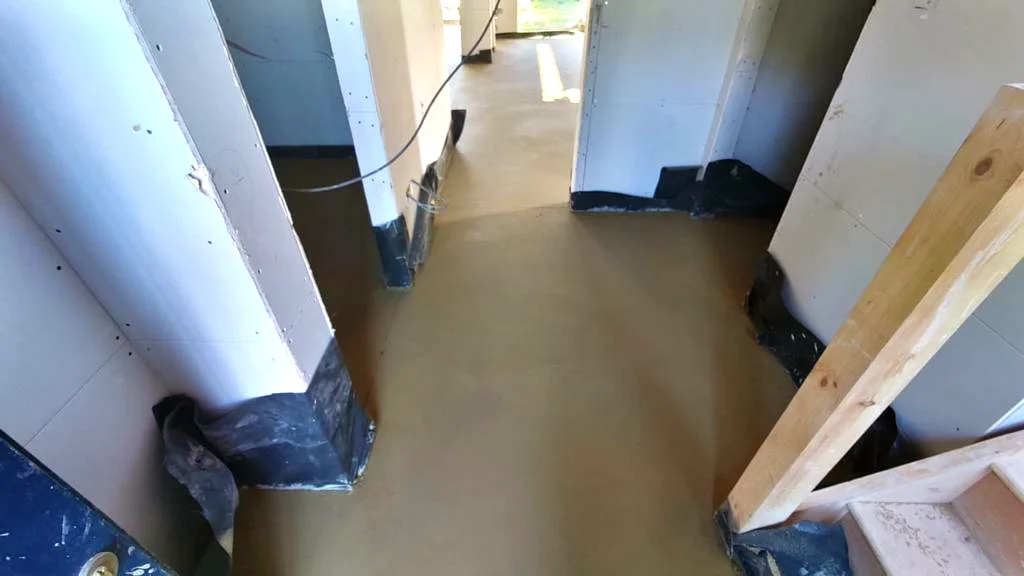
K & B Screeding’s own team, led by director Donatas Bardisevicius. Founded 2019, company 12298780.
See what customers say in our Google reviews and on our testimonials page.
Floor Levelling from Slough to Bournemouth
Bournemouth is about 77.5 miles south-west of our Slough base as the crow flies, with postcodes including BH1, BH4, BH11 and BH5. The nearest towns to it are Christchurch (4.3 miles), Ferndown (5.6 miles), Wimborne Minster (7.3 miles) and Ringwood (9.4 miles).
More on floor levelling, part of our screeding services. Not sure whether you need a thin compound or a full flowing screed? See self levelling screed explained.
