
Which screed suits which Bournemouth home
The 196,453 residents that Census 2021 counted in the Bournemouth built-up area live in a varied stock, and the floor trouble changes from one kind of house to the next.
The oldest stock is Victorian and Edwardian. The town began in 1810 when Lewis Tregonwell built villas on the heath, grew fast once the railway arrived in 1870, and its centre is known for its Victorian architecture. Up on the East and West Cliff and around Boscombe, a villa of that era is likely to have suspended timber or an old solid floor. If the solid one has given up and comes out, the replacement is usually sand and cement, laid by hand, which copes with bays, small rooms and wet areas.
Flat conversions are the second group. When a large house is split into flats, the new floors between levels usually need acoustic insulation under a screed that meets the sound rules. A pumped liquid screed over acoustic layers suits that work, because it flows to an even depth across the whole flat.
The suburbs spread inland and east through places such as Charminster, Moordown and Southbourne, and across them there is a large stock of inter-war and post war houses. Rear extensions with insulated ground floors are the usual project on houses of that age, and many now include wet heating, covered on our underfloor heating screed page for Bournemouth.
New apartment buildings, such as the 169 seafront apartments at Honeycombe Chine, are a different specification again. Specs for blocks like that sometimes call for a calcium sulphate grade, and the anhydrite flow screed page sets out what choosing one means on site.
Homes in Bournemouth at a glance
Of the 84,721 households in Bournemouth, 46% live in flats and 31% in detached houses. The largest share of its housing, 27%, was built before 1919, and 21% between the wars.
| Homes in Bournemouth | Share |
|---|---|
| Detached houses | 31% |
| Semi-detached houses | 14% |
| Terraced houses | 6% |
| Flats | 46% |
| Built before 1919 | 27% |
| Built 1919 to 1944 | 21% |
| Built 1945 to 1972 | 19% |
| Built 1973 to 1999 | 17% |
| Built since 2000 | 16% |
House types from Census 2021 (table TS044); building age from the Valuation Office Agency council tax stock of properties, 31 March 2026 (table CTSOP 4.1). Figures cover the Bournemouth built-up area (E63006699).
Screeding services in Bournemouth
- Liquid ScreedUpper floor flats, converted houses and open-plan extensions: pumped liquid screed in Bournemouth, walkable in 24 to 48 hours.
- Sand and Cement ScreedOld villa floors dug out and relaid, wet rooms laid to a fall: hand-compacted sand and cement screed in Bournemouth.
- Underfloor Heating ScreedUnderfloor heating screed for rear extensions on inter-war and post-war Bournemouth houses, full pipe cover and no voids.
- Anhydrite & Flow ScreedAnhydrite flow screed for Bournemouth apartment floors and new build plots, poured to the specified CA grade, sanded and tested.
- Floor LevellingFloor levelling for Lansdowne office refits, Castlepoint shop fit outs and uneven Bournemouth villa floors, ready for LVT and tiles.
- Latex ScreedVictorian and Edwardian refits around Boscombe and the Cliffs, smoothed over plywood or firm tiles with latex screed in Bournemouth.
- Concrete Floor GrindingConcrete floor grinding for Castlepoint units, Westbourne shop refits and Bournemouth garage slabs, glue and paint removed, dust extracted.
We also offer fibre reinforced screed, quick drying screed, high strength screed, bonded screed, floor preparation, screed repairs, concrete floor repair, screed pumping, insulation & membranes, commercial screeding and residential screeding in Bournemouth.
Pumps, parking and pour dates around Bournemouth
Pour day has to be slotted in among everyone else on the job. We want the building closed in first, with glazing and outside doors fitted, the wet plaster done and any heating circuit already through its pressure test. Tiles, LVT or wood then wait while the screed dries, so pick the fitter's date once the pour is fixed rather than working backwards from it.
Access needs thought in a town with this many flats. A pump and mixer need somewhere to stand within a hose run of the building, and at a converted villa that can mean a parking suspension or a hose laid up a shared stairwell. Tell us about permit zones, shared entrances and which floor the flat is on when you ask for a price, whether the address is in Talbot Woods, Springbourne, Wallisdown or Alum Chine.
Commercial premises are their own category. The Lansdowne Business District, which received government funding in 2017 through the Lansdowne Programme to improve it as an office district, and the 40 units at Castlepoint north of the centre are the sort of buildings where refits need a flat base quickly. Uneven floors there usually call for self levelling compound before new flooring, while bigger schemes come under our commercial screeding service.
Screeding prices for Bournemouth floors
Sand and cement £18 to £25 per m², liquid £24 to £31 per m², supplied and laid (MyJobQuote, August 2026). MyJobQuote does not say whether these figures include VAT. See our floor screeding cost guide.
Who lays your floor screed in Bournemouth
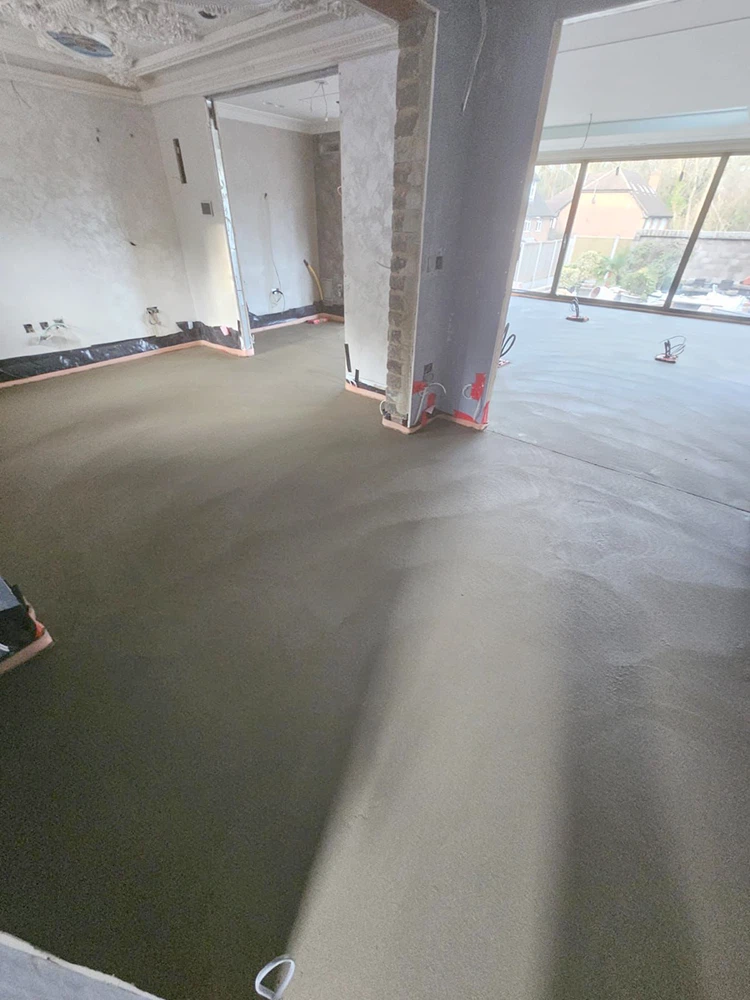
K & B Screeding’s own team, led by director Donatas Bardisevicius. Founded 2019, company 12298780.
See what customers say in our Google reviews and on our testimonials page.
Reaching Bournemouth
Bournemouth is about 77.5 miles south-west of our Slough base as the crow flies, with postcodes including BH1, BH4, BH11 and BH5. The nearest towns to it are Christchurch (4.3 miles), Ferndown (5.6 miles), Wimborne Minster (7.3 miles) and Ringwood (9.4 miles). Neighbourhoods we cover in Bournemouth include Alum Chine, Bear Cross, Boscombe, Bourne Valley and Branksome.
See our screeding services for every screed type we lay.
