
Latex over old boards and tiles in Boscombe villas
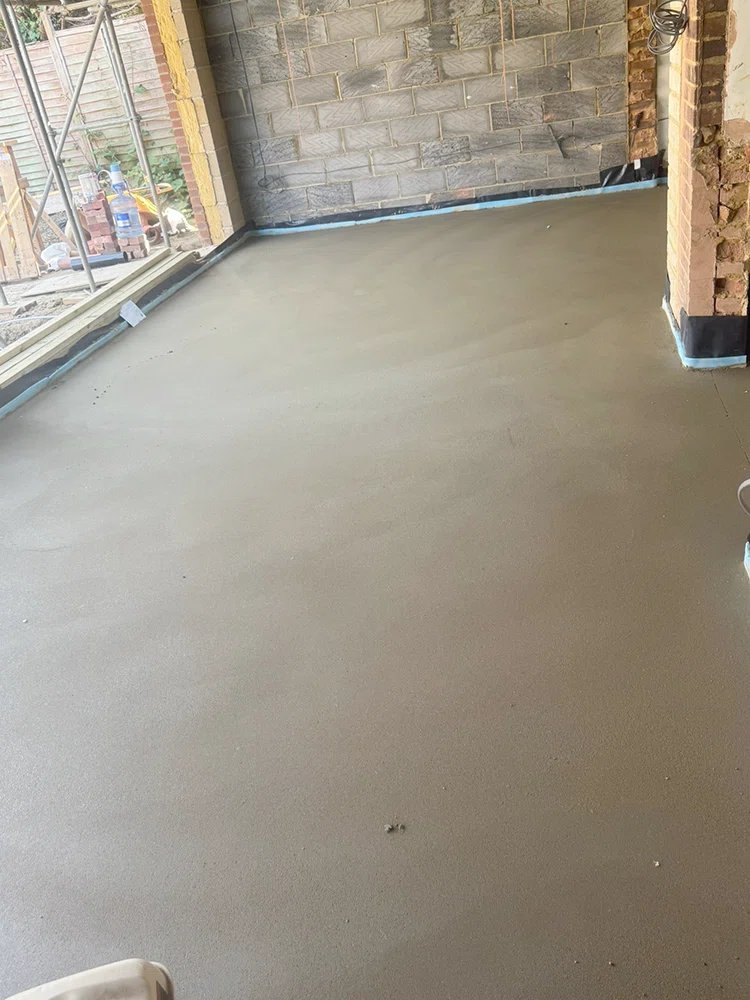
Latex screed is a trade name rather than a separate kind of screed. It arrives in two parts: a cement based powder and a latex liquid, which goes into the mix where an ordinary compound would take water. The result is spread thin, normally a few millimetres, and it only works on a base that is already sound.
In the Victorian and Edwardian villas around Boscombe and the East and West Cliff, the floor under a tired kitchen or bathroom tends to be one of three things.
Suspended timber is the first. Latex never goes straight onto bare floorboards, because the boards move and a thin layer cracks with them. The boards are screwed down, then overboarded with flooring grade plywood, and the latex goes over the primed ply.
Old ceramic or quarry tiles are the second. Where every tile is firmly stuck and free of polish, latex can go over them, which saves lifting a floor that may sit on an unknown base. Any loose or hollow tile comes up first and the gap is made good.
Worn solid floors are the third: an older slab with shallow hollows and traces of old adhesive. Thin, hard residue can sometimes stay under a suitable primer, but soft or tacky residue has to come off, and on heavier deposits grinding the concrete back gives a clean surface first.
In Boscombe, many large family homes and guest houses became houses in multiple occupation from the 1970s, so one room can have a different base from the next. We check each room rather than assume. If a base needs more than a smoothing coat, our floor preparation service covers the work beforehand.
When latex is not enough in Bournemouth homes
Latex smooths a floor. It does not repair one, and the checks before it goes down decide whether it lasts.
Damp is the first check. A ground floor in an older Bournemouth house may have no reliable membrane, and latex over a damp slab will not stop moisture reaching the vinyl or lino above it. We test the base, and where damp shows, the floor needs a membrane or a new build-up before any compound.
Movement is the second. Springy boards, a sagging joist or plywood that flexes underfoot will crack a thin layer however carefully it is mixed. Those faults are put right with fixings, packing or fresh overboarding.
Level is the third. If a room drops away along its length, latex at a few millimetres follows the slope instead of correcting it. A floor out by that much needs a deeper levelling pour or, where an old villa floor is being dug out anyway, a hand-laid sand and cement screed.
Primer is matched to the base. Plywood, tiles, concrete and calcium sulphate each take their own, and calcium sulphate is always sanded free of laitance and primed before latex touches it. Skip it and the bond to the base is left to chance.
Whether the address is in Pokesdown, Kinson, Branksome or Muscliffe, those same checks come before we put a price on the floor.
How we price latex screed in Bournemouth
A fixed written price within 24 hours, once we know the area and the base. See our floor screeding cost guide.
Who lays your latex screed in Bournemouth
K & B Screeding’s own team, led by director Donatas Bardisevicius. Founded 2019, company 12298780.
See what customers say in our Google reviews and on our testimonials page.
Latex Screed from Slough to Bournemouth
Bournemouth is about 77.5 miles south-west of our Slough base as the crow flies, with postcodes including BH1, BH4, BH11 and BH5. The nearest towns to it are Christchurch (4.3 miles), Ferndown (5.6 miles), Wimborne Minster (7.3 miles) and Ringwood (9.4 miles).
More on latex screed, part of our screeding services.
