
Relaying old solid floors in Boscombe and East Cliff villas
Before a new finish goes down in a Boscombe, East Cliff or West Cliff villa, the Victorian or Edwardian floor underneath, whether timber or old solid, often needs work. If the original slab has cracked, dropped or no longer keeps damp out, it is better broken out and replaced: membrane and insulation first, then fresh screed over them.
Sand and cement suits that work for practical reasons. Small site-mixed batches go by barrow down a narrow villa hallway, one room at a time, with no pump involved. Bays, chimney breasts and steps in level from room to room are no trouble for it. And it can be formed to a fall, which a self-levelling screed cannot.
Floated on insulation, the depth is 65mm in a house and 75mm in a commercial building. Where the old slab is sound and only needs building up, a bonded screed of 25 to 40mm fixed to the base can be enough; see our bonded screed service.
In a house being split into flats, the new floors between levels usually need acoustic insulation, and a sand and cement screed can be laid over that layer to the build-up the sound rules call for.
The trade-off is drying. Each of the first 40mm takes roughly a day, and the rate slows beyond that, so a 65mm floor is ready well after a thinner liquid one would be. Plan the flooring around it, or ask about fast drying screed options when the programme is tight.
Wet rooms and garages across Bournemouth's suburbs
Homes built between 1919 and 1944 make up 21% of Bournemouth's stock, and the suburbs, including Charminster, Moordown and Southbourne, hold a large stock of inter-war and post war houses. Two jobs in houses of that age suit sand and cement in particular.
The first is the wet room. Walk-in, level-access showers rely on a gentle, even slope down to the drain, and a screeder working sand and cement by hand can form exactly that. Calcium sulphate screed should not go into a wet area at all, so sand and cement is the default here, with tanking laid over it before the tiles.
The second is the garage. Converting one normally involves raising the garage floor to the level of the house, over a membrane and insulation. Screeding a garage for conversion goes through the depths and how the damp course is handled.
On 2026 published pricing, sand and cement runs £18 to £25 per m²; adding fibres for better crack resistance costs another £1 to £3 per m². For a large new ground floor in a Bournemouth extension, compare this with liquid screed for larger floors.
Sand and Cement Screed prices in Bournemouth
Sand and cement screed: £18 to £25 per m² supplied and laid (MyJobQuote, August 2026), so £450 to £630 for 25 m². MyJobQuote does not say whether these figures include VAT. See our floor screeding cost guide or screed calculator.
Who lays your sand and cement screed in Bournemouth
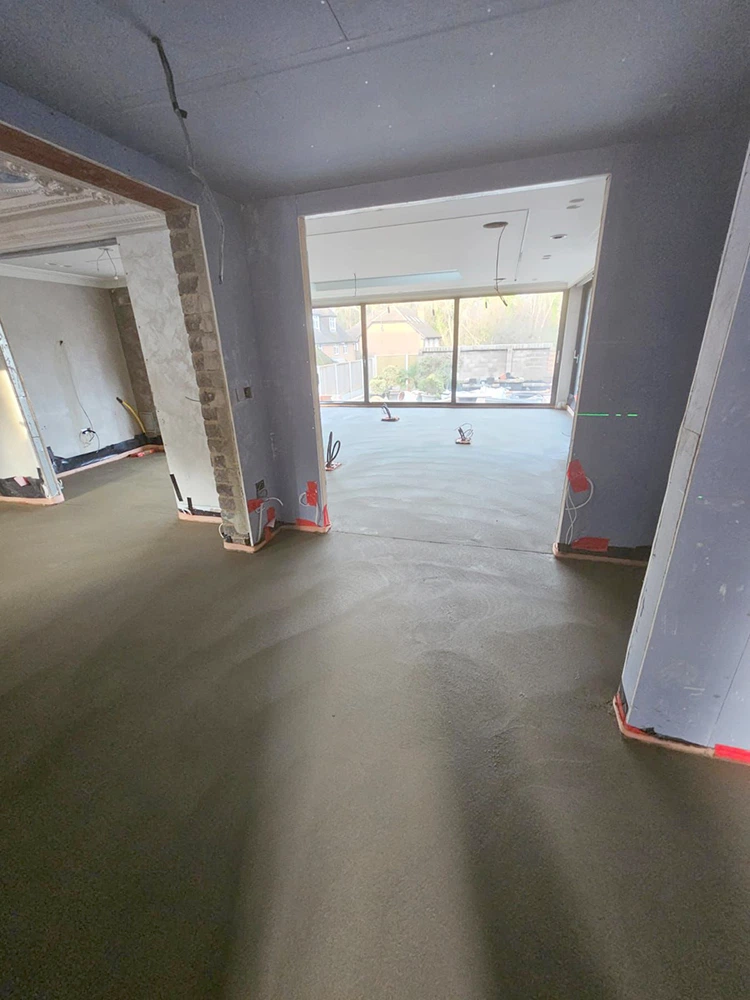
K & B Screeding’s own team, led by director Donatas Bardisevicius. Founded 2019, company 12298780.
See what customers say in our Google reviews and on our testimonials page.
Sand and Cement Screed from Slough to Bournemouth
Bournemouth is about 77.5 miles south-west of our Slough base as the crow flies, with postcodes including BH1, BH4, BH11 and BH5. The nearest towns to it are Christchurch (4.3 miles), Ferndown (5.6 miles), Wimborne Minster (7.3 miles) and Ringwood (9.4 miles).
More on sand & cement screed, part of our screeding services.