
Getting the pump hose into Bournemouth flats
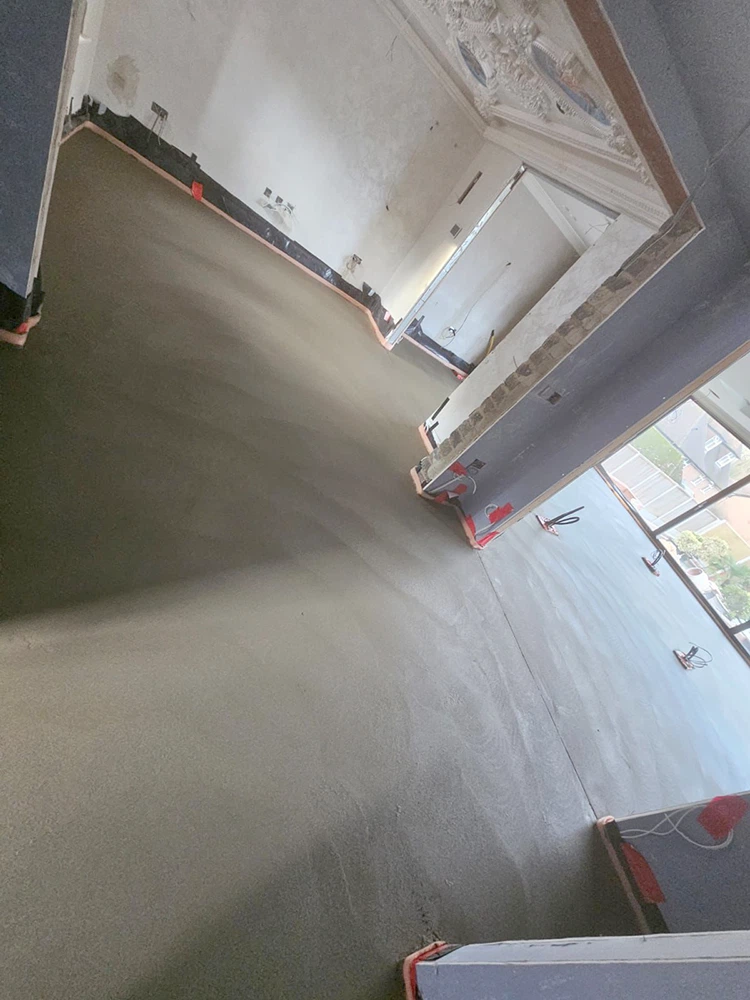
The mix turns up ready to go and travels by hose from the lorry straight to the room. In Bournemouth the question is rarely whether it will flow and more often how the hose gets there.
With a ground floor extension and off-street parking, the mixer normally sits on the drive or by the kerb while the hose goes along the side passage. Upper floor flats take more planning. The hose has to climb a stairwell or pass through a window, and it needs a clear route that other residents can live with for a morning. In a converted villa with one shared entrance, agree that route with the neighbours and the freeholder before the day.
Parking is the other variable. Where a street has permit bays or yellow lines, the truck mixer still needs space to stand while it discharges, and if a parking suspension is needed, the council's lead time sets the earliest pour date. How the kit gets set out is shown under pumped screed set-up; pumps and machines are not something we hire out.
Once it is in, the screed spreads to a level surface without hand trowelling, which is why SR1 or SR2 flatness is readily achievable. That flatness matters for the LVT and large tiles that many flat owners choose. Comparing it with a hand-laid floor for your Bournemouth flat? Our liquid versus sand and cement guide lays out the differences.
Depth and drying for Bournemouth extensions and newer homes
Homes built since 2000 account for 16% of Bournemouth's stock, and on those, as on new extensions, the ground floor is usually insulated. That is where liquid screed fits. On a bed of insulation in a Bournemouth house it can go as thin as about 35mm, or 40mm in commercial premises, where sand and cement would need 65mm. Over heating pipes the cover is at least 25mm, giving roughly 45 to 50mm in total.
Thinner means quicker to dry. A useful rule is about a day per millimetre for the first 40mm, slowing after that, so warmth and ventilation in the room make a real difference. Foot traffic can usually start within 24 to 48 hours, which lets other trades carry on while the floor dries.
Shrinkage is low, so a large open-plan kitchen needs far fewer joints than it would in sand and cement.
Liquid screed is either calcium sulphate or cement based, and which one goes in depends on the room and what will be laid on it. For the calcium sulphate specification in detail, see anhydrite flow screed in Bournemouth. Planning heating pipes in the floor? Pipe cover and warm-up are dealt with on our page about heated floors in Bournemouth.
Liquid Screed prices in Bournemouth
Liquid screed: £24 to £31 per m² supplied and laid (MyJobQuote, August 2026), so £960 to £1,240 for 40 m². MyJobQuote does not say whether these figures include VAT. See our floor screeding cost guide or screed calculator.
Who lays your liquid screed in Bournemouth
K & B Screeding’s own team, led by director Donatas Bardisevicius. Founded 2019, company 12298780.
See what customers say in our Google reviews and on our testimonials page.
Liquid Screed from Slough to Bournemouth
Bournemouth is about 77.5 miles south-west of our Slough base as the crow flies, with postcodes including BH1, BH4, BH11 and BH5. The nearest towns to it are Christchurch (4.3 miles), Ferndown (5.6 miles), Wimborne Minster (7.3 miles) and Ringwood (9.4 miles).
More on liquid screed, part of our screeding services.
