
Where liquid screed fits in Christchurch houses
Liquid screed works at its most efficient on a clear, open floor over insulation. In Christchurch that describes three common projects.
Rear extensions are the first. A new room with an insulated floor and no old slab to work around suits a pumped screed laid in one pour, often carried across the join into a knocked-through kitchen. Newer houses are similar: 12% of the town's homes have been built since 2000, and their ground floors are usually insulated already.
Flats and retirement blocks are the second. Floors between levels in these buildings carry acoustic insulation, and a liquid screed flows to an even depth across it. The hose can climb to upper floors, so there is no carrying of materials up the stairs.
Larger ground floors in detached houses are the third, where the aim is a single flat surface for tiles or LVT with few joints. SR1 or SR2 flatness is readily achievable with a self-levelling screed, and its low shrinkage keeps joints to a minimum.
There are calcium sulphate liquids and cement based liquids. The first is common on dry, heated floors; the second goes where moisture is a concern. For the calcium sulphate specification in detail, see anhydrite flow screed in Christchurch. Not sure yet whether to go pumped or traditional? This comparison of the two screed types may help settle it.
Getting the pump to Somerford, Mudeford and Purewell homes
The lorry and pump want a spot beside the property, and from there the hose snakes indoors via whichever door or window is nearest the room. A detached house with its own drive rarely causes any trouble. At a terrace or a block of flats, the hose may need to run along a passage or up a stairwell, and a place for the truck to park matters more.
When you ask for a price, tell us about access at the address, whether it is in Somerford, Mudeford, Purewell or elsewhere in the town. A photo of the frontage and the route to the room is often enough. The set-up is described under how our pumped pours work; please note we have no pumps or machines for hire.
Thickness starts low: roughly 35mm floated over a house's insulation, 40mm in commercial space, which leaves a traditional screed looking chunky by comparison. Walking on it is fine at 24 to 48 hours, yet drying out fully goes at around one day per millimetre until 40mm. If pipes are going in, read heated floor screeds in Christchurch.
Liquid Screed prices in Christchurch
Liquid screed: £24 to £31 per m² supplied and laid (MyJobQuote, August 2026), so £960 to £1,240 for 40 m². MyJobQuote does not say whether these figures include VAT. See our floor screeding cost guide or screed calculator.
Who lays your liquid screed in Christchurch
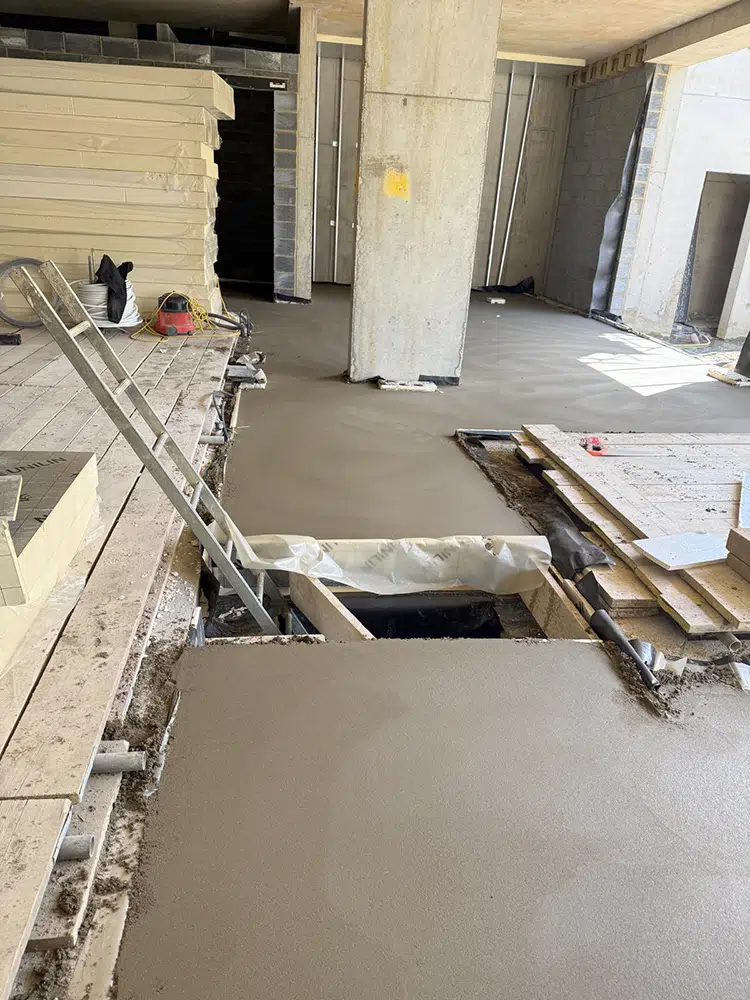
K & B Screeding’s own team, led by director Donatas Bardisevicius. Founded 2019, company 12298780.
See what customers say in our Google reviews and on our testimonials page.
Liquid Screed from Slough to Christchurch
Christchurch is about 73.8 miles south-west of our Slough base as the crow flies, with postcodes including BH23. The nearest towns to it are Bournemouth (4.3 miles), New Milton (5.6 miles), Ferndown (6.4 miles) and Ringwood (7.5 miles).
More on liquid screed, part of our screeding services.
