
Latex for Christchurch bathroom and kitchen refits
Homes built between 1919 and 1944 make up 12% of Christchurch's stock, and floors of that age have usually been covered and recovered several times over the decades. Lift the old lino in a kitchen of that age and you may find quarry tiles, a worn concrete slab or boards someone has already overboarded.
That is the setting latex was made for. The powder is cement based, and the liquid it is stirred into is latex rather than plain water, giving a thin layer that grips well and finishes smooth. It goes down at a few millimetres, enough to bury grout lines, board joints and small pits without noticeably raising the floor at the door.
Timber floors are prepared first. Bare boards are never latexed directly; they are screwed down and overboarded with flooring grade plywood, and the ply is primed before the latex goes on.
Tiled floors can stay if every tile is firmly bonded. Hollow or cracked ones come out, the gaps are filled, and the surface is cleaned and primed.
Adapting a bathroom for easier living is a common reason for a new floor in a Christchurch home, and safety flooring, which is thin and shows every ridge, normally wants a latex base. Where the room needs a fall to a drain for level access, though, latex is the wrong tool; that is a job for a sloped sand and cement screed. If an old slab carries adhesive or paint that has to come off first, concrete grinding in Christchurch deals with it.
Damp checks before latex near Christchurch Harbour
Latex is a finishing layer and cannot hold back moisture. That makes a damp test the first check in a Christchurch house, especially on ground floors near the harbour or the town's two rivers. A slab with no working membrane can push moisture up through a thin compound and lift the vinyl or LVT on top. Where a floor fails the test, it needs a membrane or a relaid build-up first, and insulation and membranes explains the layers involved.
Movement is the second check. Overboarded floors that still flex, or tiles that ring hollow underfoot, will crack a layer only a few millimetres thick.
Level is the third. Latex smooths; it does not correct a floor that runs downhill across a room or sits lower than the next one. Filling an old sunken floor to remove a step is screed work, and a surface out by more than latex can handle goes to floor levelling in Christchurch or a new screed.
Primer comes last, and each base takes its own: plywood, ceramic, concrete and calcium sulphate all differ. Calcium sulphate is always sanded free of laitance and primed before anything bonds to it, a step that is easy to miss in a flat whose screed turns out to be that material.
The same order of checks applies whether the address is in Highcliffe, Walkford, Fairmile or Friars Cliff.
How we price latex screed in Christchurch
A fixed written price within 24 hours, once we know the area and the base. See our floor screeding cost guide.
Who lays your latex screed in Christchurch
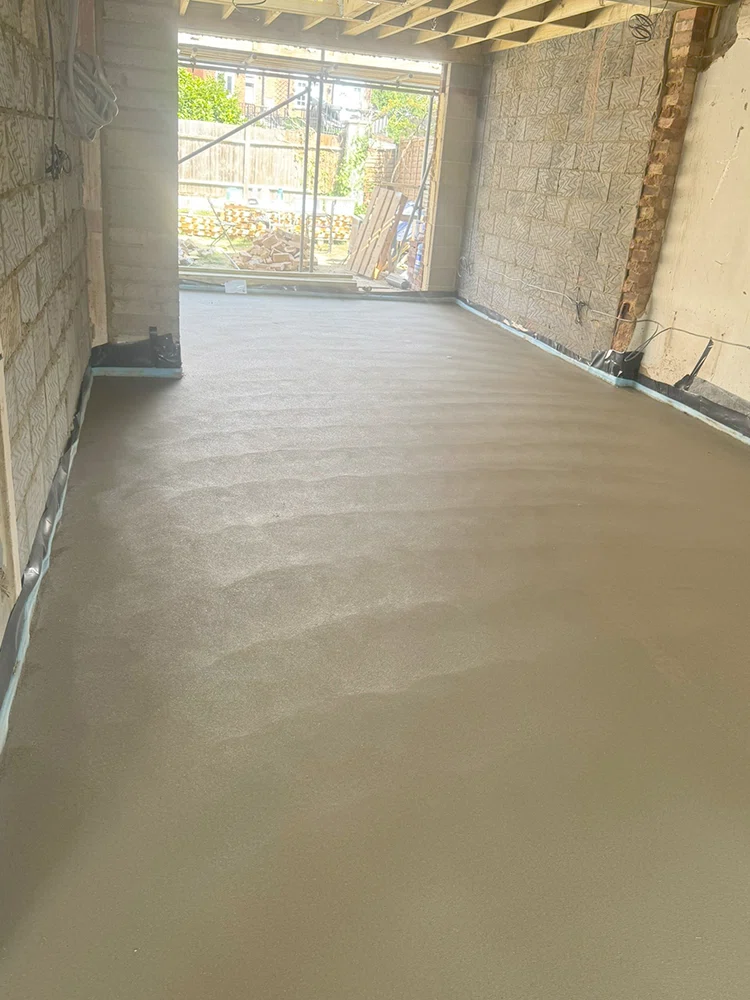
K & B Screeding’s own team, led by director Donatas Bardisevicius. Founded 2019, company 12298780.
See what customers say in our Google reviews and on our testimonials page.
Latex Screed from Slough to Christchurch
Christchurch is about 73.8 miles south-west of our Slough base as the crow flies, with postcodes including BH23. The nearest towns to it are Bournemouth (4.3 miles), New Milton (5.6 miles), Ferndown (6.4 miles) and Ringwood (7.5 miles).
More on latex screed, part of our screeding services.