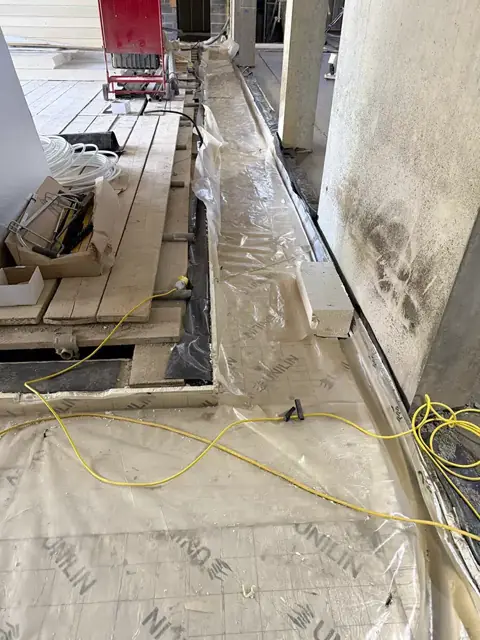
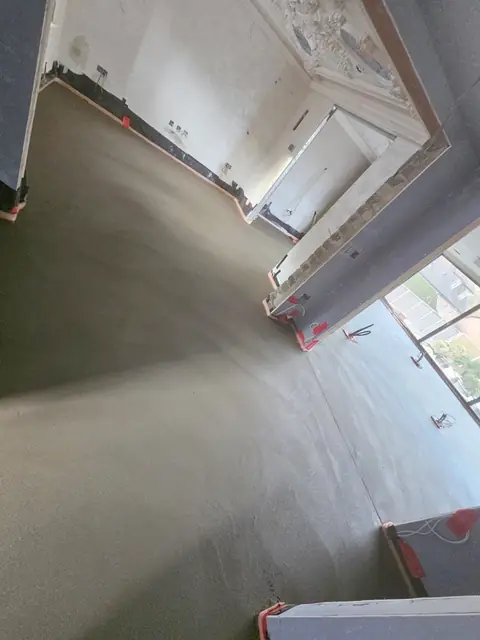
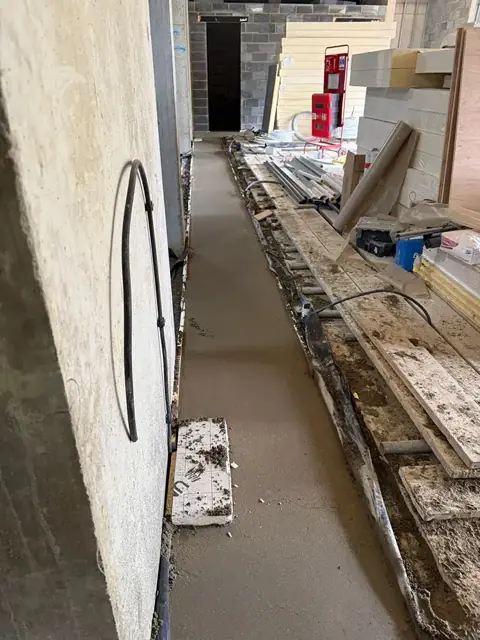
Almost every floor failure can be traced back to preparation. Laitance, curing compounds, old adhesive, paint, dust, oil and weak patches all stop new materials bonding properly. No amount of quality in the screed or floor covering on top will make up for a surface that was never ready to receive it. K & B Screeding treats preparation as the first stage of every floor.
Floor preparation is a service in its own right for us, not an afterthought. We prepare floors for our own screeds and for other trades' floor coverings across London and the Home Counties.
Our floor preparation methods
We choose the method to suit the base and the finish that is going down next.
Shot blasting
Steel shot is fired at the floor at high speed and recycled by the machine, removing laitance, weak surface material and light coatings. It leaves a clean, uniformly textured profile that gives excellent adhesion, and it is fast over large, open areas. Shot blasting is our first choice before a bonded screed or a resin finish.
Diamond grinding
Rotating diamond heads grind the surface flat. Grinding removes high spots and ridges, old adhesive residue, thin coatings and paint, and leaves a smoother surface than shot blasting. It is ideal where the floor needs to be both clean and flat, for example before a levelling compound.
Scarifying
Scarifying uses rotating cutters to strike the surface, taking off thicker coatings, heavy build-up and damaged material. It removes more than grinding in a single pass and is used where heavier removal is needed.
Crack and joint repairs
Cracks are cut out and filled, joints are cleaned and repaired, and hollow or broken areas are removed and reinstated so the floor is sound throughout. See screed repairs for more.
Moisture, damp and membranes
A floor can look perfect and still hold enough moisture to ruin a new floor covering. We test for moisture before flooring goes down, using hygrometer testing to measure the relative humidity of the base. Where rising damp or residual construction moisture is a risk, we can install a damp proof membrane or a suitable surface applied barrier. See insulation and membranes.
Levelling after preparation
Once the surface is clean and sound, many floors still need levelling. Minor unevenness is corrected with a levelling compound. Larger differences in level, or floors that need a new base altogether, call for a new screed.
Choosing the right method
| Method | Best for | Surface left |
|---|---|---|
| Shot blasting | Removing laitance and light coatings over large areas | Clean, evenly textured |
| Diamond grinding | High spots, adhesive residue, paint, thin coatings | Clean and flatter |
| Scarifying | Thick coatings, heavy build-up, damaged surfaces | Rougher, heavily profiled |
| Crack and joint repair | Local defects in slabs and screeds | Sound and continuous |
Swipe the table sideways to see every column.
The process
- Survey. We inspect the floor, identify coatings and contamination, and test for moisture where needed.
- Recommend. We explain which method suits the base and the new finish, and why.
- Protect. Adjoining areas are protected and dust is controlled with extraction.
- Prepare. The surface is prepared, repaired and cleaned.
- Hand over. The floor is left clean, sound and ready for the next stage, whether that is our screed or somebody else's floor covering.
Preparing for different floor finishes
Each floor finish has its own requirements, and we prepare the surface to suit the one you have chosen.
- LVT, vinyl and rubber. These thin, flexible finishes show every imperfection, so the surface must be smooth and flat, usually with a skim of levelling compound, and dry enough to pass a moisture test.
- Tiles and stone. The base must be sound, clean and flat, with laitance removed and the correct primer for the screed type, especially on calcium sulphate screeds.
- Resin coatings. Resin needs a clean, open textured surface, so shot blasting or grinding is essential for the bond.
- Engineered wood and laminate. The base needs to be flat and dry, with a suitable underlay or damp proof membrane where required.
- Carpet. More tolerant of minor unevenness, but the surface must still be sound and free of loose material.
Tell us what is going down and we will prepare the floor to that standard.
Floor preparation near you
We carry out floor preparation across London and the Home Counties from our base in Slough, and we have a dedicated page for floor preparation in Northampton. Our coverage for screeding also includes Northampton, Watford and Reading.
“They did an excellent job and do hard work, I am really happy with their work. So very happy with the workmanship and highly recommend them.”
Part of our screeding and floor screeding services, laid by our own team across London and the Home Counties.