
Heating extensions on Christchurch semis and detached houses
Semi-detached houses make up 20% of Christchurch homes, and much of the town was built after the war. Extending one of these houses at the back is the usual moment to add underfloor heating: the new floor is built from scratch, so insulation, pipes and screed can all be planned together.
Before anything else, agree how much screed will sit over the pipes. Pumped liquid has to clear them by a minimum of 25mm, which puts a Christchurch extension floor at around 45 to 50mm overall; hand-laid sand and cement wants roughly 45mm over the pipes, so the whole floor ends up thicker and weighs more. The screed has to spread heat and carry the floor load, and cover that is too thin can crack under furniture and foot traffic.
Because liquid wraps itself round every pipe and leaves no air gaps, the room heats up quicker and more evenly. That makes it the usual choice over heating, although sand and cement is still used where the room may get wet or the heating design calls for it.
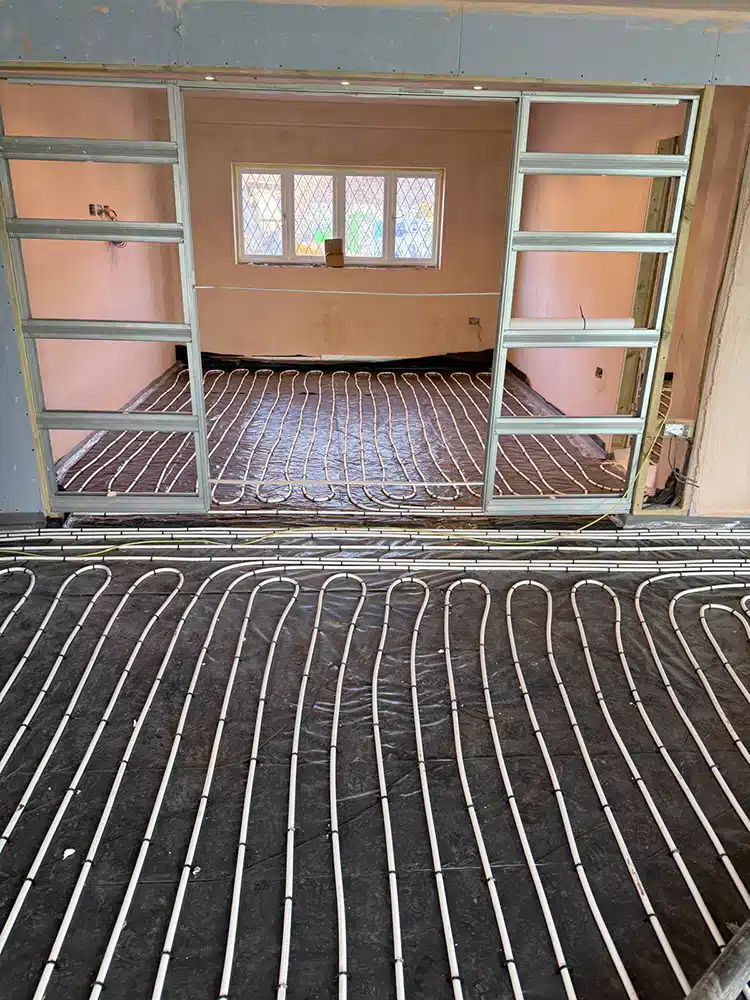
Your heating engineer clips the pipes down and runs the pressure test ahead of our visit. We then go over the membrane, edge strip and insulation, and we can provide them where needed. Where the new heated floor meets the old house, door thresholds and the level of the existing kitchen floor set the finished height, so measure early. Pumped screed for Christchurch homes has more on the liquid option.
Commissioning heated floors in Christchurch flats and new homes
Homes built since 2015 make up 5% of Christchurch's stock, and new flats and retirement blocks are where heating in the screed is often designed in from the start. In those buildings the screed also sits over acoustic layers, so the full build-up is set by the designer and we lay to it.
Once the screed is down, heat goes on slowly. Give calcium sulphate around 7 days before the system sends any heat through it, and sand and cement no fewer than 21. After that, the flow temperature climbs a little at a time. Rushing it can crack or curl the screed, and a crack in a heated floor is costly to fix because the pipes sit inside it.
Near the harbour and river floodplains, remember that calcium sulphate and prolonged damp do not mix. The membrane under the insulation matters as much as the screed on top; see insulation and membranes. Our guide on screed thickness covers depths for heated floors, and the anhydrite flow screed page for Christchurch explains the calcium sulphate grades.
Underfloor Heating Screed prices in Christchurch
Liquid screed over underfloor heating: £20 to £35 per m² supplied and laid (trade2base, June 2026), so £700 to £1,230 for 35 m². trade2base gives these figures excluding VAT. See our floor screeding cost guide or screed calculator.
Who lays your underfloor heating screed in Christchurch
K & B Screeding’s own team, led by director Donatas Bardisevicius. Founded 2019, company 12298780.
See what customers say in our Google reviews and on our testimonials page.
Underfloor Heating Screed from Slough to Christchurch
Christchurch is about 73.8 miles south-west of our Slough base as the crow flies, with postcodes including BH23. The nearest towns to it are Bournemouth (4.3 miles), New Milton (5.6 miles), Ferndown (6.4 miles) and Ringwood (7.5 miles).
More on underfloor heating screed, part of our screeding services.
