
Keeping heated Ringwood extensions level with the house
Most houses around Ringwood's centre date from after 1945, and a heated extension on one of them has to meet a slab that was laid decades ago. The new floor carries insulation, pipes and screed, and all three must fit beneath the level of the existing kitchen or hallway.
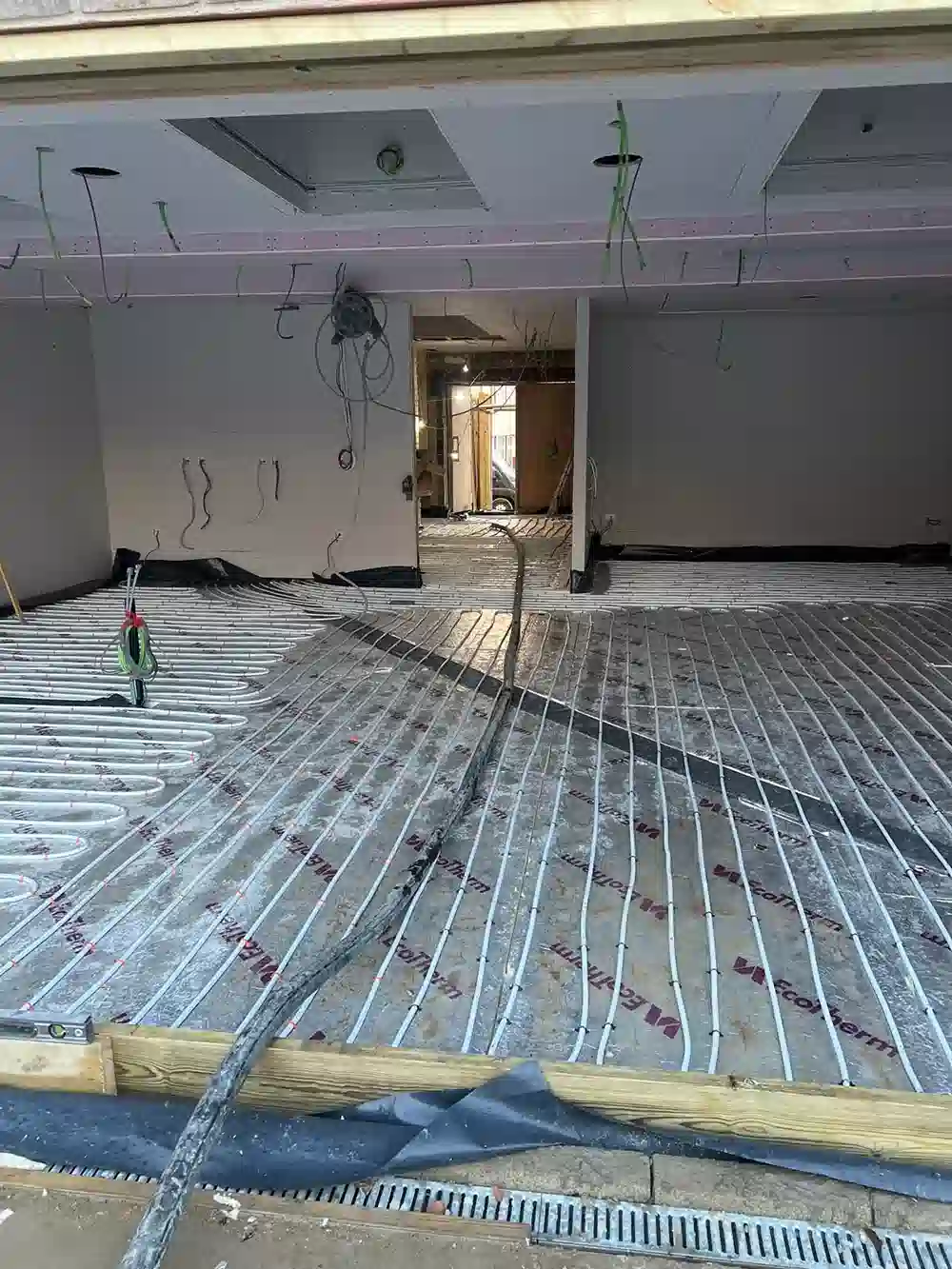
How much has to go over the pipes depends on what you pour. Pumped liquid needs 25mm above them as a minimum, which tends to make the layer 45 to 50mm deep. Sand and cement, laid by hand, needs close to 45mm over the loops, and that adds noticeably to the overall build-up. That is why a thin liquid screed is so often chosen for heated extensions: it saves height and flows fully around the pipes with no voids, which also helps the heat spread evenly.
Semi-detached houses are 30% of Ringwood's homes, and a single storey rear extension with underfloor heating is a common way to add a family room to one. Houses built between 1973 and 1999, 26% of the town, are at the age when kitchens are replaced and ground floors opened up, often with heating added at the same time.
What sits under the pipes counts too: insulation boards, the membrane and a strip round the edges. Either we inspect them before pouring, or we provide them under insulation and membranes. For typical depths across different floors, see our screed thickness guide.
Heating up a new floor in Ringwood safely
Screed and heating need a careful introduction.
Calcium sulphate will usually take heat roughly a week after the pour. Give a sand and cement floor 21 days or longer before any warm water runs through it. From there, the system should be commissioned gradually. Start at a low water temperature, raise it in small steps and hold each one for a period, rather than turning the thermostat straight to full. A sudden start can crack or curl the screed.
Using the heating in this way also dries the floor, which brings forward the date for tiles, LVT or engineered wood. Tell your heating engineer and flooring fitter the pour date so each can plan.
Garden rooms and conservatory replacements often have tight heights and large glazed areas, so they need a sensible heat-up and a moisture test before flooring. How that test works is covered in our guide to drying screed.
You get the warm-up steps from us on paper. Keep it with the heating engineer's commissioning notes, so anyone who works on the floor later knows what was laid, when, and how the heating was introduced.
Underfloor Heating Screed prices in Ringwood
Liquid screed over underfloor heating: £20 to £35 per m² supplied and laid (trade2base, June 2026), so £700 to £1,230 for 35 m². trade2base gives these figures excluding VAT. See our floor screeding cost guide or screed calculator.
Who lays your underfloor heating screed in Ringwood
K & B Screeding’s own team, led by director Donatas Bardisevicius. Founded 2019, company 12298780.
See what customers say in our Google reviews and on our testimonials page.
Underfloor Heating Screed from Slough to Ringwood
On the map, Ringwood sits south-west of Slough, about 68.7 miles from our base in a straight line (postcodes including BH24), next to Verwood (4.6 miles), Ferndown (5.3 miles), Christchurch (7.5 miles) and New Milton (8.8 miles).
More on underfloor heating screed, part of our screeding services.
