
Heating in dug-out floors near Lymington quay
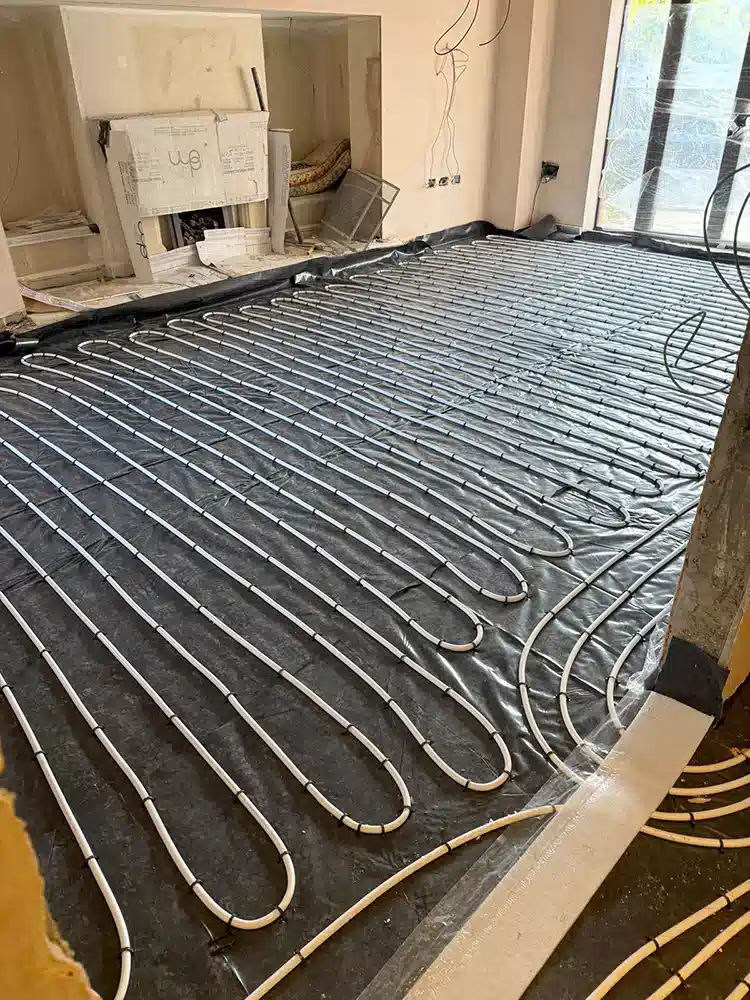
Once an old floor by the quay is coming out for lack of a damp proof membrane, the new build-up gets designed from the ground upwards. Underfloor heating is never easier to add, because the dig-out, not the room, supplies the depth for insulation, pipes and screed.
Plan that depth to the millimetre all the same. A pumped screed needs 25mm or more above the pipe tops, making the screed 45 to 50mm overall in most cases. Sand and cement laid by trowel needs about 45mm on top of the pipework, so that version stands taller. In a Georgian or Victorian room with a hearth and a bottom stair that stay put, the slimmer liquid build-up normally frees space for insulation, and insulation is what keeps the warmth from leaking down into the ground.
How well the pipes are surrounded matters just as much. Liquid runs under and around each loop and leaves no air behind, so warmth spreads through the slab without cold stripes. Hand-laid screed gets there too, but only with careful compaction along each run.
In some period rooms there is hardly any height to give. Then the screed choice comes first and the rest follows. The dig-out itself is covered under sand and cement in Lymington, and the guide to screed depths goes deeper into build-ups.
Heated extensions in Pennington and Buckland
A single storey extension on a post-war house in Pennington or Buckland is a straightforward home for underfloor heating, since the floor is brand new. The awkward bit is the join: the heated screed must end flush with the old kitchen slab, so insulation, pipe cover and screed depth all get worked back from that one height. Just 6% of Lymington's homes went up since 2015, so heated floors in the town are far more likely to be retrofits or extensions than new builds.
After pouring, give the screed time before the heating runs. Calcium sulphate will usually take warmth from about 7 days, sand and cement only after 21 at least. Commission it softly, opening with a low flow temperature and raising it in stages across several days. Our schedule for that is left in writing for your heating engineer to follow.
Turning the heat straight up is a frequent cause of cracks and debonding. Taken slowly, the heating also dries a calcium sulphate floor faster than anything else.
Liquid screed poured over heating loops carries a published 2026 rate of £20 to £35 per square metre. A calcium sulphate specification is explained further on our anhydrite screed page for Lymington, and the same service runs in Christchurch too.
Underfloor Heating Screed prices in Lymington
Liquid screed over underfloor heating: £20 to £35 per m² supplied and laid (trade2base, June 2026), so £700 to £1,230 for 35 m². trade2base gives these figures excluding VAT. See our floor screeding cost guide or screed calculator.
Who lays your underfloor heating screed in Lymington
K & B Screeding’s own team, led by director Donatas Bardisevicius. Founded 2019, company 12298780.
See what customers say in our Google reviews and on our testimonials page.
Underfloor Heating Screed from Slough to Lymington
Lymington is about 66.2 miles south-west of our Slough base as the crow flies, with postcodes including SO41. The nearest towns to it are New Milton (5 miles), Christchurch (10.6 miles), Totton (11.3 miles) and Southampton (11.8 miles).
More on underfloor heating screed, part of our screeding services.
