
From conservatory to heated room in Hedge End
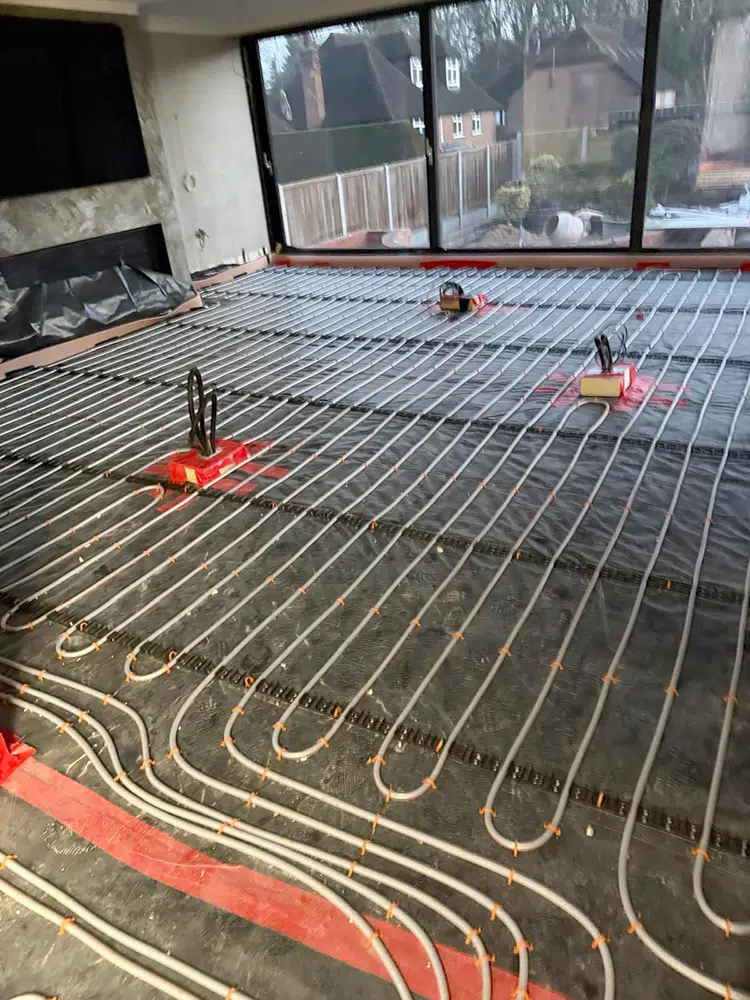
A conservatory rebuilt as a proper room gets a new floor from the ground up. The old base is taken out or overlaid, then a membrane, insulation, the heating pipes and a screed go down. Because the finished floor has to meet the house, the depth of that build-up is worked out before any digging starts.
Pipe cover is the rule that matters. A pumped screed must have 25mm or more on top of the pipes, which brings the whole layer to around 45 to 50mm. For a hand-laid floor, plan on roughly 45mm over them. Those depths give the strength to carry the floor finish and an even spread of heat across the room.
Pumped screed surrounds every pipe with no trapped air, so a former conservatory warms up quicker and the system does less work. A hand-laid screed can be used too, and is compacted carefully round the pipes. Whichever goes down, we first look at the insulation boards, the membrane and the foam strip round the walls, and replace or supply any that are missing or damaged.
The finish matters as well. Tiles, LVT and engineered wood all need a flat base, and a well laid heated screed is flat enough to take them without heavy preparation. Our screed thickness guide explains the layers and depths in more detail, and pumped liquid screed for Hedge End homes explains the pour itself.
The first heat-up in a Hedge End home
Once the screed is down, leave the thermostat alone. Calcium sulphate normally needs about 7 days before the first low heat, sand and cement at least 21. Then commissioning is gradual: start at a low flow temperature, raise it in small steps over several days, hold it at working temperature, then bring it down before the floor finish goes on. The schedule is your heating engineer's to set, and we tell you plainly what the screed needs so the two match.
On a calcium sulphate floor, the heat-up doubles as force drying. The wait gets shorter, but tiles or engineered wood still need a moisture reading first. Keep a record of the temperatures used, as flooring suppliers may ask for it.
Even in the 14% of Hedge End homes built between 2000 and 2014, adding heating to an existing room means a new build-up, so levels at doors, stairs and kitchen plinths need checking before the pipes are laid, and a small step may need levelling where old meets new. For heated floors a little further west, see underfloor heating screed in Southampton.
Underfloor Heating Screed prices in Hedge End
Liquid screed over underfloor heating: £20 to £35 per m² supplied and laid (trade2base, June 2026), so £700 to £1,230 for 35 m². trade2base gives these figures excluding VAT. See our floor screeding cost guide or screed calculator.
Who lays your underfloor heating screed in Hedge End
K & B Screeding’s own team, led by director Donatas Bardisevicius. Founded 2019, company 12298780.
See what customers say in our Google reviews and on our testimonials page.
Underfloor Heating Screed from Slough to Hedge End
On the map, Hedge End sits south-south-west of Slough, about 51.4 miles from our base in a straight line (postcodes including SO30 and SO31), next to Eastleigh (4.4 miles), Southampton (4.4 miles), Fareham (7 miles) and Totton (8.1 miles).
More on underfloor heating screed, part of our screeding services.
