
Heated kitchen extensions behind Southsea terraces
Rear kitchen extensions on the terraces of Southsea, Fratton and North End are the natural place for underfloor heating. The extension is a new floor anyway, and heating it frees up wall space in a narrow room.
Floor height is the problem to solve. Insulation, pipes and screed together must stop at the height of the old hall floor. A pumped floor needs a 25mm minimum over the loops, so 45 to 50mm is typical from insulation to surface; the traditional mix needs nearer 45mm on top of them, so it builds higher. On a tight Southsea extension that usually points to pumped liquid screed, which also wraps the pipes completely with no air gaps.
Where an old suspended timber floor is being replaced with an insulated slab in the main house, it is worth deciding on heating before the slab is laid. Adding it later means lifting finished floors, which costs far more than planning the pipes in from the start. The slab, insulation and pipe layout can then be designed together, with the screed depth fixed before anything is ordered.
Semi-detached houses are 19% of Portsmouth's homes, and these often have more room to extend than a terrace, though the same height rule applies. Agree the finished floor level with your builder before insulation is ordered, and let us check the membrane and edge strip before the pour. If you are juggling heights on a Portsmouth extension, our guide to screed thickness has the depths for each type of floor.
Commissioning a heated floor in a Portsmouth home
The screed and the heating must be brought up to temperature carefully.
A calcium sulphate floor can normally start taking heat about a week after it is poured. Sand and cement must sit for three weeks, 21 days or more, before anyone touches the thermostat. After that the system is commissioned gradually, raising the water temperature in stages and holding each one, rather than setting it to full. A rushed start can crack the screed or cause the edges to curl.
Run gently, the heating pulls moisture out, so tiles, LVT or engineered wood can follow sooner. Share the pour date with both the heating engineer and the flooring fitter, so they know when each step can happen.
Just 4% of Portsmouth's homes were built since 2015, so most heated floors here go into existing houses and extensions rather than new plots. That makes the depth check before the pour all the more important.
Heated floors in flats have their own considerations, including acoustic layers and access. For the insulation layer under the pipes, see our insulation and membranes page, and for timing, our screed drying guide.
Underfloor Heating Screed prices in Portsmouth
Liquid screed over underfloor heating: £20 to £35 per m² supplied and laid (trade2base, June 2026), so £700 to £1,230 for 35 m². trade2base gives these figures excluding VAT. See our floor screeding cost guide or screed calculator.
Who lays your underfloor heating screed in Portsmouth
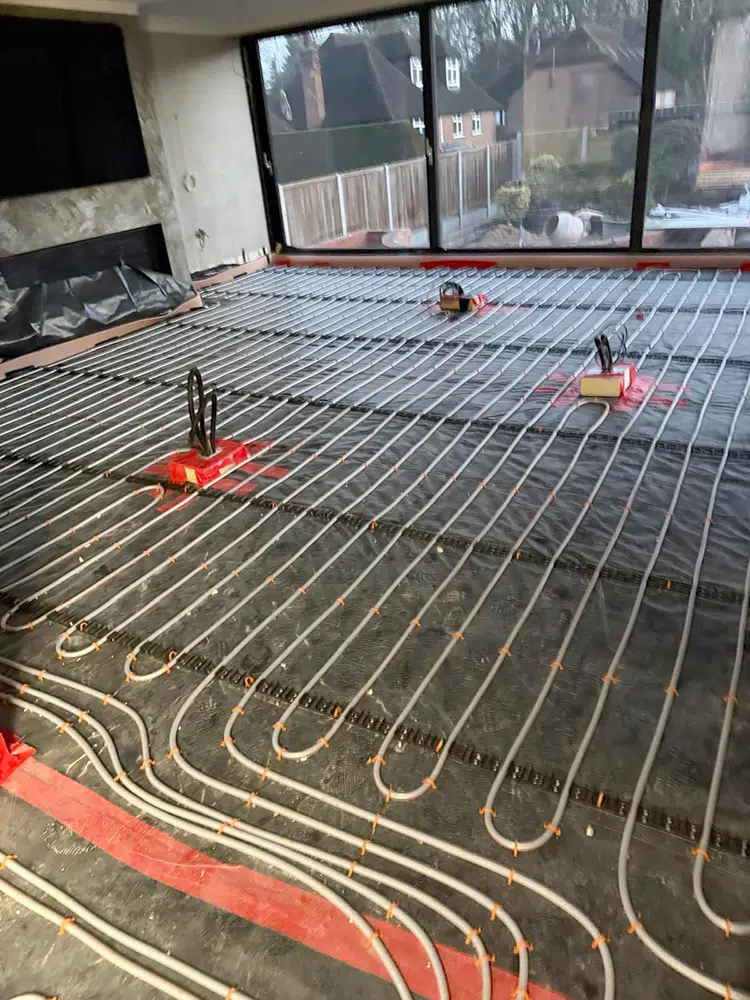
K & B Screeding’s own team, led by director Donatas Bardisevicius. Founded 2019, company 12298780.
See what customers say in our Google reviews and on our testimonials page.
Underfloor Heating Screed from Slough to Portsmouth
Portsmouth is about 54.4 miles south-south-west of our Slough base as the crow flies, with postcodes including PO1, PO3, PO2 and PO6. The nearest towns to it are Gosport (1.4 miles), Fareham (5.3 miles), Havant (6.2 miles) and Emsworth (7.6 miles).
More on underfloor heating screed, part of our screeding services.
