
Pipe cover and floor height in Chichester retrofits
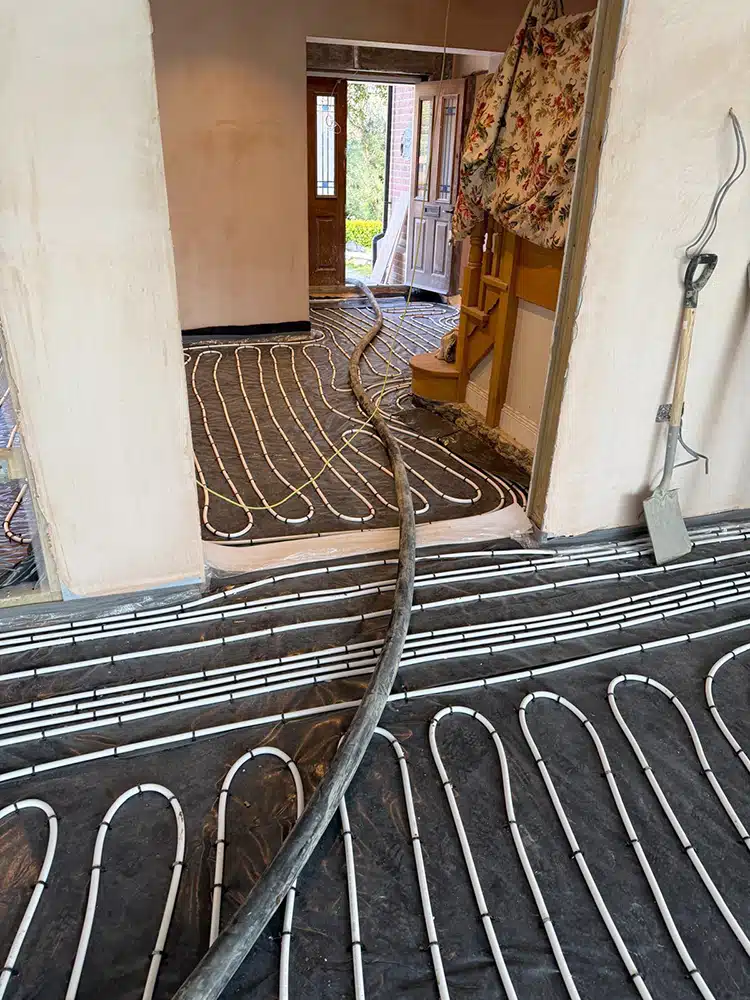
Underfloor heating only performs if the screed surrounds the pipes completely and has the right thickness above them. With liquid screed the pipes need 25mm on top as a minimum, so the floor usually totals 45 to 50mm. Sand and cement needs about 45mm of cover, which makes it noticeably deeper overall, and the insulation below adds more again.
In a new extension, the depth is set on the drawings, so either screed can work. An older house taking heating for the first time is harder. Inside the walled centre, older solid floors may have no damp proof membrane and the finished level often cannot rise much. Every millimetre counts, which is why a flowing screed is usually chosen for retrofits: less depth for the same job, and it flows into every gap around the pipes with no air pockets. See pumped liquid screed in Chichester for how it is laid.
Semi-detached houses account for 26% of the city's homes, and a rear extension with a heated kitchen floor is a typical project for a house of that kind. The new floor has to finish level with the existing one, so we check the old floor height before the insulation is ordered. If a small step remains at the join, levelling compound across the join brings both floors into line before tiles go down.
Insulation, membrane and the strip round the room's edges all get checked by us before pouring, and we can supply whichever is missing. What goes beneath the screed, and why, is covered on our insulation and membranes page.
Switching on the heating in a Chichester garden room
Heating schedules depend on the screed. A calcium sulphate floor can normally be warmed by the system from around day 7. With sand and cement, leave the system off for at least three weeks, which is 21 days. In both cases the water temperature should climb gradually over several days, never jump to full output, because sudden heat can crack a young screed.
Garden rooms and outbuildings raise another question: will the floor be kept warm through winter, or left cold? A screed drying slowly in an unheated room holds up the flooring, so tell us how the space will be used when you ask for a price.
The first heat-up also helps drying. A heated calcium sulphate floor can be force dried, and a hygrometer test then confirms when it is ready for its finish. Our thickness guide lists normal depths build-up by build-up. Over underfloor heating, liquid screed is priced from £20 up to £35 per m² in 2026 figures, and our quote for your garden room or extension is fixed before we start.
Underfloor Heating Screed prices in Chichester
Liquid screed over underfloor heating: £20 to £35 per m² supplied and laid (trade2base, June 2026), so £700 to £1,230 for 35 m². trade2base gives these figures excluding VAT. See our floor screeding cost guide or screed calculator.
Who lays your underfloor heating screed in Chichester
K & B Screeding’s own team, led by director Donatas Bardisevicius. Founded 2019, company 12298780.
See what customers say in our Google reviews and on our testimonials page.
Underfloor Heating Screed from Slough to Chichester
On the map, Chichester sits south of Slough, about 48.4 miles from our base in a straight line (postcodes including PO19), next to Bognor Regis (6 miles), Emsworth (7 miles), Selsey (7.2 miles) and Havant (9.2 miles).
More on underfloor heating screed, part of our screeding services.
