
Grinding back old floors in Chichester homes
A diamond grinder works by spinning heads set with diamond segments across the floor, cutting the surface away in very thin layers. It is controlled, so a ridge can be taken down to meet the surrounding slab without disturbing the rest, or a whole room skimmed just enough to remove what sits on top.
In houses the usual reason is what the last floor left behind. Lift a carpet, a vinyl sheet or a set of cork tiles and there is often black bitumen adhesive, broken smoothing compound or patches of floor paint underneath. New adhesive and levelling compound will not hold reliably on any of these, so they come off first. Grinding also opens up a dense or dusty surface so a primer can soak in.
Extensions bring a second job. Where a new slab meets the original floor of the house, the two rarely finish at exactly the same height, and the lip at the join needs taking down. Grinding the high side is often simpler than raising the low one. Garages are similar: oil stains, old paint and a rough float finish are ground off before a conversion floor goes in, as our garage floor screed guide describes.
There is a limit on depth. Screed has a minimum thickness, and grinding too much off a thin bonded or floating screed can leave it weaker than designed. We measure what can safely come off before starting, and where more has to go than the screed allows, screed repairs or a relay are priced instead.
Refits, dust and the Southern Gateway in Chichester
Commercial floors are where grinding earns its keep. The Southern Gateway plan, which takes in the law courts area down to the canal basin, is the kind of mixed-use redevelopment where ground floor units are fitted out after the shell is built. Slabs in schemes like that can carry ridges, trowel marks and lips between pour bays that a thin finish would show. Marine businesses in the wider area, around Chichester Marina for example, may need the same preparation when a unit gets a new floor covering.
Grinding cannot fix a floor that slopes across a room or dips in the middle. It removes local high points; it does not reshape the whole surface. On those floors we grind the peaks, then lay compound or a new screed, and our floor levelling service covers that second stage. If a resin system is going on, the resin contractor applies it after our preparation.
Dust is taken seriously. Grinding concrete, screed or old tiles throws up fine dust containing silica, which is harmful to breathe. Every grinder we use runs with an extractor attached, and doorways and neighbouring rooms are sheeted off. For large open areas or thick coatings, shot blasting or scarifying may suit better; both appear on our floor preparation page.
How we price floor grinding in Chichester
A fixed written price within 24 hours, once we know the area and what has to come off. See our floor screeding cost guide.
Who grinds your concrete floor in Chichester
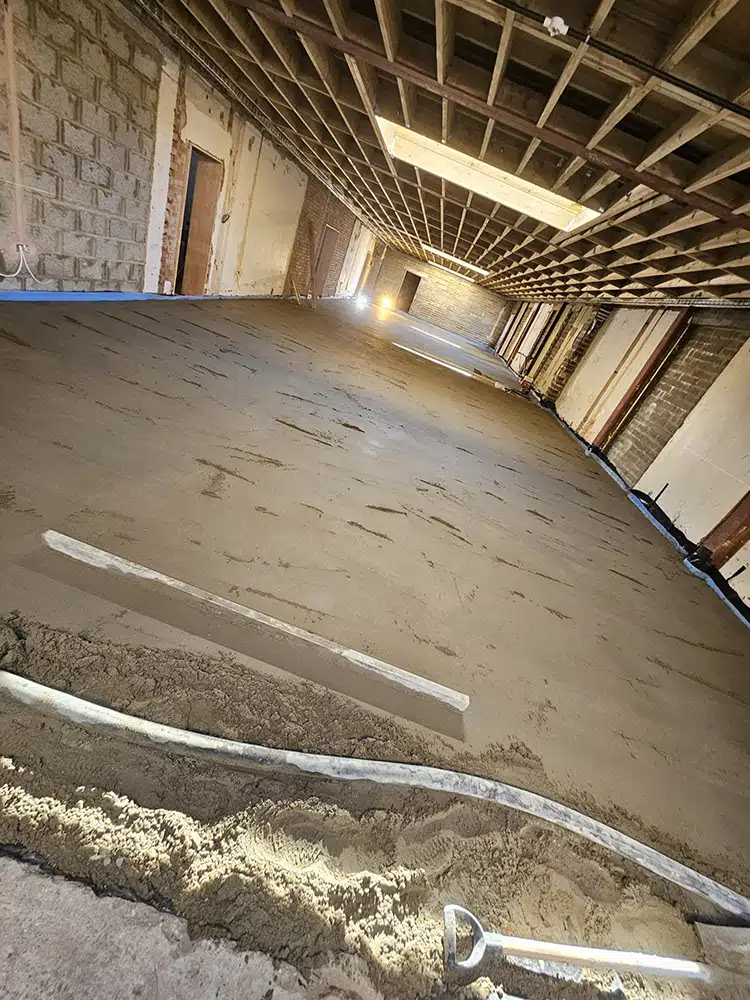
K & B Screeding’s own team, led by director Donatas Bardisevicius. Founded 2019, company 12298780.
See what customers say in our Google reviews and on our testimonials page.
Concrete Floor Grinding from Slough to Chichester
On the map, Chichester sits south of Slough, about 48.4 miles from our base in a straight line (postcodes including PO19), next to Bognor Regis (6 miles), Emsworth (7 miles), Selsey (7.2 miles) and Havant (9.2 miles).
More on floor grinding, part of our screeding services.
