
Trade counter and warehouse floors at Lineside and Toddington
North of the town centre, close to the A259 bypass, Lineside's mix of trade counter and industrial units has four speculative units that were completed in 2022. A large business park sits at Toddington too. Floors in premises like these get worked hard and change hands, and each new occupier wants a surface that suits a different use.
On an older unit, the problem is usually what is stuck to the concrete: painted walkways, line markings, glue left behind where vinyl covered a trade counter, or a thin sealer worn patchy by forklift traffic. A diamond grinder cuts through those layers in thin passes, with an extractor at the head drawing the dust away. When the concrete underneath is clean and open, primers and compounds bond properly.
Newer slabs need attention too. Ridges where bays were laid, trowel marks and a weak, dusty surface skin can all stop a finish sitting flat or bonding well, and a light grind clears them.
For very large areas or thick coatings, shot blasting or scarifying may be quicker than grinding, and our floor preparation page explains when each method fits. If the floor has to take heavy loads afterwards, a high strength screed may be the right next layer.
Unit fit-outs run on tight dates. We agree the order of stripping, grinding, priming and levelling with the fit-out contractor, so the flooring contractor can follow straight on.
Extensions on Wick and Toddington semis in Littlehampton
Wick and Toddington were absorbed into the town as it grew after the war, and the semis on those edges, from the post-war decades through to the 1990s, are typical candidates for a kitchen extension. Homes built from 1973 to 1999 alone make up 36% of the town. Where an extension slab joins the original kitchen floor, a lip of a few millimetres is common, and an LVT run across the join will show it. Grinding takes the high side down so the two meet flush.
The old kitchen floor may need work as well. Once old vinyl or tiles come up, the adhesive left on the concrete is usually ground off before levelling compound across both rooms goes on.
A floor that slopes or sags across its width is not cured by grinding. It removes local high points, and cutting deeper to chase a fall can leave a screed thinner than it should be. On a floor like that we grind the peaks, then level or rescreed.
Silica dust is the safety issue. Concrete, screed and tiles all contain it, and grinding releases it in a fine, breathable form, so every machine we run is connected to extraction.
We grind as a contractor, not a hire shop. We do not sell or rent grinders or tooling, and resin and polished concrete are not part of our work. Bognor Regis is about 6 miles away, with its own page on concrete floor grinding in Bognor Regis.
How we price floor grinding in Littlehampton
A fixed written price within 24 hours, once we know the area and what has to come off. See our floor screeding cost guide.
Who grinds your concrete floor in Littlehampton
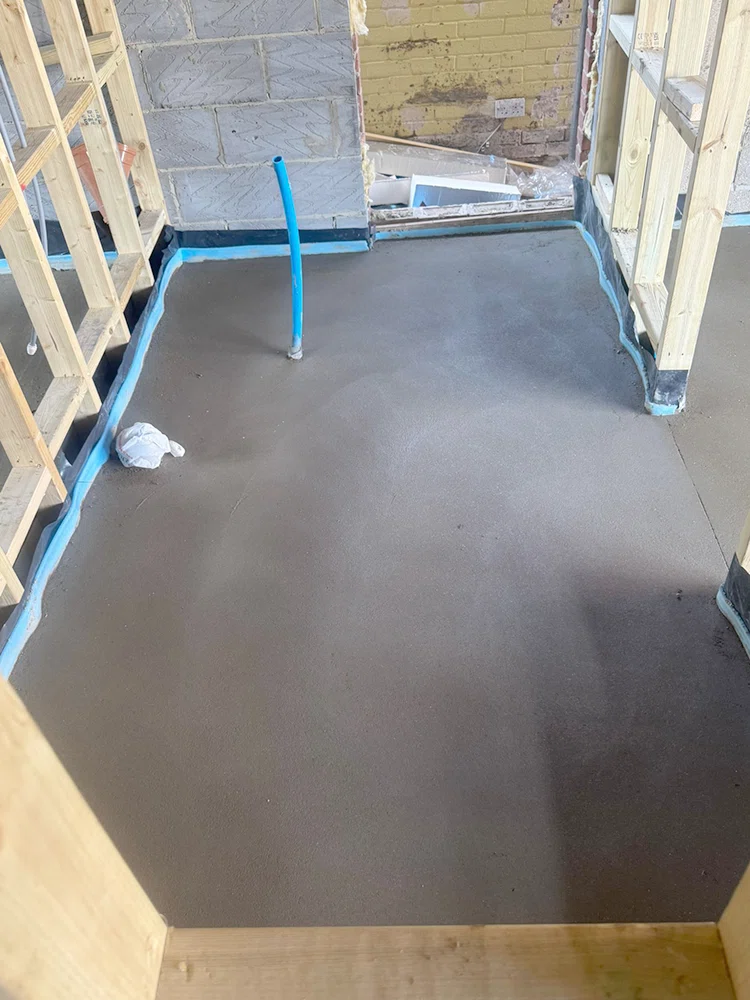
K & B Screeding’s own team, led by director Donatas Bardisevicius. Founded 2019, company 12298780.
See what customers say in our Google reviews and on our testimonials page.
Concrete Floor Grinding from Slough to Littlehampton
As the crow flies, our yard in Slough is about 50.2 miles from Littlehampton, which lies to the south. Postcodes here include BN17, and Bognor Regis (6 miles), Worthing (7.4 miles), Chichester (10.6 miles) and Shoreham-by-Sea (11.8 miles) are close by.
More on floor grinding, part of our screeding services.
