
Relaying failed floors in older Littlehampton terraces
A terrace near the River Arun or the town centre may still have its original solid ground floor, or a later concrete one laid with little or no damp protection. Over time that floor cracks, lifts or lets damp through, and new flooring will not stay down on it.
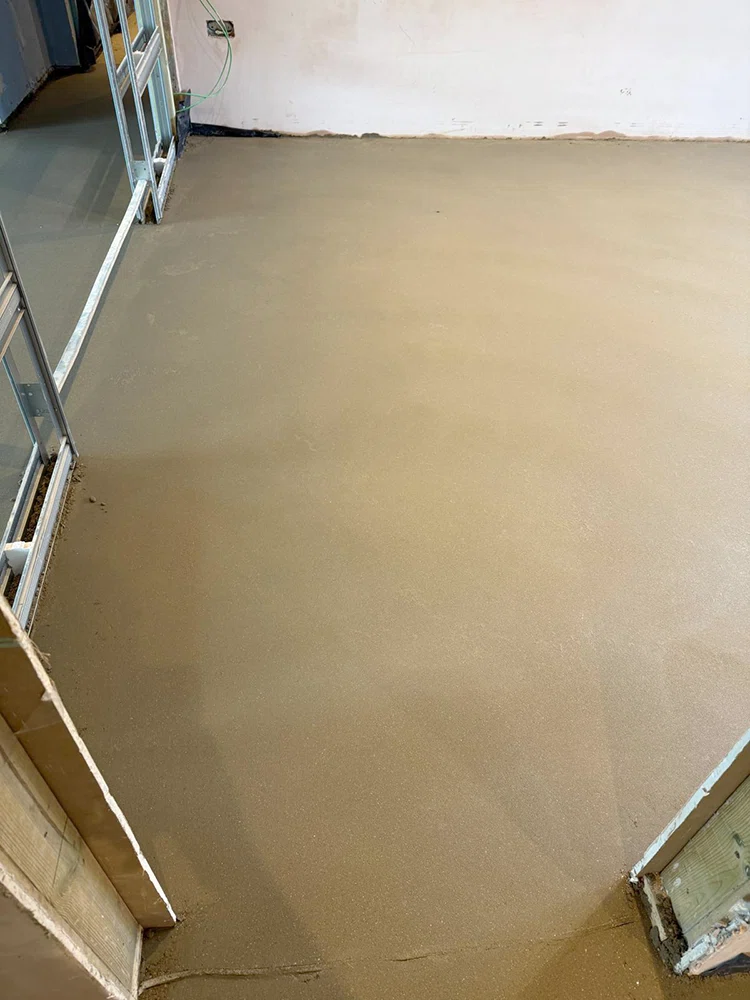
Patching will not hold, so the old floor comes out. The old floor is broken out, the ground beneath is prepared, and a new base goes in with insulation and a new membrane. A sand and cement screed then forms the finished surface. Our insulation and membranes page covers that layer in more detail.
Sand and cement suits terraces well. It is mixed in small batches, so it can be barrowed through a narrow hallway with no pump on the street. Depths can vary between rooms to meet old thresholds. And it gives a cement base that tiles and adhesives take to readily.
Floating screeds on insulation should be at least 65mm deep in homes and 75mm in commercial work. Where an old concrete base is sound and floor height is tight, a bonded screed at 25 to 40mm is the thinner option.
Converted flats make up 10% of homes in Littlehampton. Floors in converted houses vary from room to room, and hand-laid screed copes well with that variation. For larger rooms or extra crack resistance, see fibre reinforced screed.
Littlehampton wet rooms, garages and drying
Some rooms need cement screed regardless of the house. A wet room floor has to slope towards its drain, and calcium sulphate is ruled out anywhere water reaches the floor. Hand-laid sand and cement, tanked and tiled, is the standard answer.
Garages are similar. Whether it still houses a car or is being converted into a room, a garage needs a cement based floor that can take load early. Converting one? Our guide to screeding a garage floor walks through it.
What you give up is speed, because this mix dries more slowly than a pumped floor, taking roughly a day for each millimetre across the first 40mm and longer per millimetre after. Timber or vinyl on a 65mm floor may be a couple of months off. Tiles are more tolerant but still need a moisture test. If your fitter is already booked, ask us to price a faster drying mix.
Where the old floor is solid but uneven, it may only need a levelling coat. See floor levelling in Littlehampton before deciding to dig out.
Sand and Cement Screed prices in Littlehampton
Sand and cement screed: £18 to £25 per m² supplied and laid (MyJobQuote, August 2026), so £450 to £630 for 25 m². MyJobQuote does not say whether these figures include VAT. See our floor screeding cost guide or screed calculator.
Who lays your sand and cement screed in Littlehampton
K & B Screeding’s own team, led by director Donatas Bardisevicius. Founded 2019, company 12298780.
See what customers say in our Google reviews and on our testimonials page.
Sand and Cement Screed from Slough to Littlehampton
As the crow flies, our yard in Slough is about 50.2 miles from Littlehampton, which lies to the south. Postcodes here include BN17, and Bognor Regis (6 miles), Worthing (7.4 miles), Chichester (10.6 miles) and Shoreham-by-Sea (11.8 miles) are close by.
More on sand & cement screed, part of our screeding services.
