
Relaying old floors between Brighton Road and Old Shoreham Road
When an old floor is taken up, the job becomes a rebuild. Quarry tiles may be bedded on a thin, damp base. A timber floor may have rotted near the walls. Either way the old material comes out, the base is dug down to make room, and a new floor is built up: compacted base, insulation, a damp-proof membrane, then screed.
Take extra care with the membrane in the older terraces between Brighton Road and Old Shoreham Road, which can have little or no damp proofing under the floor. Laying new screed without one invites moisture into the finished floor. Our insulation and membrane service supplies those layers as part of the build-up.
Rooms like these are where hand-laid cement screed makes sense. Hallways, front rooms with bay windows and narrow kitchens are all easy to lay and level by hand, and the mix can be adjusted on site.
Depth follows the build-up. Laid floating over insulation, it goes in at 65mm in a house, or 75mm on commercial work. Where a sound concrete base is kept and the screed is bonded to it, 25 to 40mm can be enough, which helps when door heights are fixed. The screed thickness guide explains each option.
Expect £18 to £25 per m² on published 2026 UK figures. Adding fibres, which cut down surface cracking, costs about £1 to £3 per m² more.
Wet rooms, garages and workshops in Southwick
Some rooms suit a cement screed better than anything else. Any wet room, or a shower you walk straight into, has to slope towards its drain, which is shaped by hand, and calcium sulphate does not belong on floors that could stay damp. Sand and cement gives a sound base for tanking and tiles.
Garage conversions are another. The floor is raised to meet the house, insulated, fitted with a membrane and screeded to the same finished level as the hallway. The small, often irregular area is easy to handle with a hand-laid screed.
Workshop floors are a third. The harbour industries south of Brighton Road include spaces that need durable workshop screeds, and a strong cement screed can take load sooner than other types. Fibres or a rapid drying additive can go in the mix when the job calls for them.
The main trade-off is drying. At 65mm, a cement screed takes far longer to dry than a liquid one, so leave a gap in the programme before any flooring. Once it is dry, a thin coat of compound to level the new screed can bring it to SR1 for sheet vinyl. For older housing further east, see sand and cement screed in Brighton and Hove.
Sand and Cement Screed prices in Southwick
Sand and cement screed: £18 to £25 per m² supplied and laid (MyJobQuote, August 2026), so £450 to £630 for 25 m². MyJobQuote does not say whether these figures include VAT. See our floor screeding cost guide or screed calculator.
Who lays your sand and cement screed in Southwick
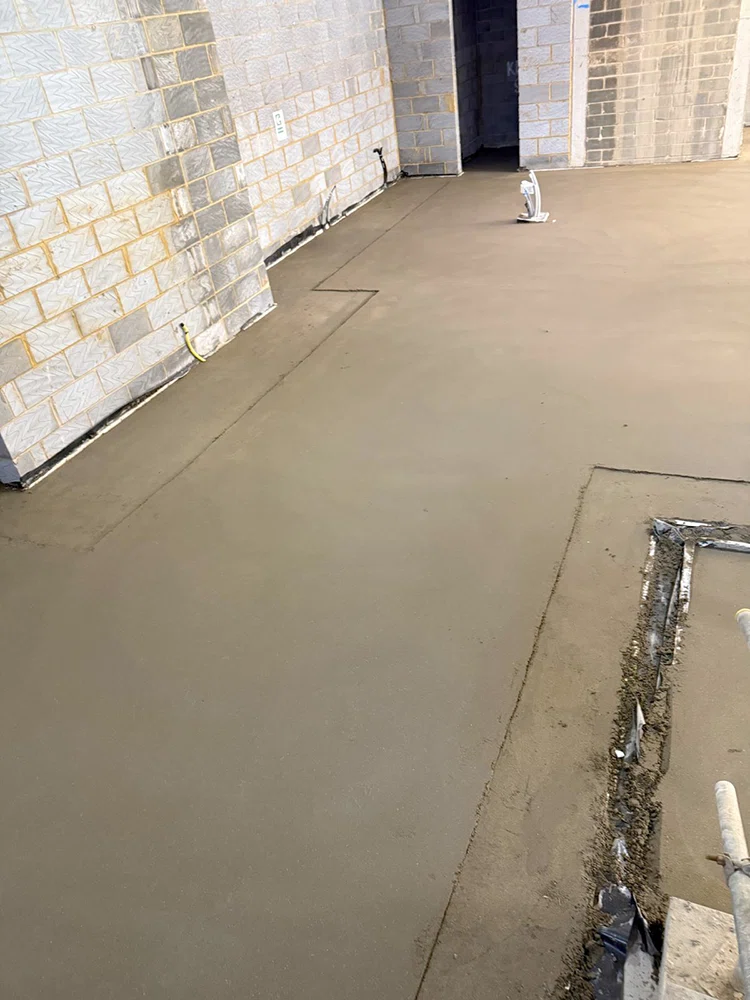
K & B Screeding’s own team, led by director Donatas Bardisevicius. Founded 2019, company 12298780.
See what customers say in our Google reviews and on our testimonials page.
Sand and Cement Screed from Slough to Southwick
On the map, Southwick sits south-south-east of Slough, about 51.4 miles from our base in a straight line (postcodes including BN42), next to Shoreham-by-Sea (1.5 miles), Brighton and Hove (4.2 miles), Worthing (6 miles) and Burgess Hill (9.6 miles).
More on sand & cement screed, part of our screeding services.