
Digging out old floors in Lewes terraces
A kitchen or back addition sitting on earth with no membrane will stay cold and can draw damp into the room. Patching the top rarely lasts. What actually lasts is taking the old floor out, putting a membrane and insulation in its place and screeding on top, and a hand-laid floor handles that work well.
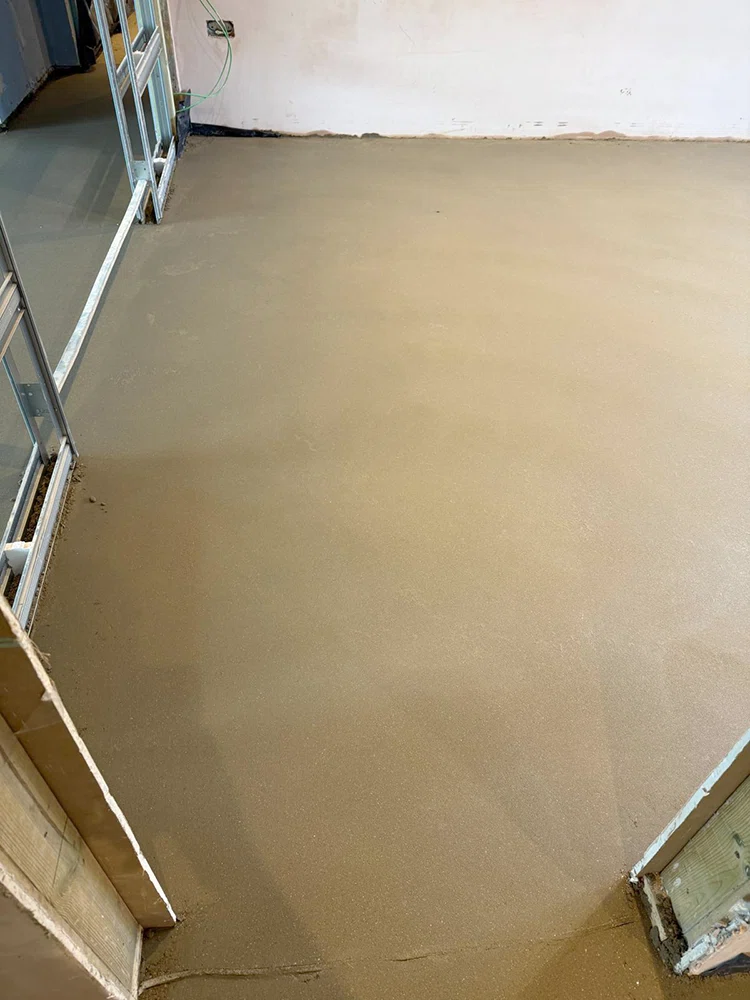
A floating sand and cement screed in a home goes down at 65mm over the insulation. It is mixed on site to suit the area, compacted by hand and finished level, so it copes with the narrow rooms, awkward doorways and changes of level typical of older terraces. The membrane and insulation below matter as much as the screed, and our page on insulation and membranes under screed sets out the build up.
Some old Lewes floors can stay where they are. In listed and conservation area houses in the centre, Cliffe and Southover, the aim is often a thin or breathable build up that disturbs as little as possible. If the slab underneath is sound but there is little height to play with, a 25 to 40mm screed bonded to the slab may do the job.
The inter-war years left their mark too: 13% of Lewes homes date from 1919 to 1944. Solid floors of that age can crack or lose their damp protection, and the same survey applies: what is under it, how thick it is, and whether it can be kept or has to come out.
Wet rooms, garages and falls in Lewes
Calcium sulphate screed cannot cope with water, but sand and cement can, which is why it goes under wet rooms, walk-in showers and utility floors. A hand-laid screed can also be shaped to falls, sloping gently to a drain, which a self-levelling screed will not do on its own.
Converted flats account for 5% of homes in Lewes, and a bathroom or kitchen floor in a house split into flats often has to be rebuilt within a tight height between existing thresholds. Laying by hand gives control over each small area. Garages are another common case, and a conversion usually means raising the floor, adding insulation and bringing it level with the house, as our guide to garage floor screed explains.
It is also the safer pick when the floor has to carry weight early or the finish has to go onto a cement base. Adding fibres costs about £1 to £3 per m² more, while a fast drying mix is £20 to £28 per m² on MyJobQuote's figures.
What you give up is speed of drying. The first 40mm dries at about a day per millimetre and the rest more slowly, so in normal conditions a 65mm floor takes well beyond 40 days before anything sensitive to moisture can be laid on it.
Sand and Cement Screed prices in Lewes
Sand and cement screed: £18 to £25 per m² supplied and laid (MyJobQuote, August 2026), so £450 to £630 for 25 m². MyJobQuote does not say whether these figures include VAT. See our floor screeding cost guide or screed calculator.
Who lays your sand and cement screed in Lewes
K & B Screeding’s own team, led by director Donatas Bardisevicius. Founded 2019, company 12298780.
See what customers say in our Google reviews and on our testimonials page.
Sand and Cement Screed from Slough to Lewes
As the crow flies, our yard in Slough is about 53.7 miles from Lewes, which lies to the south-south-east. Postcodes here include BN7, and Peacehaven (5.4 miles), Newhaven (5.7 miles), Brighton and Hove (7.6 miles) and Uckfield (7.6 miles) are close by.
More on sand & cement screed, part of our screeding services.