
Dig outs under Victorian terraces near Newhaven harbour
An old solid floor with no membrane is cold and often damp, and new flooring laid over it rarely lasts. Terraced houses make up 27% of Newhaven's homes, and in the Victorian terraces near the centre and harbour this is one of the most common reasons to take a floor up.
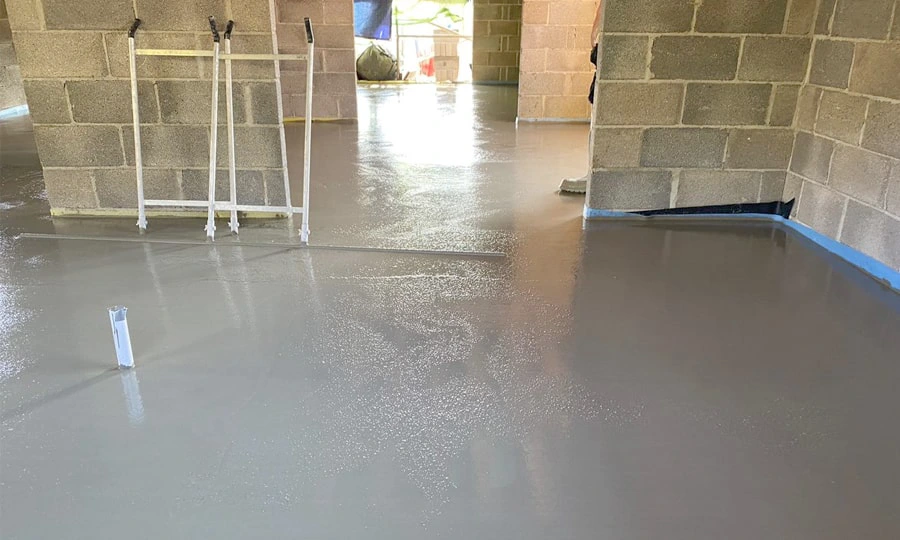
There is a fixed sequence to it. We break up the old floor and take it away, get the ground ready, then lay a damp proof membrane and insulation. On top of that goes a 65mm floating screed of sand and cement, mixed there and then, tamped down by hand and trowelled level. Our page on insulation and membranes under screed explains each layer and why the membrane must be continuous.
Hand laying suits these houses. Terraced rooms are small, doorways are narrow and levels change from front to back, and a screed placed by hand can follow all of that. It also gives the floor early strength if the next trade is waiting.
The inter-war houses need the same survey. Homes from 1919 to 1944 account for 10% of the town, and their solid floors may have cracked or lost their damp protection. If the slab is still sound and the floor height is tight, bonding a 25 to 40mm screed directly onto it can save digging the whole thing out. Bonded work is priced at £12 to £18 per m² (trade2base, June 2026).
Bathrooms, garages and small rooms in Newhaven
Wet rooms need a cement screed, and this is it. Calcium sulphate screeds cannot be used there, so shower rooms, wet rooms and utility floors take a cement screed, and a hand-laid one can be formed to falls so that water runs to the drain.
Garage conversions are another typical job. Most garage floors sit lower than the house and need raising, with a membrane and insulation under the new screed; the layers are set out in our guide to screeding a converted garage.
Mixes can be adjusted. Fibre reinforced screed adds about £1 to £3 per m² and reduces the risk of surface cracking, and a quick drying screed at £20 to £28 per m² (MyJobQuote) shortens the wait for floor coverings.
The drawback is drying time. A 65mm screed gives up its water slowly, at around a day for each millimetre until it reaches 40mm, then slower still, so in ordinary conditions it needs well over 40 days. An unheated house will take longer, so the programme needs to allow for it, and a moisture test, not the calendar, decides when flooring goes down.
Sand and Cement Screed prices in Newhaven
Sand and cement screed: £18 to £25 per m² supplied and laid (MyJobQuote, August 2026), so £450 to £630 for 25 m². MyJobQuote does not say whether these figures include VAT. See our floor screeding cost guide or screed calculator.
Who lays your sand and cement screed in Newhaven
K & B Screeding’s own team, led by director Donatas Bardisevicius. Founded 2019, company 12298780.
See what customers say in our Google reviews and on our testimonials page.
Sand and Cement Screed from Slough to Newhaven
As the crow flies, our yard in Slough is about 59.2 miles from Newhaven, which lies to the south-south-east. Postcodes here include BN9, and Peacehaven (2 miles), Seaford (2.9 miles), Lewes (5.7 miles) and Brighton and Hove (8.6 miles) are close by.
More on sand & cement screed, part of our screeding services.
