
Rebuilding old ground floors in Eastbourne's Victorian houses
Eastbourne's centre was planned as a resort from 1859, and Victorian hotels still line the seafront. In houses of that age, the original ground floor is often a thin solid floor with no membrane underneath, or one that has cracked and settled over the years. A repair that lasts means breaking that floor out, putting down insulation with a damp proof membrane over it, and screeding on top.
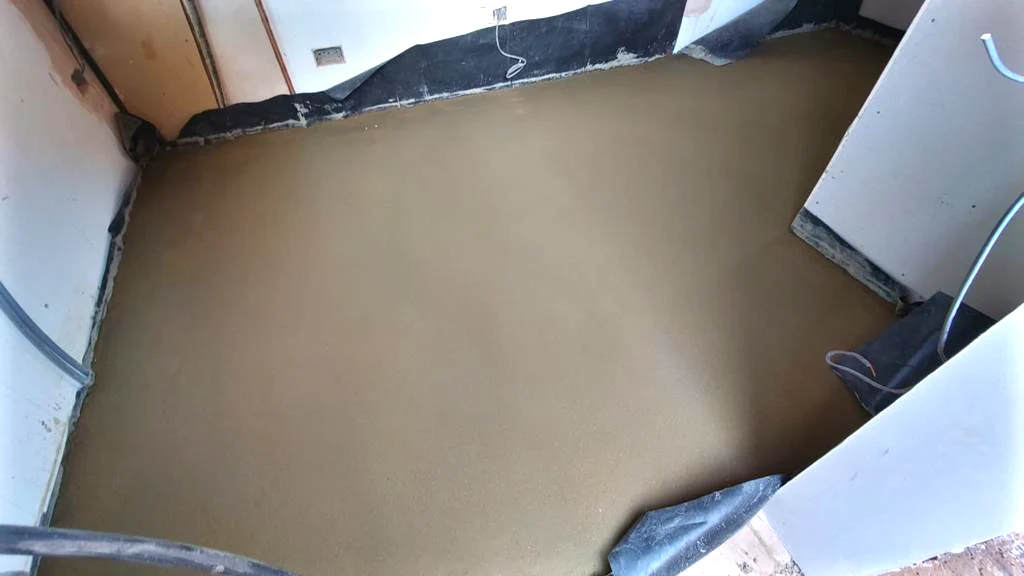
That is work for a screed mixed and placed by hand. It is mixed to suit each area, carried in, compacted and then floated to a dense, level surface. It copes well with narrow hallways, stepped rooms and awkward doorways, and it can be laid to falls where a floor needs to drain.
Depth is the main decision. Floating on insulation, the screed wants 65mm or more in a house and 75mm in commercial use. Bonded straight to a sound, prepared slab, it can drop to 25 to 40mm, useful when the new floor must meet an existing threshold. If a floor is prone to cracking, fibres can be added for £1 to £3 per m², and our fibre reinforced screed service explains when that is worth doing.
What you give up is speed. At 65mm, expect roughly a day of drying for each millimetre up to 40mm and slower going after that, so set the flooring date by the screed and not by the builder's diary. On published 2026 figures the cost runs between £18 and £25 per m².
Hampden Park garage conversions and Eastbourne wet rooms
Garage conversions come up on the semis and terraces of Hampden Park and Langney. A garage slab is usually lower than the house floor, uninsulated and sometimes sloped towards the door. To lift it, we add insulation and a membrane, then a screed thick enough that the converted room meets the hallway at the same height. That build-up is set out step by step in our guide to garage conversion floors.
Showers and wet rooms are where sand and cement really pays its way. Water left standing weakens calcium sulphate, so any floor that will get wet is laid in a cement based mix, falling towards the drain. The same applies to utility rooms and any floor under a boiler or washing machine where a leak is possible.
About 11% of the town's homes date from between 1919 and 1944, and interwar houses can mix a suspended timber floor in the front rooms with a solid floor at the back. A sand and cement screed can bring those areas to a single level when a kitchen is opened up. If the new floor will be heated, read about heated screeds in Eastbourne before settling on a depth, or see sand and cement screed in Seaford.
Sand and Cement Screed prices in Eastbourne
Sand and cement screed: £18 to £25 per m² supplied and laid (MyJobQuote, August 2026), so £450 to £630 for 25 m². MyJobQuote does not say whether these figures include VAT. See our floor screeding cost guide or screed calculator.
Who lays your sand and cement screed in Eastbourne
K & B Screeding’s own team, led by director Donatas Bardisevicius. Founded 2019, company 12298780.
See what customers say in our Google reviews and on our testimonials page.
Sand and Cement Screed from Slough to Eastbourne
On the map, Eastbourne sits south-east of Slough, about 66.4 miles from our base in a straight line (postcodes including BN21, BN20, BN23 and BN22), next to Polegate (4.1 miles), Hailsham (6.8 miles), Seaford (7.8 miles) and Bexhill-on-Sea (9.9 miles).
More on sand & cement screed, part of our screeding services.
