
Heated extension floors in Eastbourne's post-war homes
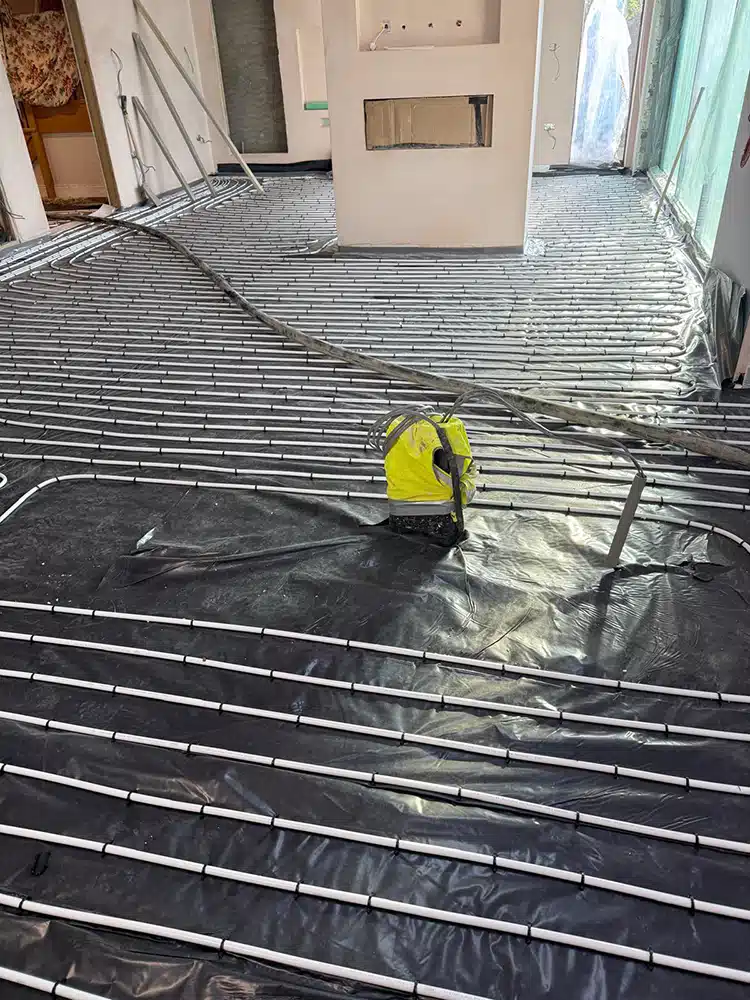
Roughly 26% of homes in Eastbourne were built between 1945 and 1972, and houses of that period often gain a kitchen extension or a garden room with heating in the floor. The pipework belongs to your heating engineer, who fits it and runs the pressure test, and our screed goes on afterwards. Installing the pipes is not part of what K & B does.
Get the cover right and most other things follow. Liquid screed wants 25mm or more over the pipes, so 45 to 50mm overall is normal, and sand and cement wants around 45mm of cover. Skimp on it and cracks can open along the pipe runs. Overdo it and the room takes too long to warm.
Because liquid screed wraps itself around every pipe and leaves no air gaps, heat spreads faster and more evenly, which is why it is normally chosen for open extension floors. Sand and cement still works well, especially in smaller rooms, but it is deeper and slower to dry. Our page on pumped liquid screed in Eastbourne covers the pour itself.
Before we arrive, check that the insulation is laid, the edge strip runs around every wall and the membrane is in place. We check it again on the day and can supply those layers where needed. Liquid screed over heating comes to £20 to £35 per m² on published 2026 figures, with depth and area setting where a job falls. For thickness in more detail, see our screed thickness guide.
Tight floor heights in older Eastbourne houses
Adding heating under the floor of an older Eastbourne house is harder work than heating a new extension. Doors, thresholds and the bottom stair have already fixed the finished height, and insulation, pipes and screed all have to squeeze in beneath it.
Liquid screed earns its place here, since the pipes need less of it on top than they would with sand and cement. Where the existing floor is sound but uneven, levelling it first gives the heating system a flat base to sit on. If the old floor has given up, digging it out may be the only way to find room for insulation.
The first heat-up is the stage where heated floors are most often spoiled. Calcium sulphate screed can normally take heat from around 7 days, while sand and cement has to wait 21 days or more. Either way, the temperature rises slowly, a step at a time, following the written schedule we leave with you. Rushing it risks cracking.
At Sovereign Harbour, where homes already have heating in the floor, the need is usually a repair or a levelling layer rather than a new screed. Our screed repairs service covers damaged areas over existing pipes.
Underfloor Heating Screed prices in Eastbourne
Liquid screed over underfloor heating: £20 to £35 per m² supplied and laid (trade2base, June 2026), so £700 to £1,230 for 35 m². trade2base gives these figures excluding VAT. See our floor screeding cost guide or screed calculator.
Who lays your underfloor heating screed in Eastbourne
K & B Screeding’s own team, led by director Donatas Bardisevicius. Founded 2019, company 12298780.
See what customers say in our Google reviews and on our testimonials page.
Underfloor Heating Screed from Slough to Eastbourne
On the map, Eastbourne sits south-east of Slough, about 66.4 miles from our base in a straight line (postcodes including BN21, BN20, BN23 and BN22), next to Polegate (4.1 miles), Hailsham (6.8 miles), Seaford (7.8 miles) and Bexhill-on-Sea (9.9 miles).
More on underfloor heating screed, part of our screeding services.