
Floor height and heating pipes in older Lewes houses
In an old Lewes house, adding wet heating comes down to a few millimetres either way. Liquid screed wants a minimum of 25mm above the pipes, giving a total of 45 to 50mm in most rooms. A sand and cement screed needs about 45mm of cover, and at 65mm or more in total it takes a good deal more height. In a room with fixed door thresholds and a hearth, that difference can decide which screed is possible.
In many of the town's Victorian and Edwardian terraces, the kitchen and back addition were laid directly on the ground. When those floors are dug out anyway, there is a chance to set the new level with room for insulation, pipes and screed, rather than squeezing them in above what is there.
Things get trickier in Cliffe, Southover and the historic centre, with their listed and conservation area homes. Their build ups often have to stay thin, and sometimes breathable, so the heating design and the screed have to be settled together, before pipes are ordered. A pumped liquid screed for Lewes floors flows fully around the pipes with no air pockets, and its thinner section is often what makes a retrofit work.
The heating engineer lays the pipes; our team lays the screed. We go over the edge strip, membrane and insulation before any screed goes in, and if one of them is missing we can provide it. What each of those layers does is set out under insulation, membranes and screed preparation.
Switching on the heating in a Lewes extension
Heated extensions are the most straightforward case. South Malling's post-war semis typically get extensions on concrete slabs, and a new room gives a clean start: insulation, pipes, then screed at the depth the heating design calls for.
Detached houses make up 10% of Lewes homes, and those with larger gardens sometimes add a garden room, which works the same way on a smaller scale. Houses built from 1973 to 1999 make up 21% of the town's stock, and wherever a heated extension joins an existing house, the finished levels of the two floors have to be matched before the depth is set.
Running the heating hard on a screed that is still wet is a mistake. With calcium sulphate, gentle warming can normally start at around 7 days, while sand and cement has to wait a minimum of 21. Either way, the flow temperature is stepped up slowly during commissioning so the floor gives up its moisture evenly and stays free of cracks. You get the heat-up plan from us in writing.
On trade2base's June 2026 figures, liquid screed laid over heating pipes costs £20 to £35 per m². For depths by floor type, see the screed thickness guide.
Underfloor Heating Screed prices in Lewes
Liquid screed over underfloor heating: £20 to £35 per m² supplied and laid (trade2base, June 2026), so £700 to £1,230 for 35 m². trade2base gives these figures excluding VAT. See our floor screeding cost guide or screed calculator.
Who lays your underfloor heating screed in Lewes
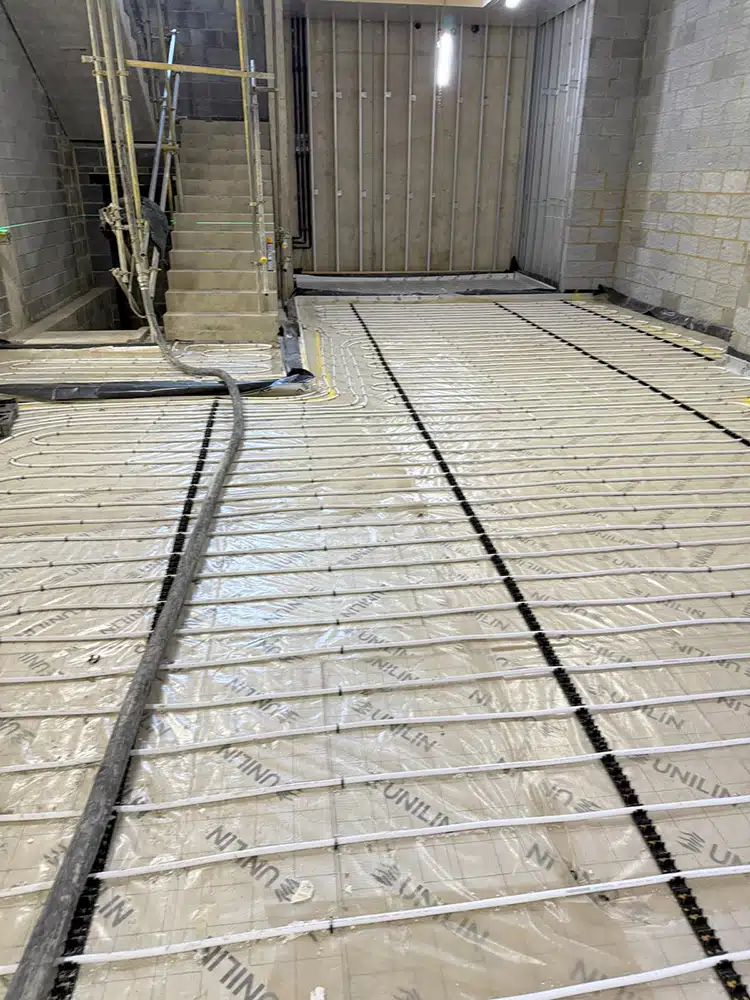
K & B Screeding’s own team, led by director Donatas Bardisevicius. Founded 2019, company 12298780.
See what customers say in our Google reviews and on our testimonials page.
Underfloor Heating Screed from Slough to Lewes
As the crow flies, our yard in Slough is about 53.7 miles from Lewes, which lies to the south-south-east. Postcodes here include BN7, and Peacehaven (5.4 miles), Newhaven (5.7 miles), Brighton and Hove (7.6 miles) and Uckfield (7.6 miles) are close by.
More on underfloor heating screed, part of our screeding services.
