
Heating retrofits in inter-war Southwick semis
In an older Southwick house, the ground floor was never designed for heating. It may be suspended timber, quarry tiles on a thin base, or an early concrete slab with no insulation. Laying pipes straight on top would lose heat downwards and raise the floor above the doors.
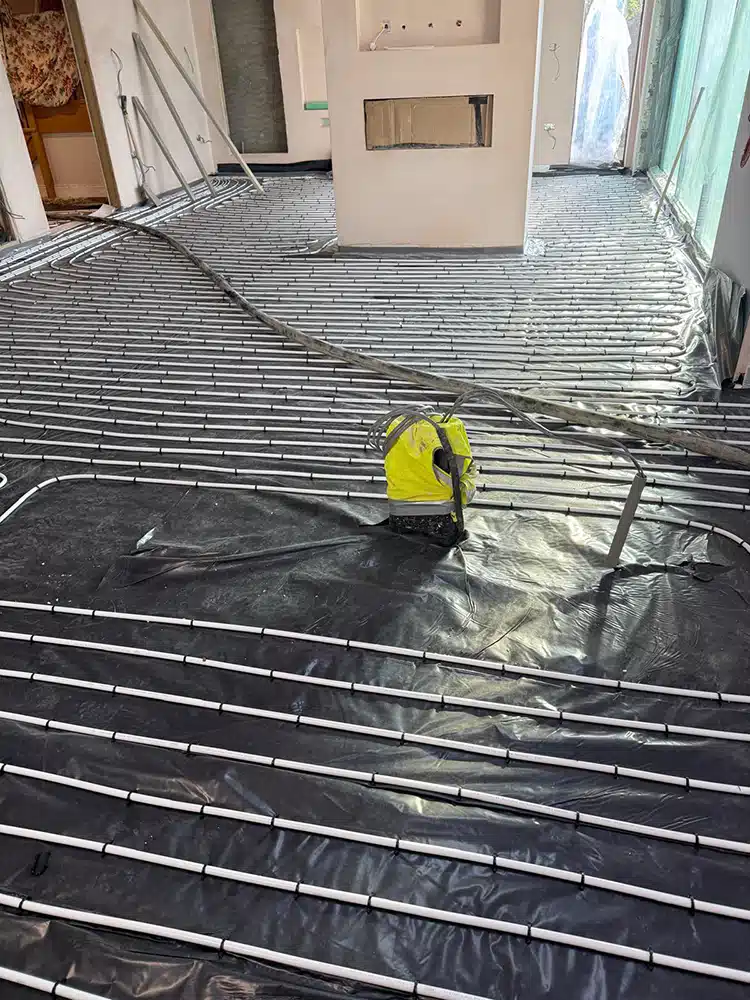
So a retrofit usually starts by taking the old floor out. The base is dug down, insulation goes in, the heating engineer fixes the pipes, and the screed is laid over them. The finished level has to meet the doors, stairs and any rooms that are not being changed, which sets how deep each layer can be.
Pipe cover is where the screed type matters. Liquid screed must sit 25mm or more above the pipes, around 45 to 50mm in total. Sand and cement wants roughly 45mm over them, so that floor is thicker. When height is tight, liquid screed around heating pipes can be the difference between a floor that fits and one that does not. It also flows around the pipes fully, with no air pockets.
Fitting the pipes is not our job, and they have to be in and pressure tested before we pour. On the day we look over the edge strip, membrane and insulation first, and we leave a surface flat enough for tiles, LVT or engineered wood.
Liquid screed over heating pipes is £20 to £35 per m² on published 2026 UK figures.
Extensions and first heat-up in Southwick
Rear extensions are the simpler case. The floor is built from scratch, so there is room for full insulation and the right cover over the pipes, and the screed is set to match the finished height of the house next door.
The heating cannot go on straight away. With calcium sulphate, warmth can normally be introduced from around 7 days. With sand and cement, it is 21 days at the earliest. After that, the heating engineer raises the temperature in small steps over several days, holds it, then lowers it. Rushing this stage can crack the screed or cause tiles to fail later, so everyone on site should know the schedule before the pour.
Used gently, the heating then helps dry the floor before the final covering, though a moisture test still comes first. What speeds or slows that wait is covered in our guide to how long screed takes to dry.
Where the programme is tight on a sand and cement floor, a quick drying screed can shorten it. For similar heated extensions further west, see underfloor heating screed in Worthing.
Underfloor Heating Screed prices in Southwick
Liquid screed over underfloor heating: £20 to £35 per m² supplied and laid (trade2base, June 2026), so £700 to £1,230 for 35 m². trade2base gives these figures excluding VAT. See our floor screeding cost guide or screed calculator.
Who lays your underfloor heating screed in Southwick
K & B Screeding’s own team, led by director Donatas Bardisevicius. Founded 2019, company 12298780.
See what customers say in our Google reviews and on our testimonials page.
Underfloor Heating Screed from Slough to Southwick
On the map, Southwick sits south-south-east of Slough, about 51.4 miles from our base in a straight line (postcodes including BN42), next to Shoreham-by-Sea (1.5 miles), Brighton and Hove (4.2 miles), Worthing (6 miles) and Burgess Hill (9.6 miles).
More on underfloor heating screed, part of our screeding services.