
Specifying calcium sulphate for Southwick extensions and flats
Each calcium sulphate screed carries a code set by the European screed standard. Its C figure is the compressive strength and its F figure the flexural strength, measured in N/mm2.
Three grades cover most homes. Light domestic use calls for CA-C20-F4. Most houses, flats and offices are specified at CA-C25-F5. Floors that will work harder get CA-C30-F6. On a drawn specification, we pour the grade that is named. On a simpler extension, we recommend one based on the room and the finish.
There are also alpha hemihydrate screeds. Designers use them when the floor needs to dry sooner or be thinner, handy in an inter-war semi whose doors leave no room to raise the floor. For these, the maker's product sheet sets the depth and drying time, and the general rules for the standard grades do not apply.
In Southwick, 18% of homes are purpose-built flats. Apartment floors suit calcium sulphate well, because the screed shrinks very little and large bays can be poured with few joints. Any joints the floor does need, such as across a doorway or where two heating zones meet, are set out and agreed with you ahead of the pour. In a refurbished block, the existing structure and any acoustic layer are checked first, because they set the depth available.
For more on how the material works, read anhydrite screed explained. If the existing base needs cleaning, grinding or repair first, our floor preparation work gets it ready.
Sanding, priming and moisture checks in Southwick
The finish of a calcium sulphate floor depends on what happens after the pour. While it dries, a weak skin called laitance builds up on top. Sand it off before any adhesive or compound goes on, or the finish ends up gripping a crust that can later let go. A primer made for calcium sulphate then goes on the sanded surface.
Moisture testing follows. Many flooring manufacturers set a lower moisture limit for calcium sulphate than for cement, so it is common for a floor to look dry and still fail the test. So we go by a hygrometer reading, not the number of days since the pour. If the room has underfloor heating, running it from about 7 days onwards can normally force the drying along.
Wet areas are the exception. A bathroom with a level access shower, a utility room or a ground floor workshop that may see water should have a cement based flowing screed or a hand-laid cement floor. Our page on hand-laid cement floors for Southwick wet rooms covers those. For the same service inland, see anhydrite screed in Burgess Hill.
Anhydrite & Flow Screed prices in Southwick
Liquid flowing screed (which includes anhydrite): £24 to £31 per m² supplied and laid (MyJobQuote, August 2026), so £960 to £1,240 for 40 m². MyJobQuote does not say whether these figures include VAT. See our floor screeding cost guide or screed calculator.
Who lays your anhydrite and flow screed in Southwick
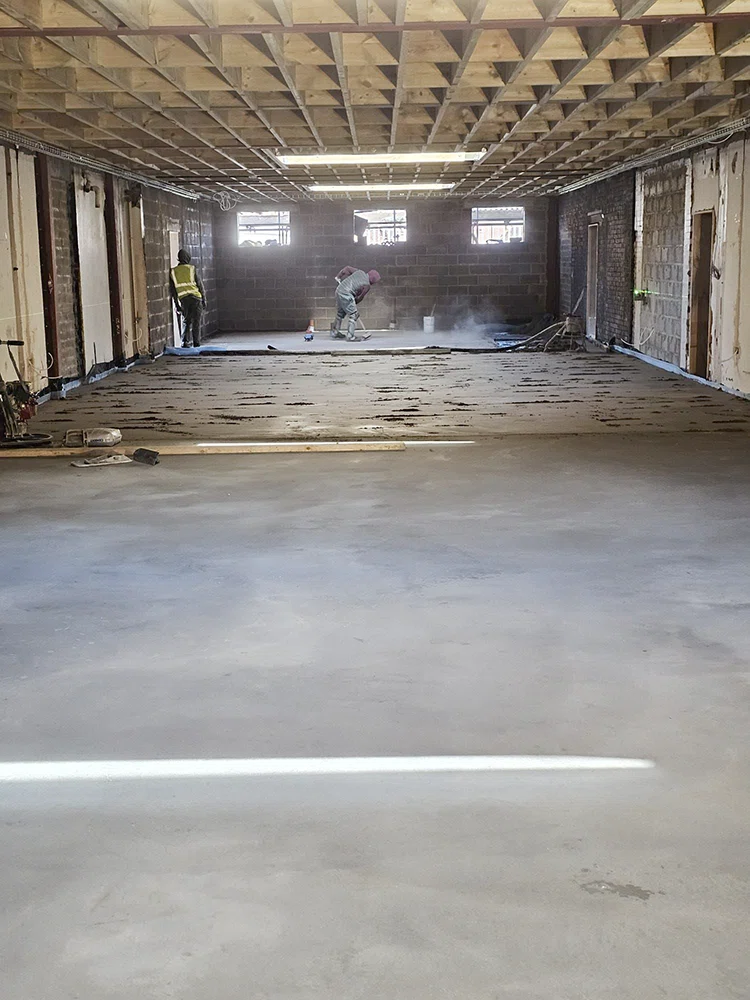
K & B Screeding’s own team, led by director Donatas Bardisevicius. Founded 2019, company 12298780.
See what customers say in our Google reviews and on our testimonials page.
Anhydrite & Flow Screed from Slough to Southwick
On the map, Southwick sits south-south-east of Slough, about 51.4 miles from our base in a straight line (postcodes including BN42), next to Shoreham-by-Sea (1.5 miles), Brighton and Hove (4.2 miles), Worthing (6 miles) and Burgess Hill (9.6 miles).
More on anhydrite screed, part of our screeding services.
