
Anhydrite grades for Lewes flats and new plots
Anhydrite is called up on drawings by a code from the European screed materials standard. In that code, C gives the compressive strength and F the flexural strength, each in N/mm2. For a lightly used domestic floor the code is usually CA-C20-F4; most houses, flats and offices take CA-C25-F5; heavier use moves up to CA-C30-F6. On a drawing it appears as one of those codes, and that is what we pour; we do not swap grades to suit ourselves.
Purpose-built flats account for 19% of Lewes homes, and their floors suit calcium sulphate well. Because shrinkage on setting is low, a single bay can be large and the joints few. Any joints that are needed, say across a doorway or where one heating zone meets another, are drawn into the bay layout and agreed beforehand.
Now and then the drawings call for an alpha hemihydrate product. Designers pick these when the floor has to dry sooner or be thinner, and as each one has its own product sheet for depth and drying, that sheet is what we follow.
The scheme at the Phoenix, promoted by Human Nature as a large timber development with business and community space alongside the homes, shows the kind of project where a written floor specification is the starting point. We prepare everything beneath the screed with our own team, and our anhydrite screed explainer goes further into the material.
Laitance, moisture and wet areas in Lewes
Pouring is only half of the job. While it dries, calcium sulphate throws up a thin, weak surface skin known as laitance. Flooring adhesive will not hold onto that skin, so when the screed is dry we sand it away and prime with a primer made for calcium sulphate. Skipping this step is how tiles and LVT come loose later.
Moisture needs the same care. Flooring makers often allow less moisture in calcium sulphate than in cement, so a reading that would be fine on a cement base may still be too wet on this one. That is why a hygrometer reading, not the number of days since the pour, decides when it is ready. If heating pipes are in the floor, they can usually be used to force dry it from about 7 days, which is useful when the flooring fitter is waiting.
Anywhere that might get wet should not have calcium sulphate at all. Showers and utility rooms take a flowing screed made with cement instead or, where the floor must slope to a drain, a hand-laid screed laid to falls. For the same material nearby, see our anhydrite screed page for Brighton and Hove.
Anhydrite & Flow Screed prices in Lewes
Liquid flowing screed (which includes anhydrite): £24 to £31 per m² supplied and laid (MyJobQuote, August 2026), so £960 to £1,240 for 40 m². MyJobQuote does not say whether these figures include VAT. See our floor screeding cost guide or screed calculator.
Who lays your anhydrite and flow screed in Lewes
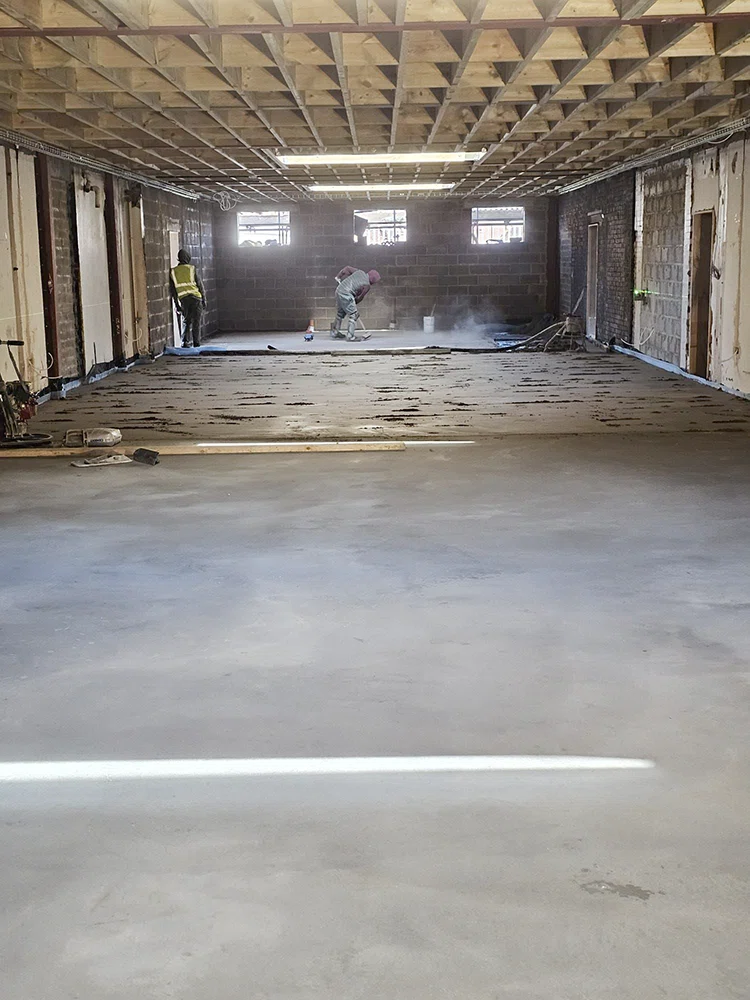
K & B Screeding’s own team, led by director Donatas Bardisevicius. Founded 2019, company 12298780.
See what customers say in our Google reviews and on our testimonials page.
Anhydrite & Flow Screed from Slough to Lewes
As the crow flies, our yard in Slough is about 53.7 miles from Lewes, which lies to the south-south-east. Postcodes here include BN7, and Peacehaven (5.4 miles), Newhaven (5.7 miles), Brighton and Hove (7.6 miles) and Uckfield (7.6 miles) are close by.
More on anhydrite screed, part of our screeding services.
