
Specifying anhydrite for the Hailsham and Hellingly masterplan era
Building on Hailsham's northern edge is set to continue under the Hailsham and Hellingly masterplan, and 9% of the town's homes were already built between 2000 and 2014. Where a plot's floor specification names a calcium sulphate grade, that grade sets the strength the floor must reach.
Those grades follow the European standard for screed materials. Read the C as compressive and the F as flexural strength, each given in N/mm2. Light domestic traffic is fine on CA-C20-F4. The everyday grade for houses, flats and offices is CA-C25-F5. Floors that will work harder get CA-C30-F6. On a developer's plot we pour exactly what the engineer has specified, and on a self-build we recommend a grade based on the rooms and finishes.
Where the drying time has to be short or the floor thin, the specification may switch to an alpha hemihydrate product. Every one of those comes with a product sheet of its own, and that sheet, not a rule of thumb, sets our depth and drying times.
Because calcium sulphate barely shrinks, wide bays go down with few joints. That suits open-plan ground floors and the whole-phase pours that housebuilders need. Thresholds and the edges of heating zones still need joints, and we plan where the bays fall before pouring. Our guide to anhydrite screed goes into the material in more depth.
Purpose-built flats make up 11% of Hailsham's homes, and apartment floors, poured in one visit over insulation, are another natural fit.
Finishing anhydrite floors on Hailsham plots before flooring
Being able to walk on an anhydrite floor does not mean flooring can go straight on. As it dries, laitance forms: a thin, weak surface layer that adhesives cannot grip. When the screed has dried far enough, we sand that layer away and prime with a product that works on calcium sulphate.
Moisture testing comes next. Flooring makers often allow less moisture in calcium sulphate than in cement screeds, so a reading that would pass a sand and cement floor may fail this one. Our hygrometer readings are written down for you. With heating fitted, drying the floor with it is usually possible from about 7 days, warming it up gradually.
Anywhere that may get wet needs a different material. A shower room, a wet room or a utility floor where a leak could happen should have a cement based flowing screed or a hand-laid cement screed for wet areas. On a plot with anhydrite elsewhere, we can lay both on the same visit.
Once the laitance is off and the floor is dry, any remaining unevenness can be dealt with by levelling compound in Hailsham.
Anhydrite & Flow Screed prices in Hailsham
Liquid flowing screed (which includes anhydrite): £24 to £31 per m² supplied and laid (MyJobQuote, August 2026), so £960 to £1,240 for 40 m². MyJobQuote does not say whether these figures include VAT. See our floor screeding cost guide or screed calculator.
Who lays your anhydrite and flow screed in Hailsham
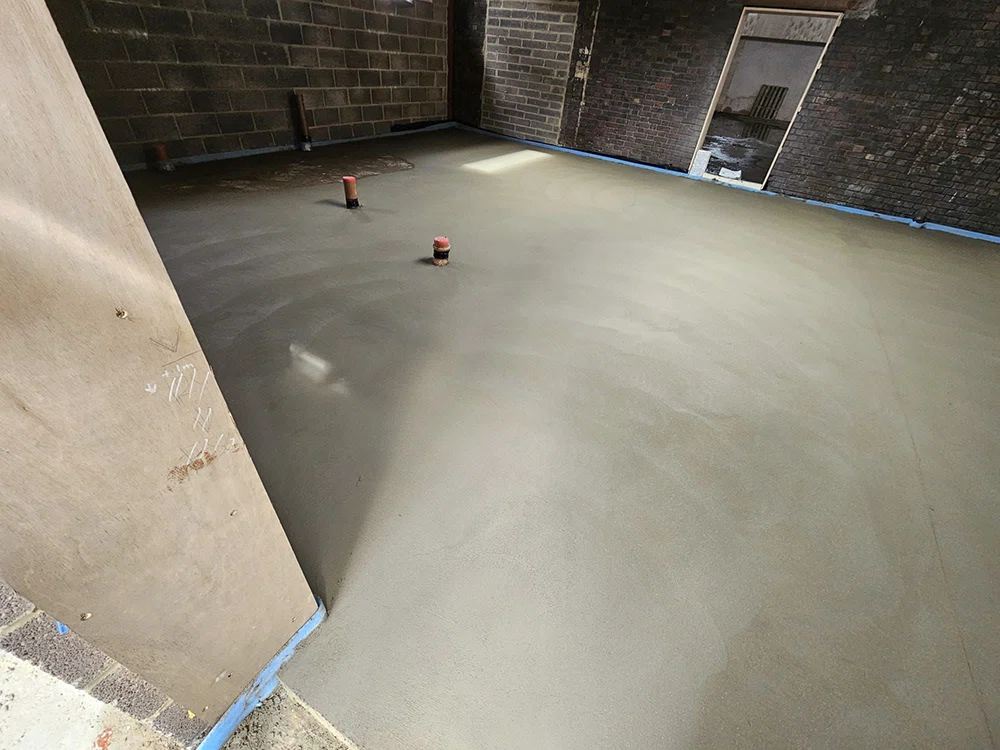
K & B Screeding’s own team, led by director Donatas Bardisevicius. Founded 2019, company 12298780.
See what customers say in our Google reviews and on our testimonials page.
Anhydrite & Flow Screed from Slough to Hailsham
Hailsham is about 60.5 miles south-east of our Slough base as the crow flies, with postcodes including BN27. The nearest towns to it are Polegate (3 miles), Eastbourne (6.8 miles), Seaford (9.5 miles) and Bexhill-on-Sea (9.5 miles).
More on anhydrite screed, part of our screeding services.