Choosing an anhydrite grade for Bexhill-on-Sea floors
Look at a calcium sulphate specification and you will find a short code from the European screed materials standard. CA identifies the material, the C figure its compressive strength and the F figure its flexural strength, both in N/mm2. Most buildings need one of three. A spare bedroom or other quiet domestic room is CA-C20-F4 territory. CA-C25-F5 is the everyday grade, right for the typical house, flat or office. Heavier wear calls for the stiffer CA-C30-F6.
Where the specification comes from an architect or developer, we pour what it names and do not swap products. That applies on new build plots, including the newest homes in Bexhill-on-Sea: 6% of the housing was built in 2015 or later. Sometimes a drawing names an alpha hemihydrate product to get a quicker dry or a thinner floor, and then that product's data sheet governs depth and drying.
Because it barely shrinks while setting, the material can go down in large bays without the close grid of joints a cement screed would need. The joint layout is still drawn up before anything is poured, with joints at door thresholds and between heating zones where the build needs them.
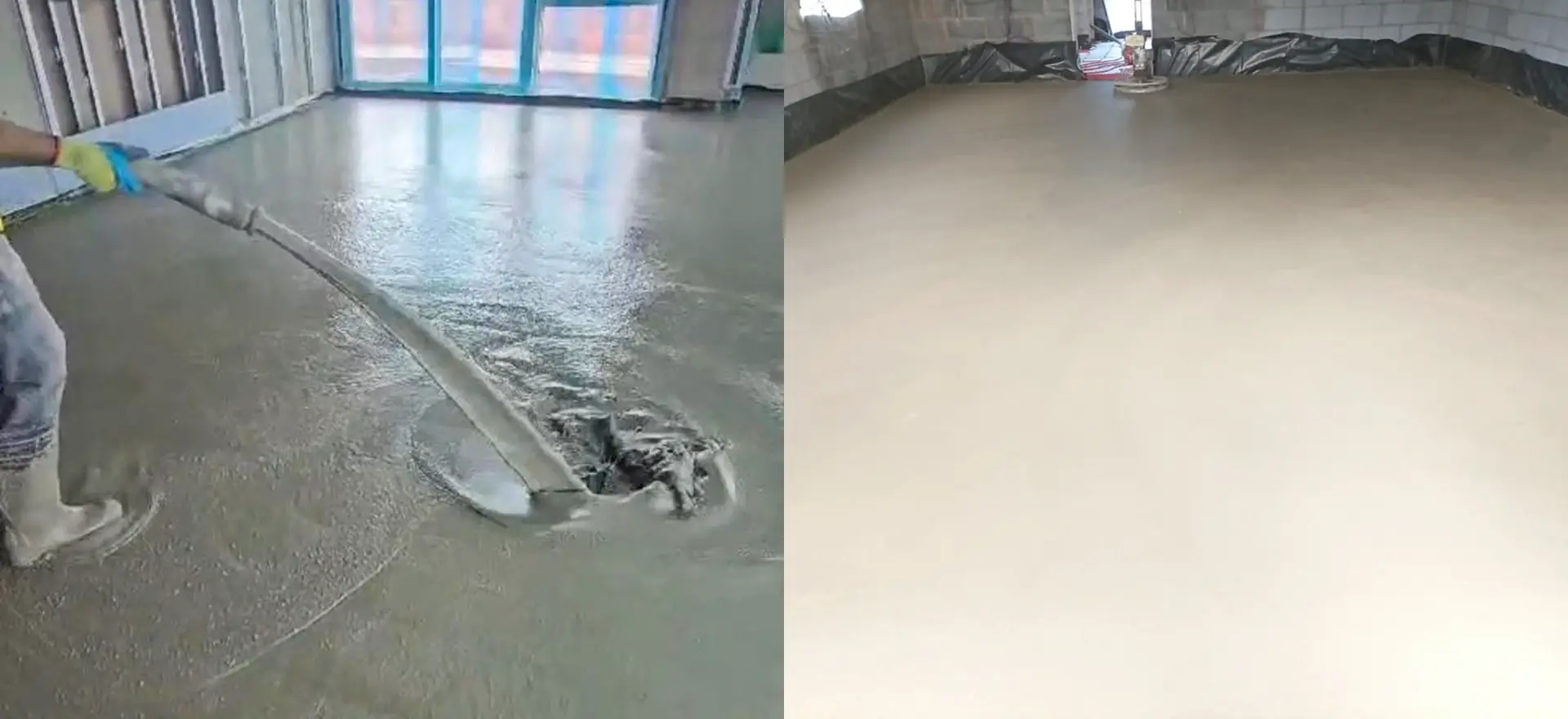
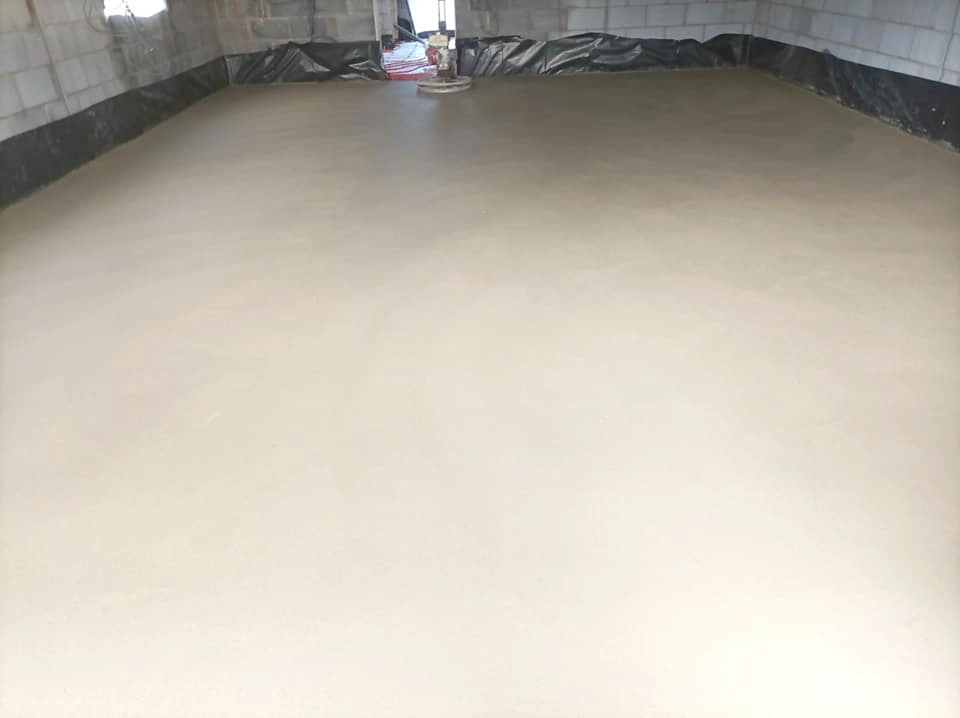
On apartment floors, calcium sulphate is often laid over insulation and heating in one continuous pour per flat. For how the binder behaves, read anhydrite screed explained. If you only need a pumped floor and have no specification, our Bexhill-on-Sea liquid screed page is the simpler starting point.
Laitance, sanding and moisture tests in Bexhill-on-Sea
Finishing the pour is only half of a calcium sulphate floor. While it dries, a thin, weak crust known as laitance builds up on top. Adhesives and levelling compounds cannot get a grip on that crust, so once the floor has dried far enough it gets sanded away and the surface is primed with a product meant for calcium sulphate. A primer chosen for cement may not suit it.
Moisture comes next. Flooring makers often allow less moisture in a calcium sulphate screed than in a cement one, so LVT, engineered wood or tiles may have to wait longer than you would guess. We rely on a hygrometer reading, not a count of days. If pipes are in, switching the heating on from about 7 days is the usual way to hurry the drying along.
Water is its weakness. In a Bexhill flat's wet room, a level-access shower or a utility prone to leaks, we would switch to a cement based flowing screed, or to traditional hand-laid sand and cement. In a converted flat where the base is suspect, our floor preparation service comes first.
Anhydrite over acoustic layers in Bexhill-on-Sea's converted flats
Many older Bexhill houses are now flats, and their upper floors bring a problem a ground floor never has: sound passing down to the neighbours. One answer is a floating screed laid over a resilient acoustic layer, so the new floor rests on the soft layer and never touches the walls or the structure directly.
Calcium sulphate suits that build-up. It flows into a continuous slab with no hand compaction, so there is no heavy tamping on top of a soft layer that could crush it in places. It shrinks very little, so a whole flat can often go down in one bay.
The details decide whether the acoustic layer does its job. The resilient layer is laid tight with taped joints so the liquid cannot run through and set against the slab beneath. Edge strip goes round every wall, pipe and door frame, because a single spot where the screed touches the structure lets sound bypass the whole layer. The depth and grade come from the acoustic product and the specification, usually CA-C25-F5 for a flat.
All of this assumes the structure can take it. Upper floors in converted houses are often timber joists, and a full depth wet screed adds a lot of weight, so the builder or a structural engineer must confirm the floor is strong and stiff enough before anything is poured. Where it is not, a lighter build-up is needed instead of a screed.
Anhydrite and flow screed prices for Bexhill-on-Sea floors
Liquid flowing screed (which includes anhydrite): £24 to £31 per m² supplied and laid (MyJobQuote, October 2026), so £960 to £1,240 for 40 m². MyJobQuote does not say whether these figures include VAT. See our liquid screed cost per m² guide or screed calculator.
Who lays your anhydrite and flow screed in Bexhill-on-Sea
K & B Screeding, led by director Donatas Bardisevicius. Founded 2019, company 12298780.
See what customers say in our Google reviews and on our testimonials page.
Anhydrite and flow screed from Slough to Bexhill-on-Sea
As the crow flies, our base in Slough is about 68 miles from Bexhill-on-Sea, which lies to the south-east. Postcodes here include TN38, TN39 and TN40, and Hastings (4.9 miles), Hailsham (9.5 miles), Eastbourne (9.9 miles) and Polegate (10 miles) are close by.
If the anhydrite delivery has to stand on the road in Bexhill-on-Sea, a suspension or dispensation can be requested from East Sussex County Council (dispensations and suspensions); we will say on the quote if it is needed.
More on anhydrite screed, part of our floor screeding service. For every screed we lay locally, see floor screeding in Bexhill-on-Sea.
Further reading: primers for calcium sulphate screed.
