
Where pumped liquid screed fits Bexhill-on-Sea homes
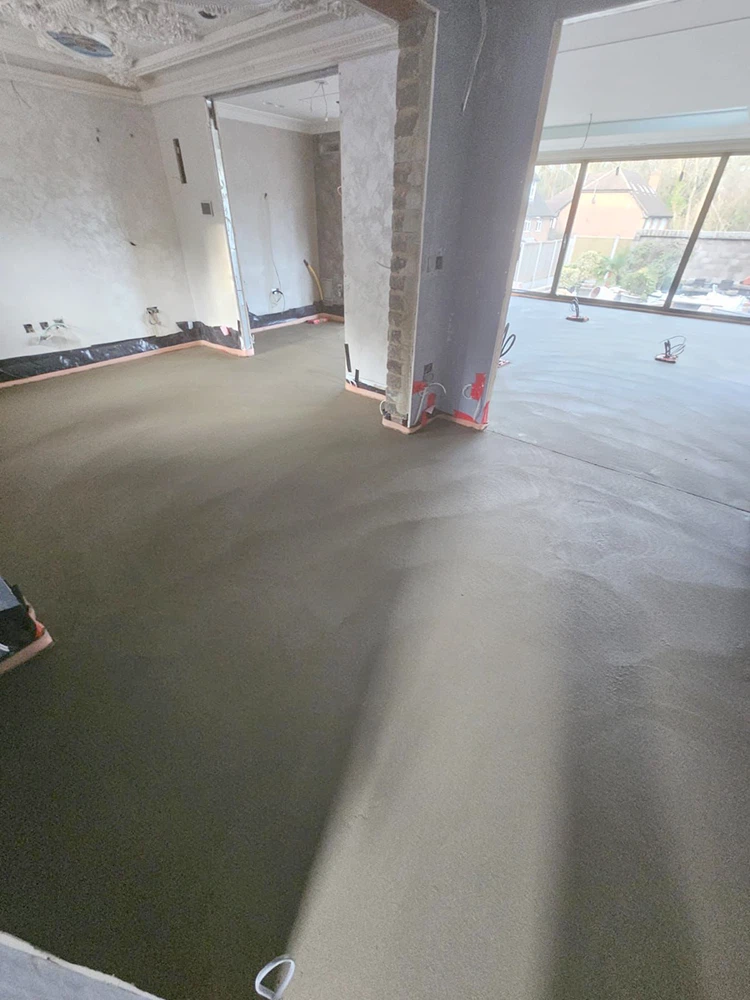
A big open floor is where pumped screed pays for itself. Take a post-war Bexhill house that has gained a rear extension and lost the wall between kitchen and dining room: you can end up with one floor running from the old dining room right out to the garden doors. The screed is pumped in and finds its own level across all of it, so nobody has to rule it off in strips, and SR1 or SR2 surface regularity is well within reach.
Garden rooms work the same way on a smaller scale. So do floors in the town's newer housing: 12% of homes in Bexhill-on-Sea were built since 2000, and ground floors on newer schemes are often designed for a flowing screed over insulation.
Next comes depth. Laid floating in a house, a liquid screed begins at roughly 35mm; run it over heating pipes and you need 25mm or more sitting above them, so most heated floors finish at 45 to 50mm overall. A traditional sand and cement floor would be deeper, and that saving is handy when the extension has to sit flush with the old slab in the next room.
There are two kinds to choose between. Calcium sulphate types are right for most dry rooms, while cement based ones go where water might reach the floor. The grades and specification are set out on our anhydrite flow screed page for Bexhill-on-Sea. It moves so little as it cures that a Bexhill extension floor can run through with only a handful of joints, where a traditional mix would want many more.
If you own a post-war Bexhill bungalow and are torn between pumped and hand-laid, our liquid versus sand and cement guide weighs them up.
Getting the pump to the room in Bexhill-on-Sea
Any pumped floor begins out on the road. The mixer and pump have to park near enough for the hose to reach your room, and from there the hose snakes through the house or up the stairs. On a bungalow with its own drive, that is usually a short, easy run. On a terrace or a street with tight parking, the lorry position has to be planned, and it helps to tell us about yellow lines, permit bays or a shared access path when you ask for a price.
Upper floor flats are possible too. Getting the hose up a stairwell to a first or second floor is fine provided the way is clear and the building manager has signed off the date. In a converted house, check whether the floor structure below is timber, because that changes the build-up and may call for an acoustic layer first.
Once it is poured, keep the doors and windows shut for a day or two so draughts cannot skin the surface too quickly, and only then open up and let air through. Drying then ticks along at roughly a millimetre a day, as far as 40mm of depth. Our guide on how long screed takes to dry explains the rest, and our screed pumping page covers the equipment side.
Liquid Screed prices in Bexhill-on-Sea
Liquid screed: £24 to £31 per m² supplied and laid (MyJobQuote, August 2026), so £960 to £1,240 for 40 m². MyJobQuote does not say whether these figures include VAT. See our floor screeding cost guide or screed calculator.
Who lays your liquid screed in Bexhill-on-Sea
K & B Screeding’s own team, led by director Donatas Bardisevicius. Founded 2019, company 12298780.
See what customers say in our Google reviews and on our testimonials page.
Liquid Screed from Slough to Bexhill-on-Sea
As the crow flies, our yard in Slough is about 68 miles from Bexhill-on-Sea, which lies to the south-east. Postcodes here include TN40, TN39 and TN38, and Hastings (4.9 miles), Hailsham (9.5 miles), Eastbourne (9.9 miles) and Polegate (10 miles) are close by.
More on liquid screed, part of our screeding services.
