
Relaying failed solid floors in older Bexhill-on-Sea houses
Older houses in Bexhill-on-Sea, especially those converted into flats, can have ground floors that were never built to modern standards. Some sit on Victorian suspended timber; others are solid floors laid with no damp proof membrane. When a solid floor cracks, sinks or stays damp, the lasting fix is to dig it out and rebuild it: a sound base, a membrane, insulation, and then a new screed on top.
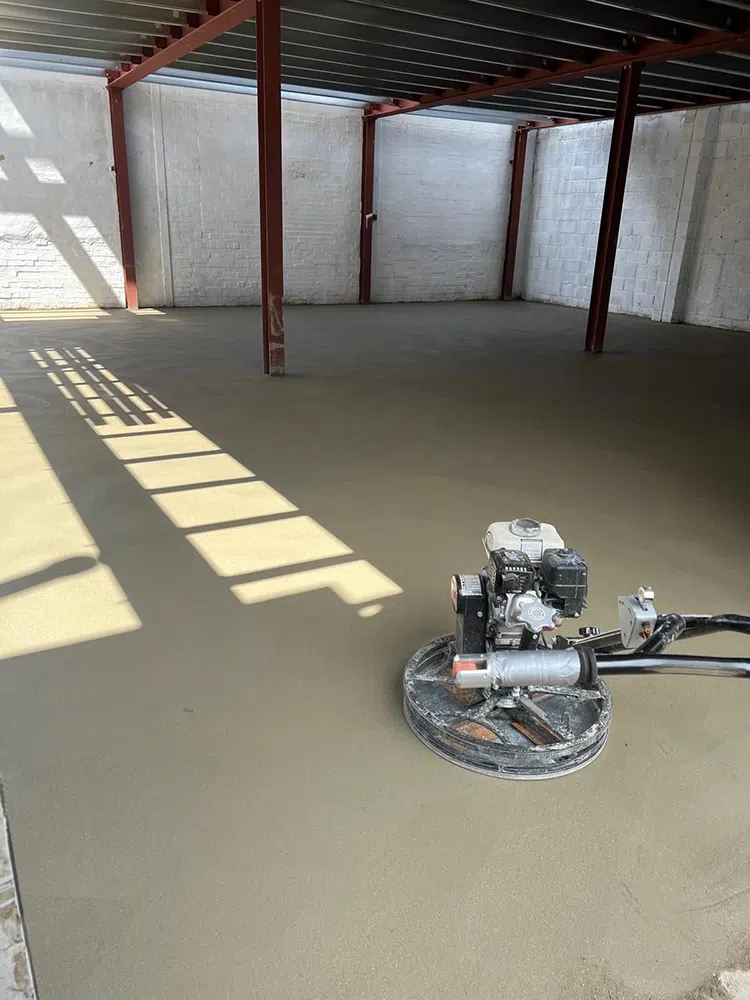
Laying it by hand makes sense there for plain, practical reasons. Because the mix is made up on site and spread to whatever depth each room calls for, a hallway, a small back kitchen and a lean-to utility can all be finished on one visit with no pump on the road. It copes with awkward doorways, chimney breasts and changes of level that would make a flowing screed hard to contain.
The thickness is set by whatever the screed is sitting on. Over insulation in a house, a floating screed wants to be around 65mm. Bonded straight onto sound concrete, it can drop to 25 to 40mm, a real help where headroom or door heights leave little to spare. Whether your slab is fit for that is covered on our bonded screed page.
Homes built between 1919 and 1944 are another 15% of the stock. Floors of that age can show similar faults: tired solid floors under old tiles, uneven joins where a back room was knocked through, or a floor that dips toward an outside wall. Our screed thickness guide shows how each build-up adds up.
Wet rooms, garages and falls across Bexhill-on-Sea
Some rooms need cement, whatever else is in the house. Showers and wet rooms need a floor that can stand being soaked and that falls toward the drain, and calcium sulphate screed is unsuitable on both counts. Sand and cement can be ruled to a gentle slope by hand, so water runs to the gully rather than sitting in a corner.
Then there are garage conversions. A garage being turned into a bedroom or study usually has a concrete slab lower than the house floor, and the gap is made up with insulation, a membrane and a screed so the new room sits level with the hall. We list each layer, bottom to top, in the garage floor screed guide.
Sand and cement is slow to dry, and that is its one real cost. A 65mm floor, at about a day per millimetre for the first 40mm and slower beyond, can take many weeks before it is ready for timber or LVT. If the programme is tight, rapid drying additives can be added to the mix; see quick drying screed. Where speed matters more than anything, a pumped liquid screed for Bexhill-on-Sea may suit better.
Sand and Cement Screed prices in Bexhill-on-Sea
Sand and cement screed: £18 to £25 per m² supplied and laid (MyJobQuote, August 2026), so £450 to £630 for 25 m². MyJobQuote does not say whether these figures include VAT. See our floor screeding cost guide or screed calculator.
Who lays your sand and cement screed in Bexhill-on-Sea
K & B Screeding’s own team, led by director Donatas Bardisevicius. Founded 2019, company 12298780.
See what customers say in our Google reviews and on our testimonials page.
Sand and Cement Screed from Slough to Bexhill-on-Sea
As the crow flies, our yard in Slough is about 68 miles from Bexhill-on-Sea, which lies to the south-east. Postcodes here include TN40, TN39 and TN38, and Hastings (4.9 miles), Hailsham (9.5 miles), Eastbourne (9.9 miles) and Polegate (10 miles) are close by.
More on sand & cement screed, part of our screeding services.
