
Relaying old floors near Seaford seafront and East Blatchington
An original ground floor in a Victorian house was rarely built with a damp proof membrane or insulation. Over a century it can crack, drop, or draw moisture up into skirtings and floor coverings. Relaying the floor properly means digging out the old material, then laying insulation, a membrane and a floating screed on top.
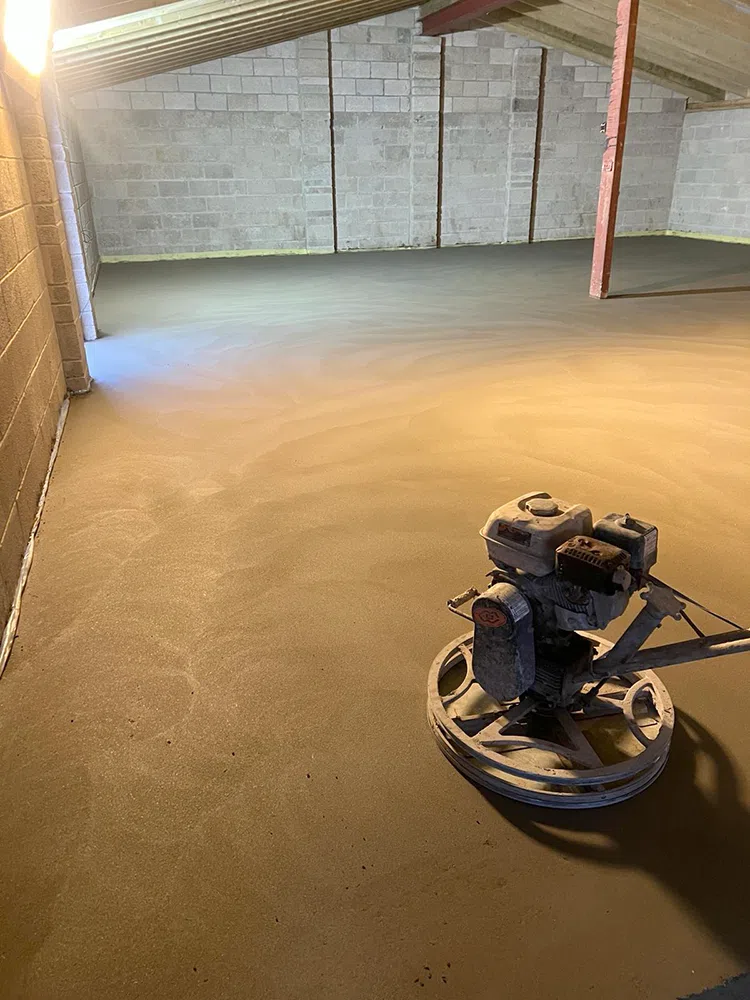
For that kind of rebuild, sand and cement is what normally goes back in. We mix it at the house, which lets the depth change from one room to the next to suit old thresholds, then compact it by hand and float it dense and level. Over insulation in a house, it goes down at about 65mm. Where a sound slab remains and only the surface has failed, a bonded screed of 25 to 40mm can be laid straight onto the prepared base, and the bonded screed service explains when that works.
The interwar houses, 13% of the town's homes, can have similar problems with older solid floors, although construction varies and each floor is judged on what is actually there when it is opened up.
Period houses near the seafront tend to mean pokey rooms, a narrow hall and the odd step between them. Working by hand handles that better than a pump does, and on small, fiddly floors it keeps the cost sensible. Our comparison of liquid and sand and cement screeds sets the two out next to each other.
Seaford wet rooms, garages and floors needing early strength
A walk-in shower or wet room is somewhere calcium sulphate is ruled out. A sand and cement screed can be laid to falls towards the drain and tanked before tiling, so bathrooms in extensions and refits usually get a cement base even when the rest of the floor is poured.
Garage conversions follow a similar logic. A garage slab normally sits below the house floor, so it gets insulation, a membrane and enough screed to bring it up to the rooms next door. The layers are laid out in our guide to screeding a garage floor.
Some floors need to take load early, or carry heavier use than a normal room, and a cement substrate is the safer base there. Adding fibres helps it resist cracking and costs £1 to £3 per m² extra.
The trade-off is time. With roughly a day needed for each of the first 40mm and longer after that, a 65mm floor keeps wood or vinyl waiting for weeks. If the fitters are already booked, a quicker drying cement mix shortens that gap.
Sand and Cement Screed prices in Seaford
Sand and cement screed: £18 to £25 per m² supplied and laid (MyJobQuote, August 2026), so £450 to £630 for 25 m². MyJobQuote does not say whether these figures include VAT. See our floor screeding cost guide or screed calculator.
Who lays your sand and cement screed in Seaford
K & B Screeding’s own team, led by director Donatas Bardisevicius. Founded 2019, company 12298780.
See what customers say in our Google reviews and on our testimonials page.
Sand and Cement Screed from Slough to Seaford
On the map, Seaford sits south-south-east of Slough, about 61.8 miles from our base in a straight line (postcodes including BN25), next to Newhaven (2.9 miles), Peacehaven (4.7 miles), Polegate (7.2 miles) and Eastbourne (7.8 miles).
More on sand & cement screed, part of our screeding services.