
Relaying tired solid floors near Polegate High Street
Polegate was a small settlement until the railway came, and 18% of the town's homes were built between the wars. A solid ground floor of that age often has no insulation and a damp proof layer that has broken down, if it had one at all. Typical signs are cold floors, a dip by the back door, damp marks at the skirting and tiles that crack along a line.
The usual repair starts with digging the old floor out. We then lay insulation, a membrane and edge strip, and put down a floating sand and cement screed at about 65mm in a domestic room. Where a sound concrete slab can stay, a bonded screed of 25 to 40mm may be enough instead, stuck to the prepared base. Getting that decision right is most of the job, and the screed thickness guide explains the options.
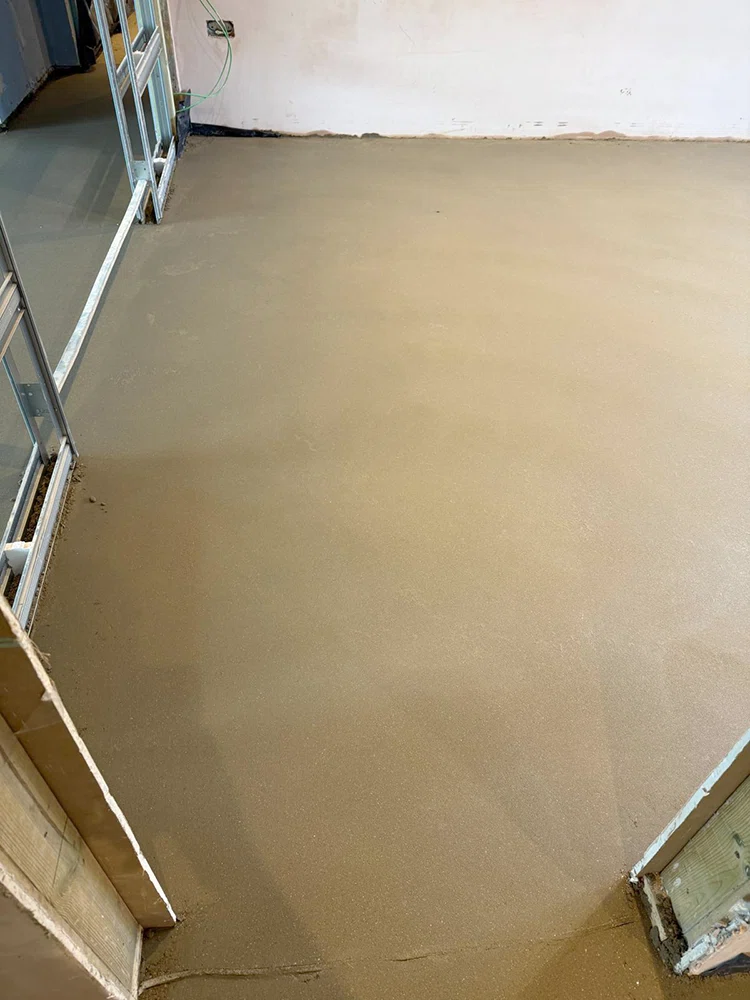
Sand and cement is mixed on site, so each room can have the depth it needs, which matters a great deal in an older house where the floor is rarely flat to start with. It is barrowed in, compacted by hand and floated to a dense finish, and it copes with narrow halls, chimney breasts and steps between rooms. It can also take fibres or a rapid drying additive, and fibre reinforced screed adds resistance to cracking.
Wet rooms, garages and small spaces in Polegate
A few rooms in any house must sit on cement, whatever goes down elsewhere. A level-access shower or wet room has to slope to its drain and cope with water, which rules out calcium sulphate. Sand and cement can be shaped to the fall by hand and tanked over afterwards.
Garages are another common case. Turning a Polegate garage into a room normally means lifting the floor with insulation and screed until it meets the house level; our garage floor screed guide sets out the layers. Floors that need to take load early, or that face heavier use, can be laid in a stronger mix.
What you give up is speed of drying. Allow about a day for each millimetre up to 40mm and longer after that, so a 65mm floor takes weeks before wood, vinyl or other moisture-sensitive flooring can be laid. If the kitchen fitter is booked soon, a faster drying screed mix cuts that down. If the finished floor still needs to be flatter for vinyl or LVT, a thin levelling compound over the new screed finishes the job.
Screeding a lived-in Polegate semi one room at a time
Semi-detached houses make up 49% of Polegate's homes and terraces another 13%, and in a house like that the ground floor is often relaid while the family carries on living upstairs. Sand and cement suits that, because it is laid in sections rather than in one continuous pour, so a hallway can be finished on one visit and the back room on the next.
The starting point is the level of the floor you are keeping. A datum is taken from the existing rooms and carried across the work area, and screed rails are set to that height so the new floor meets each threshold without a lip. Joints are formed at doorways, which is where a hand-laid floor would otherwise crack.
The mix is semi-dry. It holds together when squeezed but is nowhere near runny, and that is what lets it be compacted into a dense layer. Each section is placed in a size that can be compacted, ruled off and closed with a trowel before it starts to stiffen, and the cement content is set to how the room will be used.
The days after the pour matter as much as the day itself. A new screed is protected from fast drying for the first few days so it gains strength evenly, which means keeping doors shut, avoiding draughts and resisting the urge to put heaters on it. The finished rooms can then be used again in stages while the rest is completed.
Sand and cement screed prices in Polegate
Sand and cement screed: £18 to £25 per m² supplied and laid (MyJobQuote, August 2026), so £450 to £630 for 25 m². MyJobQuote does not say whether these figures include VAT. See our screed cost per m³ and per tonne guide or screed calculator.
Who lays your sand and cement screed in Polegate
K & B Screeding’s own team, led by director Donatas Bardisevicius. Founded 2019, company 12298780.
See what customers say in our Google reviews and on our testimonials page.
Sand and cement screed from Slough to Polegate
On the map, Polegate sits south-east of Slough, about 62.5 miles from our base in a straight line (postcodes including BN26), next to Hailsham (3 miles), Eastbourne (4.1 miles), Seaford (7.2 miles) and Newhaven (8.9 miles).
Where the screed pump must park in a marked bay in Polegate, a suspension or dispensation from East Sussex County Council (dispensations and suspensions) covers it; the quote tells you if it is needed. New floors in Polegate extensions usually need building regulations approval, with Part L insulation rules in England; the East Sussex Building Control Partnership is the council building control service.
More on sand & cement screed, part of our screeding services. For every screed we lay locally, see floor screeding in Polegate.
Further reading: screed thickness guide and sand and cement screed mix ratio.