
Garage and utility floors in Hailsham houses
Garage conversions are a natural sand and cement job. Garage slabs tend to be lower than the house floor, with no insulation and often a fall towards the door. For a habitable room, insulation and a membrane go down first, and the screed on top is set thick enough to meet the hallway floor. Our garage conversion floor guide goes through that build-up step by step.
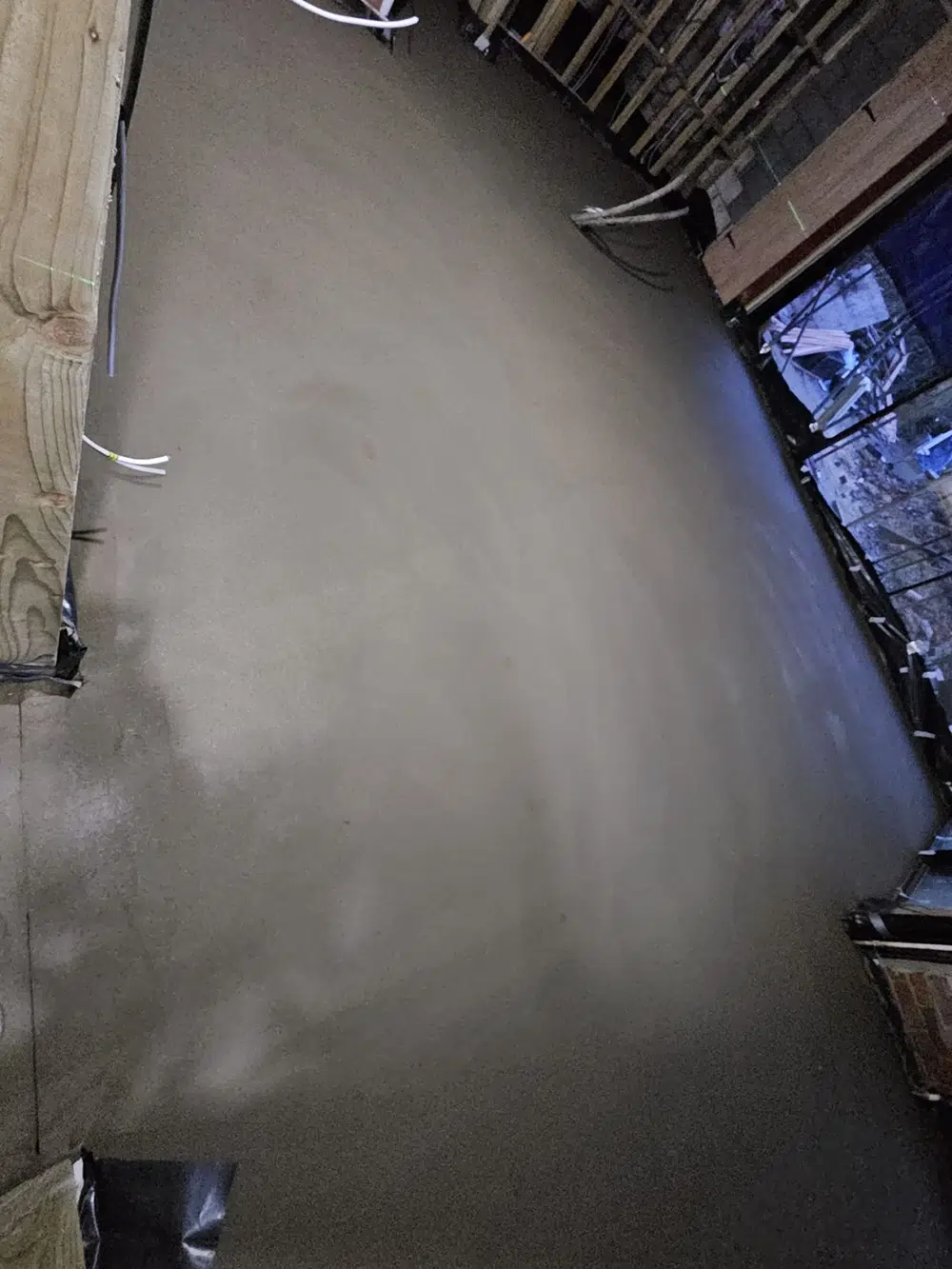
The screed is mixed on site to suit the depth and area, which makes it economical on small and awkward jobs where a pump would be underused. It is compacted and power floated to a dense surface ready for tiles or other finishes.
Depth depends on how it is laid. Laid floating on insulation, a house floor needs 65mm or more, and commercial floors 75mm. Where it is bonded to a clean, sound slab, 25 to 40mm is enough, handy when the floor has to meet a threshold that cannot move. On published 2026 figures, bonded screed costs £12 to £18 (trade2base, June 2026) a square metre and floating sand and cement £18 to £25.
Utility rooms and shower areas are the other place this screed belongs. Calcium sulphate screed does not tolerate prolonged wet, so floors where water may sit, or where a washing machine might leak, need a cement based screed. In a wet room we shape it so the surface falls to the drain.
For a floor that must take heavier loads, see our higher strength screed.
Replacing older solid floors across Hailsham
Hailsham has held a market since Henry III's charter of 1252, but its older houses are a small share of the whole. Only 5% of homes date from between 1919 and 1944. In houses of that age and older, a solid ground floor may have cracked, sunk or been laid without a damp proof membrane.
A repair that holds up means breaking the old floor out, insulating, adding a membrane and screeding over the top in sand and cement. Hand laying copes with small rooms, narrow halls and changes of level that would make a pumped screed awkward. Adding fibres to the mix, at £1 to £3 a square metre, helps control cracking.
Time is the catch. Compared with liquid screed it is slow to dry, and at 65mm you are waiting weeks rather than days before moisture sensitive flooring can be laid. If pipes run through it, leave the heating off for 21 days or more.
If you are deciding between the two types, our page on liquid screed in Hailsham sets out when a pumped floor is quicker. The same choice is covered for sand and cement screed in Uckfield.
Sand and Cement Screed prices in Hailsham
Sand and cement screed: £18 to £25 per m² supplied and laid (MyJobQuote, August 2026), so £450 to £630 for 25 m². MyJobQuote does not say whether these figures include VAT. See our floor screeding cost guide or screed calculator.
Who lays your sand and cement screed in Hailsham
K & B Screeding’s own team, led by director Donatas Bardisevicius. Founded 2019, company 12298780.
See what customers say in our Google reviews and on our testimonials page.
Sand and Cement Screed from Slough to Hailsham
Hailsham is about 60.5 miles south-east of our Slough base as the crow flies, with postcodes including BN27. The nearest towns to it are Polegate (3 miles), Eastbourne (6.8 miles), Seaford (9.5 miles) and Bexhill-on-Sea (9.5 miles).
More on sand & cement screed, part of our screeding services.