
Replacing ground floors in St Leonards and the Old Town
St Leonards-on-Sea was planned in the early nineteenth century, with Pelham Crescent and Wellington Square dating from the resort years, while the Old Town keeps its medieval core. Terraced houses make up 22% of the town's homes, and old houses on steep ground mean damp and uneven floors are common.
The lasting repair usually starts by taking the old floor out. A solid floor with no membrane, or a timber floor that has rotted, is removed and the ground dug down to make room. Then comes a new sub-base or slab, insulation, a damp proof membrane and finally the screed. The layers under the screed are handled by our insulation and membrane work.
These rooms are where a screed placed by hand pays off. Terraces have narrow halls, stepped floors and doorways that must line up with existing thresholds, and a screed that is compacted and floated by hand can follow all of that. The result is a cement base, and some floor finishes and every wet area need exactly that.
Depth is set by how it is laid. On insulation, a floating screed in a house needs 65mm or more, and 75mm in commercial buildings. Bonded straight onto a clean, sound slab, it can come down to 25 to 40mm. Floating sand and cement costs between £18 and £25 a square metre on published 2026 figures.
The trade-off is time. Compared with a liquid pour it takes far longer to dry, and at 65mm you are waiting weeks before moisture sensitive flooring can go down.
Wet rooms, small rooms and garages in Hastings
Some Hastings jobs are much smaller than a full ground floor. Small rooms are often cheaper to screed by hand than to set up a pump for, and in a tall Hastings house the back addition, a cloakroom or a basement room may be all that needs doing.
Shower floors show the reason most plainly. Calcium sulphate screed loses strength if it stays wet, so shower floors and wet rooms need a cement based screed, laid to falls towards the drain before the tanking and tiles go on.
A garage becoming a room needs its slab brought up to the level of the house, and the insulation and membrane go in beneath the new screed. Step by step, the garage conversion floor guide sets out that build-up. If you want extra crack control, fibres add £1 to £3 a square metre.
Sand and cement also takes early load better than a fresh calcium sulphate screed, which helps when following trades need to get on. If you are still choosing, our page on liquid screed in Hastings compares speed and access.
Sand and Cement Screed prices in Hastings
Sand and cement screed: £18 to £25 per m² supplied and laid (MyJobQuote, August 2026), so £450 to £630 for 25 m². MyJobQuote does not say whether these figures include VAT. See our floor screeding cost guide or screed calculator.
Who lays your sand and cement screed in Hastings
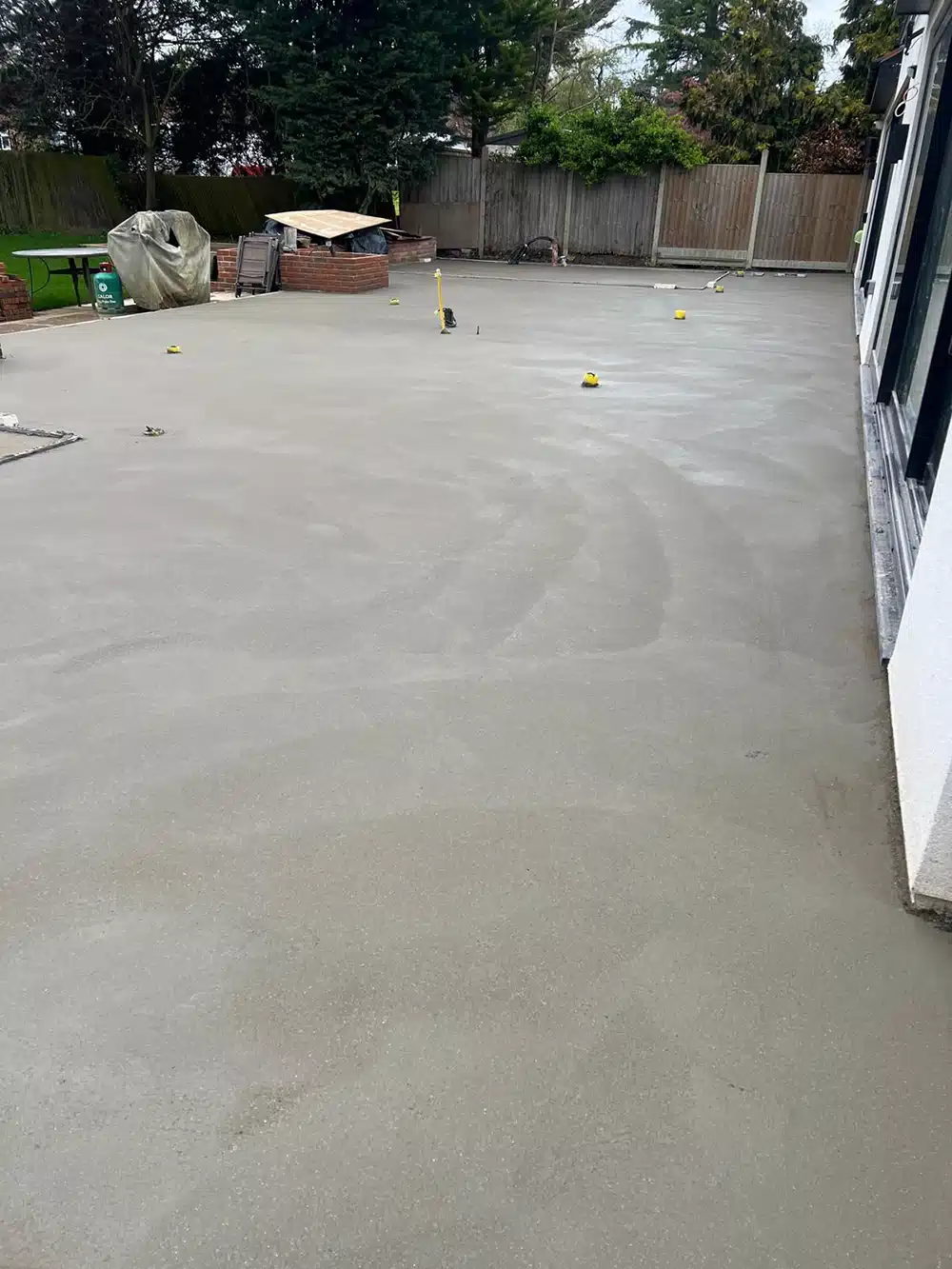
K & B Screeding’s own team, led by director Donatas Bardisevicius. Founded 2019, company 12298780.
See what customers say in our Google reviews and on our testimonials page.
Sand and Cement Screed from Slough to Hastings
As the crow flies, our yard in Slough is about 70.8 miles from Hastings, which lies to the south-east. Postcodes here include TN34, TN37, TN35 and TN38, and Bexhill-on-Sea (4.9 miles), Hailsham (14.2 miles), Eastbourne (14.7 miles) and Polegate (14.9 miles) are close by.
More on sand & cement screed, part of our screeding services.
