
Relaying original floors in Crowborough's resort-era houses
When Crowborough was sold as a health resort after 1868, houses went up with ground floors built to the standards of the day, and some of those original solid floors have no damp proof membrane. More than a century later, they may be cracked, uneven or damp, and flooring laid over them fails early.
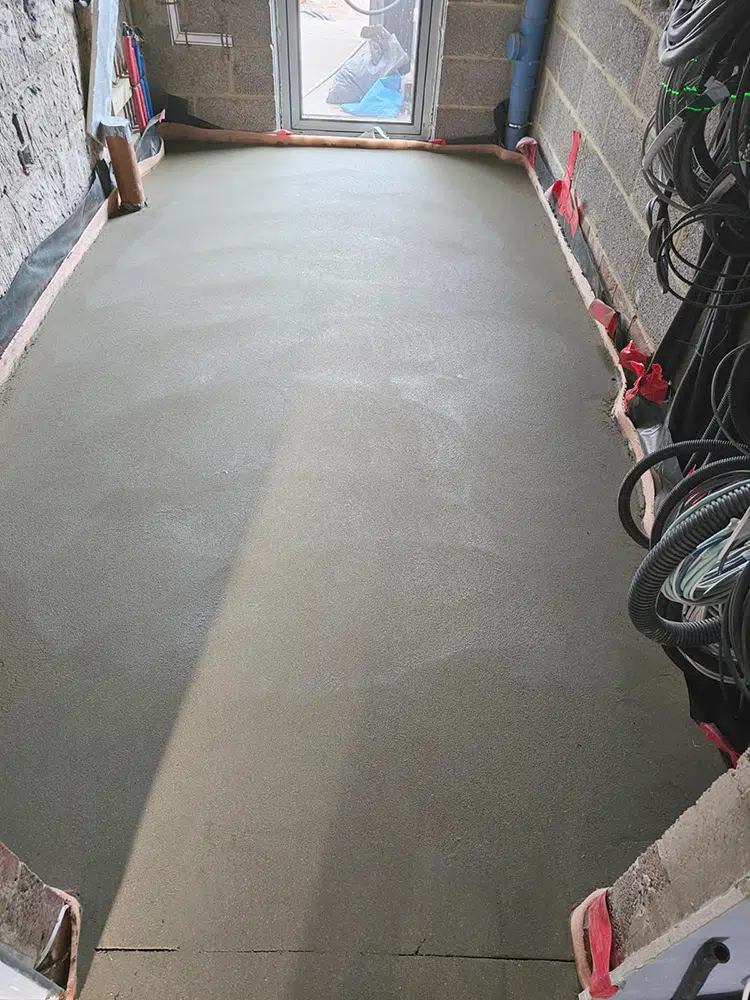
Relaying one is a sequence. The old floor is broken out, the base is made good, and a damp proof membrane goes down, lapped up the walls. On that goes the insulation, and on top a floating screed of sand and cement roughly 65mm thick. Those hidden layers can come from us as well; see insulation and membranes.
Why sand and cement rather than a pumped screed? Older houses tend to have smaller rooms, chimney breasts, bays and steps between rooms, and the screed has to be taken to slightly different levels in different places. Mixing on site lets us adjust the depth room by room, and compacting by hand gives a dense finish in tight corners. On a fiddly floor of a few square metres, it usually works out cheaper too.
Homes built between 1919 and 1944 add 8% to the older stock, and they can have the same failed solid floors. On any of these, the screed must dry before timber or LVT goes down, and a 65mm floor takes weeks. Rapid drying additives can shorten that; see quick drying screed.
Wet rooms, garages and bonded floors in Crowborough
Even in a house screeded with liquid elsewhere, certain rooms must be cement. Wet rooms and walk-in showers need a floor that tolerates water and slopes to the drain. Calcium sulphate cannot cope with that, whereas a hand-laid cement floor can be shaped to a slope that carries water to the gully.
Garage conversions are another use. Garage floors tend to sit a step lower than the hall, so making one into a room means packing it up with insulation, a membrane and screed until the levels match. We draw each layer of a converted garage floor in the garage floor screed guide.
Where the existing concrete is sound and height is tight, a bonded screed laid straight onto it can be 25 to 40mm thick, using a bonding agent so it acts with the slab. That is handy in a utility or cloakroom where doors cannot be trimmed.
A hand-laid floor takes longer to dry than a pumped one, so plan for it if you already have a date from the flooring fitter. If the new floor will be heated, read about underfloor heating screed in Crowborough for pipe cover and the 21 day wait before heating.
Sand and Cement Screed prices in Crowborough
Sand and cement screed: £18 to £25 per m² supplied and laid (MyJobQuote, August 2026), so £450 to £630 for 25 m². MyJobQuote does not say whether these figures include VAT. See our floor screeding cost guide or screed calculator.
Who lays your sand and cement screed in Crowborough
K & B Screeding’s own team, led by director Donatas Bardisevicius. Founded 2019, company 12298780.
See what customers say in our Google reviews and on our testimonials page.
Sand and Cement Screed from Slough to Crowborough
On the map, Crowborough sits south-east of Slough, about 47.8 miles from our base in a straight line (postcodes including TN6), next to Royal Tunbridge Wells (6.7 miles), Uckfield (6.9 miles), East Grinstead (8.6 miles) and Tonbridge (10.3 miles).
More on sand & cement screed, part of our screeding services.