
Hand-laid screed for older East Grinstead houses
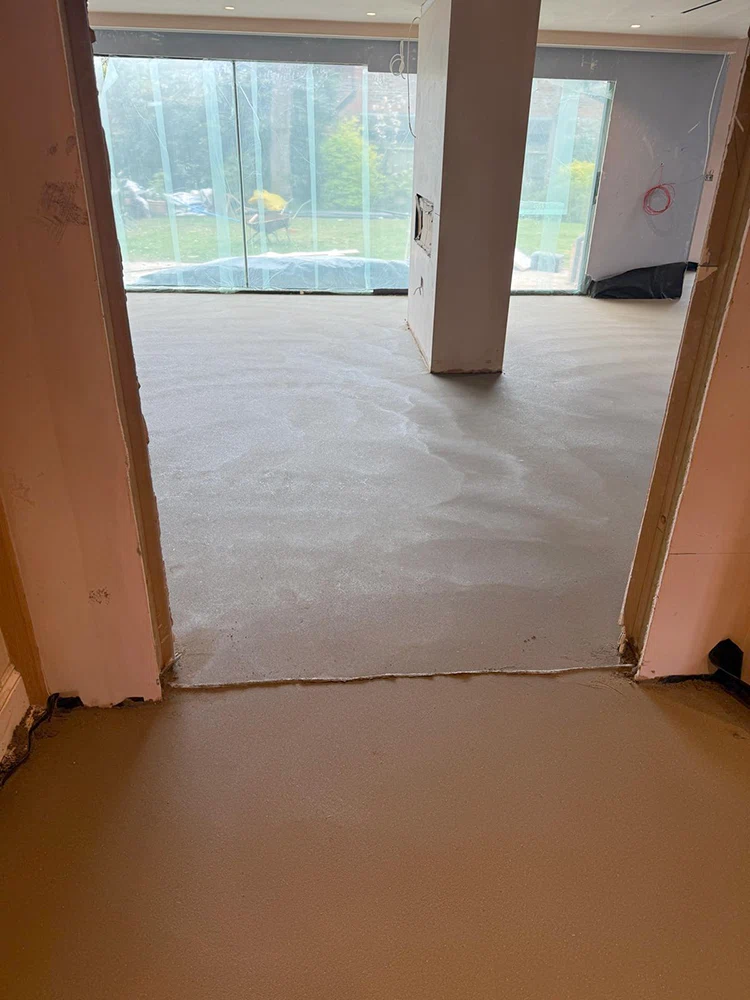
Older floors fail in predictable ways. A solid floor may crack, sink or lose its damp protection, and patching rarely lasts. When that happens, the old floor is broken out, a membrane and insulation fitted where height allows, and a new screed laid to the finished level. Sand and cement is the practical material for that kind of renovation because it is mixed in small batches and laid one room at a time, which suits narrow hallways and awkward layouts.
Homes from 1919 to 1944 add a further 9% to the town's older stock, and their floors raise similar questions when a kitchen is opened up or a room taken back to the slab. Floating over insulation, plan on about 65mm for a home, or 75mm where the building is commercial.
Timber-framed properties on and around the High Street are a different case. Their floors sit in old, sometimes uneven structures, and a thick, heavy screed may not suit them. A thin bonded screed, fixed to a sound base at 25 to 40mm, or a flexible levelling layer can be the better answer. Where only a few millimetres of correction is needed, levelling the existing floor avoids adding depth at all.
Whichever is right for your building, the floor beneath must be clean and sound before any screed goes on it. Our floor preparation work covers breaking out, cleaning and priming before any screed goes down.
Shower falls and garage conversions in East Grinstead
Showers and wet rooms want a floor that drops gently to the drain. Sand and cement can be shaped by hand to that fall, then tanked by the tiler, and it is the right material for a floor that may get wet, which calcium sulphate is not. In a house with a flowing screed elsewhere, the bathroom is often laid this way.
Turning a garage into a room means lifting its floor up to the house level over insulation and a membrane, and that can add a lot of depth. Traditional screed copes with that and takes load early. Our guide to screeding a garage floor sets out the layers that normally go in.
Mixes can be adjusted. Adding fibres, which help against cracking, costs an extra £1 up to £3 per m², while a quick drying mix, at £20 up to £28 per m², brings the flooring date forward. Ordinary sand and cement comes in at £18 up to £25 per m² in 2026 UK pricing.
Drying is the slow part. As a guide, count roughly one day for each millimetre over the first 40mm and longer beyond it, which keeps a 65mm floor in an East Grinstead house waiting several weeks for vinyl, timber or LVT. We check moisture with a hygrometer before the flooring goes down.
Sand and Cement Screed prices in East Grinstead
Sand and cement screed: £18 to £25 per m² supplied and laid (MyJobQuote, August 2026), so £450 to £630 for 25 m². MyJobQuote does not say whether these figures include VAT. See our floor screeding cost guide or screed calculator.
Who lays your sand and cement screed in East Grinstead
K & B Screeding’s own team, led by director Donatas Bardisevicius. Founded 2019, company 12298780.
See what customers say in our Google reviews and on our testimonials page.
Sand and Cement Screed from Slough to East Grinstead
As the crow flies, our yard in Slough is about 39.4 miles from East Grinstead, which lies to the south-east. Postcodes here include RH19, and Horley (7.5 miles), Crawley (7.9 miles), Crowborough (8.6 miles) and Oxted (9.3 miles) are close by.
More on sand & cement screed, part of our screeding services.
