
Calcium sulphate grades for East Grinstead apartments
A specification for anhydrite screed usually names a designation, not just a product. Each part of the code means something: CA is calcium sulphate, C gives the compressive strength and F the flexural strength, both measured in N/mm2. Lightly used domestic floors take CA-C20-F4. CA-C25-F5 is the general grade for houses, apartments and offices, and the one an apartment drawing will often show. CA-C30-F6 suits heavier use, such as busy shared areas or some commercial floors.
On a developer's plot, the grade is the engineer's decision and we pour exactly that. Where a thinner section or quicker drying is wanted, alpha hemihydrate products can be used instead, each to its own product sheet for depth and drying times.
The reason calcium sulphate suits apartments is its low shrinkage. Wide bays need few joints, so open-plan flats and long corridors are a good match. Joints are still put where the building calls for them, at doorways and wherever one heating zone meets the next, with the bay plan agreed before pouring.
Acoustic separation shapes the build-up in flats. The screed usually floats on insulation or a resilient layer, with an edge strip at every wall, so it does not bridge sound into the structure. For the material's background, read our anhydrite guide; typical floor build-ups are set out in a separate guide.
Queens Walk, West Street and drying checks
The 2006 Town Centre Master Plan pointed to retail and mixed-use redevelopment around Queens Walk and West Street, and mixed-use buildings often put homes above shops and offices. Calcium sulphate suits the flats and offices, but kitchens, wash areas and any floor that may stay wet need a cement based flowing screed or hand-laid sand and cement instead, because calcium sulphate weakens when wet.
Preparation before flooring is not optional. Calcium sulphate grows a thin, weak skin on its surface while it dries, known as laitance. With enough drying done, we sand the skin off and roll on a primer meant for calcium sulphate.
Moisture is then tested with a hygrometer. Flooring makers often set the moisture bar lower for calcium sulphate than for cement, which is why counting days is no proof. Where the flat is heated from the floor, the system can normally be used from about day 7 to force dry it. The flooring contractor gets our drying and laitance notes in writing, so they know what to check.
Anhydrite & Flow Screed prices in East Grinstead
Liquid flowing screed (which includes anhydrite): £24 to £31 per m² supplied and laid (MyJobQuote, August 2026), so £960 to £1,240 for 40 m². MyJobQuote does not say whether these figures include VAT. See our floor screeding cost guide or screed calculator.
Who lays your anhydrite and flow screed in East Grinstead
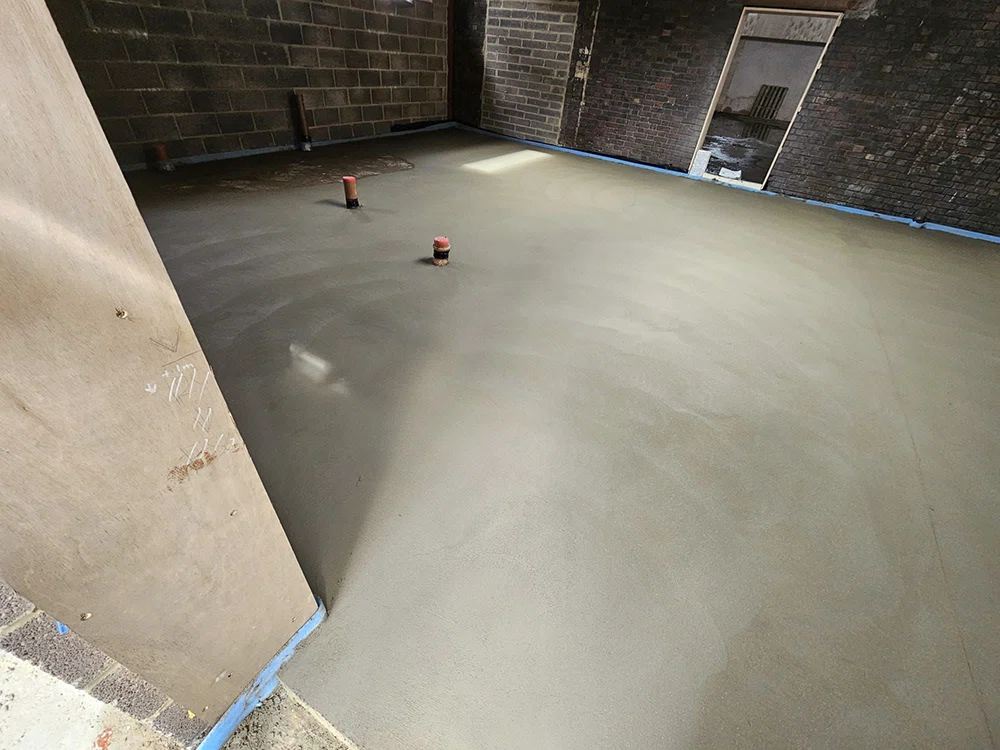
K & B Screeding’s own team, led by director Donatas Bardisevicius. Founded 2019, company 12298780.
See what customers say in our Google reviews and on our testimonials page.
Anhydrite & Flow Screed from Slough to East Grinstead
As the crow flies, our yard in Slough is about 39.4 miles from East Grinstead, which lies to the south-east. Postcodes here include RH19, and Horley (7.5 miles), Crawley (7.9 miles), Crowborough (8.6 miles) and Oxted (9.3 miles) are close by.
More on anhydrite screed, part of our screeding services.
