
Grades and products for Caterham apartment floors
Every calcium sulphate floor on a drawing carries a code. After the CA, the C number tells you how much it resists crushing and the F number how much it resists bending, each in N/mm2. Lightly used rooms in a house can take CA-C20-F4. Typical houses, flats and offices are specified CA-C25-F5. Harder wearing areas move up to CA-C30-F6.
On a Caterham block or new house it is normally the engineer who picks the grade, and we never swap it for something else. If the programme needs a quicker dry or the floor must be shallower, you may see an alpha hemihydrate product listed. Each comes with a data sheet, and its depth and drying figures are the ones we work to.
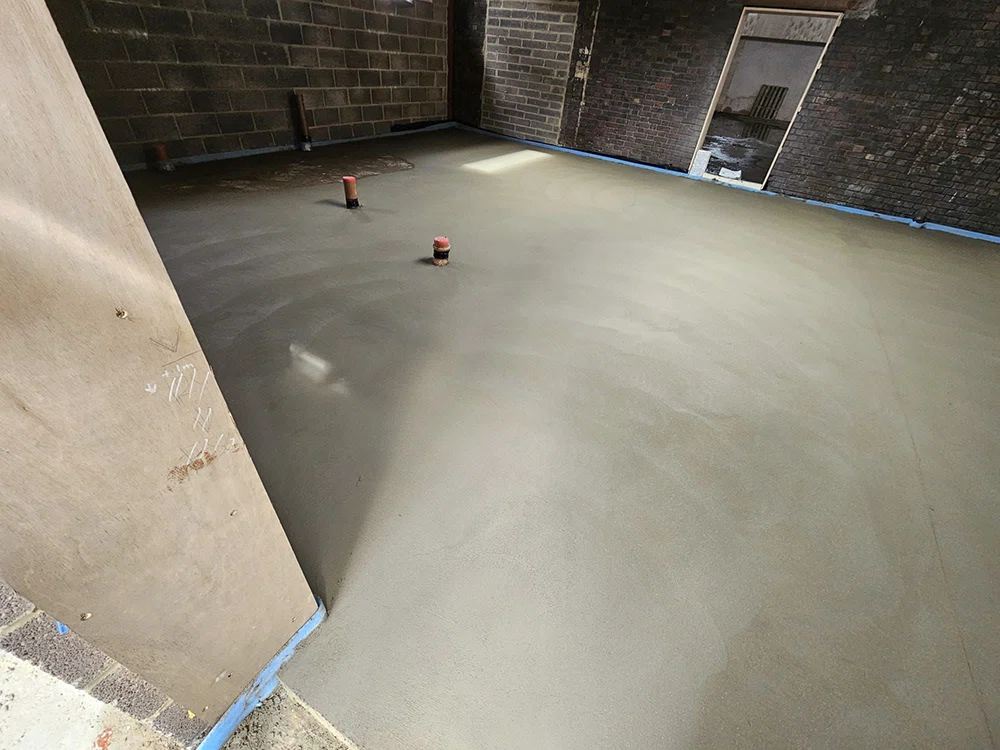
The appeal of the material is how little it shrinks. An open-plan flat or a new ground floor can go down in big bays with hardly any joints. The handful that are needed, across doorways and where heating zones change, are marked out in advance, not cut in afterwards.
In Caterham, 16% of homes were built between 2000 and 2014, and the barracks and hospital redevelopments on the Hill brought new homes alongside conversions of older institutional buildings. Where a new floor is specified in those buildings, the grade and joint plan are settled with the designer first. Our anhydrite screed guide gives more background, and flats with heated floors are covered on the underfloor heating screed page for Caterham.
Laitance and moisture checks in Caterham
Drying leaves a soft film on top of calcium sulphate, called laitance. Neither adhesive nor compound holds to that film properly, so when the floor is dry enough we sand it off and seal the surface with a primer made for calcium sulphate. Skip that step and tiles or LVT can come loose months down the line.
Moisture is the other check. Flooring makers often allow less moisture in calcium sulphate than in a cement floor, so a figure that would clear sand and cement can fail this one. A hygrometer reading, not the number of days, tells us where it stands. Where pipes run through it, the heating can normally help push the drying along from about day 7.
There is one place calcium sulphate should not go: anywhere that may stay wet. So a shower you step straight into, a wet room or a utility with a leaky machine gets a cement based flowing screed, or a hand-laid one sloped to the drain.
If the base needs attention first, such as old adhesive to remove or a new membrane, see our floor preparation service. For projects in a neighbouring town, we pour anhydrite screed in Croydon as well.
Anhydrite & Flow Screed prices in Caterham
Liquid flowing screed (which includes anhydrite): £24 to £31 per m² supplied and laid (MyJobQuote, August 2026), so £960 to £1,240 for 40 m². MyJobQuote does not say whether these figures include VAT. See our floor screeding cost guide or screed calculator.
Who lays your anhydrite and flow screed in Caterham
K & B Screeding’s own team, led by director Donatas Bardisevicius. Founded 2019, company 12298780.
See what customers say in our Google reviews and on our testimonials page.
Anhydrite & Flow Screed from Slough to Caterham
As the crow flies, our yard in Slough is about 30 miles from Caterham, which lies to the south-east. Postcodes here include CR3 and RH1, and Oxted (3.6 miles), Redhill (4.9 miles), Croydon (5.7 miles) and Reigate (6.3 miles) are close by.
More on anhydrite screed, part of our screeding services.
