
Anhydrite grades for Sutton flats and new plots
Plans for a new Sutton flat give the calcium sulphate a short grade code, which comes from the European standard that governs screed materials. Its C number, measured in N/mm2 like the F number, tells you how hard it is to crush, which is the compressive strength; F tells you how hard it is to bend, the flexural strength. For a home floor that sees little traffic, the CA-C20-F4 grade will do. CA-C25-F5 is the grade found in most houses, flats and offices, while CA-C30-F6 handles harder wear. For a flat in Sutton town centre or a house on a new build site elsewhere in the borough, the drawings decide which of those applies.
New blocks and new build plots have their grade fixed by the engineer, and that is what goes in. Occasionally the specification asks for an alpha hemihydrate product. Designers choose one when drying speed or a slimmer layer is the priority, and since it comes with its own product sheet for depth and drying, that sheet is what we follow.
The property that makes calcium sulphate popular is low shrinkage. Thanks to that, a flat or the open ground floor of a Sutton extension can go in as broad sections with very little jointing. Joints go only where needed, such as across a doorway or where two heating zones meet, and we mark out the bays before any screed arrives. How the screed gets pumped to the room is covered on the Sutton liquid screed page. There is more on how the material behaves in our anhydrite guide.
If calcium sulphate does not suit a floor, we offer a flowing screed made with cement.
Laitance, moisture and wet rooms in Sutton
A calcium sulphate floor in a Sutton flat or extension is not ready for flooring the day it can be walked on. Two checks come first.
Drying leaves a fragile surface layer, the laitance, which nothing sticks to well. Once the screed is far enough through drying, our crew sands that skin away and seals what lies beneath using a primer suitable for calcium sulphate bases. If the floor then needs smoothing for a thin sheet finish, floor levelling in Sutton goes on over that primer.
Moisture is the other test. For calcium sulphate, plenty of flooring makers set a tighter moisture threshold than for cement, so a floor can look dry and still not pass. A hygrometer gives the answer. In a heated flat or extension, running the pipes from around day 7 usually helps force the moisture out.
Keep it out of rooms that can get wet. Wet rooms, showers with level access and any utility room with a leak risk should be floored with sand and cement, or with flowing screed that uses a cement binder. If the existing base needs attention before any of this, see our floor preparation service.
Anhydrite & Flow Screed prices in Sutton
Liquid flowing screed (which includes anhydrite): £24 to £31 per m² supplied and laid (MyJobQuote, August 2026), so £960 to £1,240 for 40 m². MyJobQuote does not say whether these figures include VAT. See our floor screeding cost guide or screed calculator.
Who lays your anhydrite and flow screed in Sutton
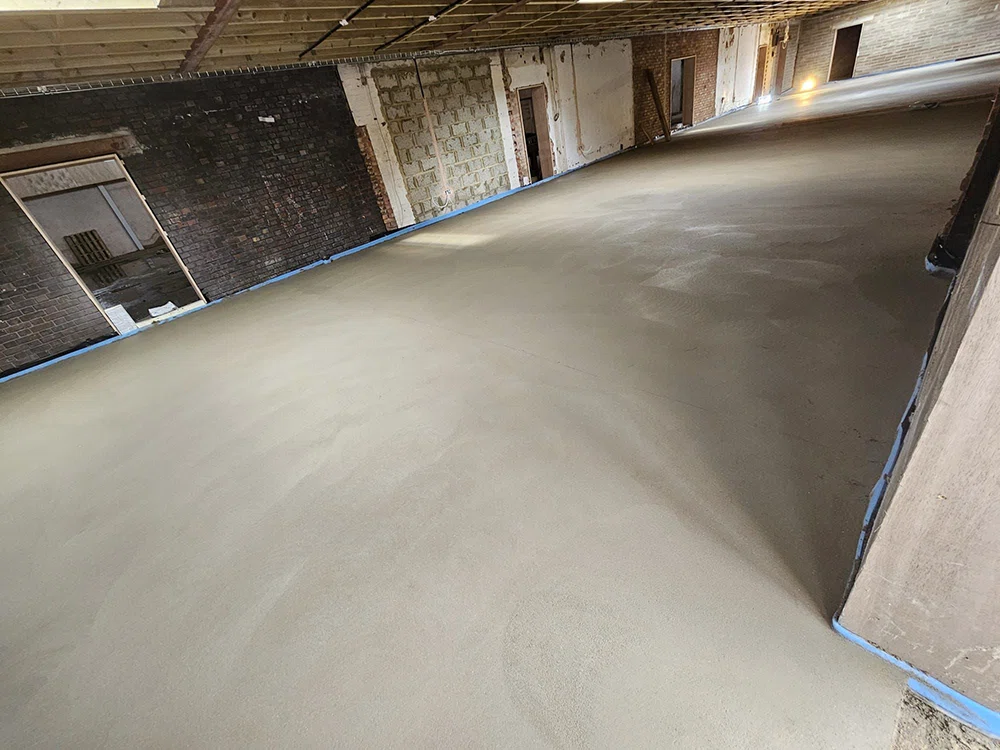
K & B Screeding’s own team, led by director Donatas Bardisevicius. Founded 2019, company 12298780.
See what customers say in our Google reviews and on our testimonials page.
Anhydrite & Flow Screed from Slough to Sutton
As the crow flies, our yard in Slough is about 23.6 miles from Sutton, which lies to the east-south-east. Postcodes here include SM6, CR0, CR4 and SM2, and Ewell (3.6 miles), Croydon (3.7 miles), Merton (3.7 miles) and Epsom (4.7 miles) are close by.
More on anhydrite screed, part of our screeding services.
