
Specifying anhydrite for Merton apartment blocks
About 28% of Merton's homes are in purpose-built blocks, and new apartment floors like those planned at High Path in South Wimbledon and at Eastfields and Ravensbury in Mitcham are where calcium sulphate screed tends to appear in a specification.
Each grade is a code for strength. On a drawing for a block like those at High Path, the figure after C is compressive strength in N/mm2, and the figure after F is flexural strength in the same unit. Light domestic traffic needs only CA-C20-F4, CA-C25-F5 is the everyday grade for homes, flats and offices, and CA-C30-F6 handles heavier loads.
The drawings set the grade, depth and build-up, and we stick to them; our own staff put down the insulation and membrane, and the bay and joint layout is decided before any screed is pumped. Because the material hardly shrinks, big bays need only a few joints, a good match for open-plan flats and heated floors.
Alpha hemihydrate products are another option on a specification. Specifiers reach for them when drying time or floor depth is tight, and each one follows its manufacturer's data sheet, not a blanket rule.
Any floor likely to get wet in service should not be calcium sulphate. Where that risk exists, a cement based flowing screed is specified instead. The material is explained at more length in what anhydrite screed is, and pumping and access are covered under Merton liquid screed.
Laitance and moisture checks before flooring in Merton
Drying anhydrite throws up a thin, weak crust on top, called laitance. It has to be removed. Once the floor has dried sufficiently, a sander takes the crust off and the dust is vacuumed up, so the primer and adhesive have firm material to bond to. If it stays, tiles and vinyl can lose their grip.
Moisture testing follows. The moisture limit is the trap: plenty of flooring brands set it lower for calcium sulphate than for cement, so a number that would pass on a cement floor can still fail here. A hygrometer test confirms when the limit is met. If heating pipes are in the floor, they can normally be used to force dry it from about 7 days, taking time out of a new block's programme.
The primer must be compatible with calcium sulphate, and the flooring contractor should check that their adhesive is approved for use on it. Our advice on drying and laitance is handed over on paper for the next trade.
Projects in Wandsworth, about 2.8 miles away, are covered on the Wandsworth anhydrite page.
Anhydrite where Morden and St Helier timber floors come out
Inter-war houses in Morden and on the St Helier estate have suspended timber floors that owners replace with insulated solid floors. When that solid floor is designed with underfloor heating, a calcium sulphate flow screed is one of the options for the top layer, and it brings some specific requirements.
The build-up starts well below the old boards. Once the timber and joists are out, the void is filled and consolidated, a slab or base is laid, and a damp proof membrane goes over it. That membrane matters more than usual, because calcium sulphate is weakened by persistent moisture, and the new floor sits where the ventilated void used to be. Laps are taped and the membrane is turned up at the walls so moisture cannot reach the screed.
Insulation goes on next, then the heating pipes fitted by your engineer, then the screed. Over the pipes it needs 25mm or more of cover, so 45 to 50mm in total is typical. That thinner section can help the new solid floor finish at the height the timber floor used to, so doors and the bottom stair still work.
Inter-war houses make up 37% of Merton's homes, more than any other age band, and replacing the ground floor is a good moment to settle which rooms may get wet. If the new layout includes a ground floor shower room or a utility at risk of leaks, that room takes a cement based flowing screed instead, with a joint at the doorway.
Anhydrite and flow screed prices in Merton
Liquid flowing screed (which includes anhydrite): £24 to £31 per m² supplied and laid (MyJobQuote, August 2026), so £960 to £1,240 for 40 m². MyJobQuote does not say whether these figures include VAT. See our liquid screed cost per m² guide or screed calculator.
Who lays your anhydrite and flow screed in Merton
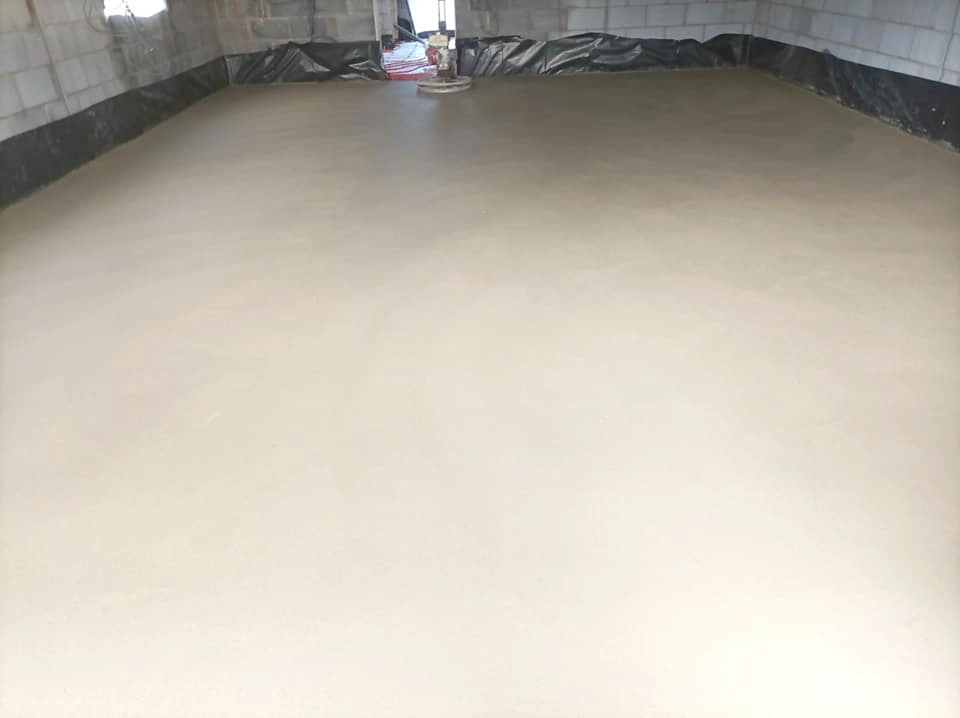
K & B Screeding’s own team, led by director Donatas Bardisevicius. Founded 2019, company 12298780.
See what customers say in our Google reviews and on our testimonials page.
Anhydrite and flow screed from Slough to Merton
Merton is about 20.6 miles east-south-east of our Slough base as the crow flies, with postcodes including SW20, SW19, SM4 and CR4. The nearest towns to it are Wandsworth (2.8 miles), Kingston upon Thames (3.4 miles), Sutton (3.7 miles) and Ewell (4.5 miles).
Where the anhydrite delivery must park in a marked bay in Merton, a suspension or dispensation from Merton Council (bay suspension and yellow line waiver) covers it; the quote tells you if it is needed.
More on anhydrite screed, part of our screeding services. For every screed we lay locally, see floor screeding in Merton.
Further reading: calcium sulphate screed guide.
