
Reading an anhydrite specification for Epsom flats and plots
Plans for an Epsom apartment block or new house generally give a code like CA-C25-F5. Under the European screed standard, the C figure is the compressive strength and the F figure the flexural strength, in N/mm2.
Three grades cover most work. The lightest grade, CA-C20-F4, suits home floors that see little traffic. In the middle, CA-C25-F5 is right for the majority of homes, flats and office floors. CA-C30-F6 sits at the top for floors that work harder. Whatever grade the engineer chooses is the grade that goes in.
Alternatively, a specification may call for an alpha hemihydrate product, used when drying needs to be quicker or the layer thinner; each has its own product sheet, which takes priority over general rules. In a conversion where the floor height is fixed, or a programme where flooring must go down early, that can be the deciding factor.
Low shrinkage is the practical benefit. Few joints are needed even in large bays, so a whole flat or an open-plan ground floor is poured in a single visit. We still put joints in at door thresholds and where heating zones meet, with the bay layout drawn up ahead of the pour. The whole build-up, including insulation and edge strip, is prepared by our own team.
About 16% of Epsom's homes were built between 2000 and 2014, and newer plots like those are where these specifications appear. For more on the material itself, read what anhydrite is and how it behaves.
Laitance and moisture on Epsom anhydrite floors
Calcium sulphate screed leaves a job to do after it dries. While it cures, a fragile film called laitance builds up on the surface, and adhesive will not hold onto it reliably. Once it is dry enough, that film is sanded away and the floor is primed using a product suited to calcium sulphate. Skip it, and loose tiles or lifting LVT often follow.
Moisture testing sets the date for flooring. We take a hygrometer reading and hold it against the figure the flooring maker gives, because many makers set a lower moisture ceiling for calcium sulphate than they do for cement. A heated floor can normally be force dried with its own system once it is about 7 days old.
Its one firm restriction is water: keep it away from any floor likely to get wet. For bathrooms, shower rooms and utility floors in a new flat, a cement based flowing screed is the alternative, or hand-laid sand and cement for Epsom wet rooms.
Converted buildings may also have old floors that need attention before any new screed goes down, and floor preparation covers that. Flow screed is also poured in Kingston upon Thames.
Anhydrite & Flow Screed prices in Epsom
Liquid flowing screed (which includes anhydrite): £24 to £31 per m² supplied and laid (MyJobQuote, August 2026), so £960 to £1,240 for 40 m². MyJobQuote does not say whether these figures include VAT. See our floor screeding cost guide or screed calculator.
Who lays your anhydrite and flow screed in Epsom
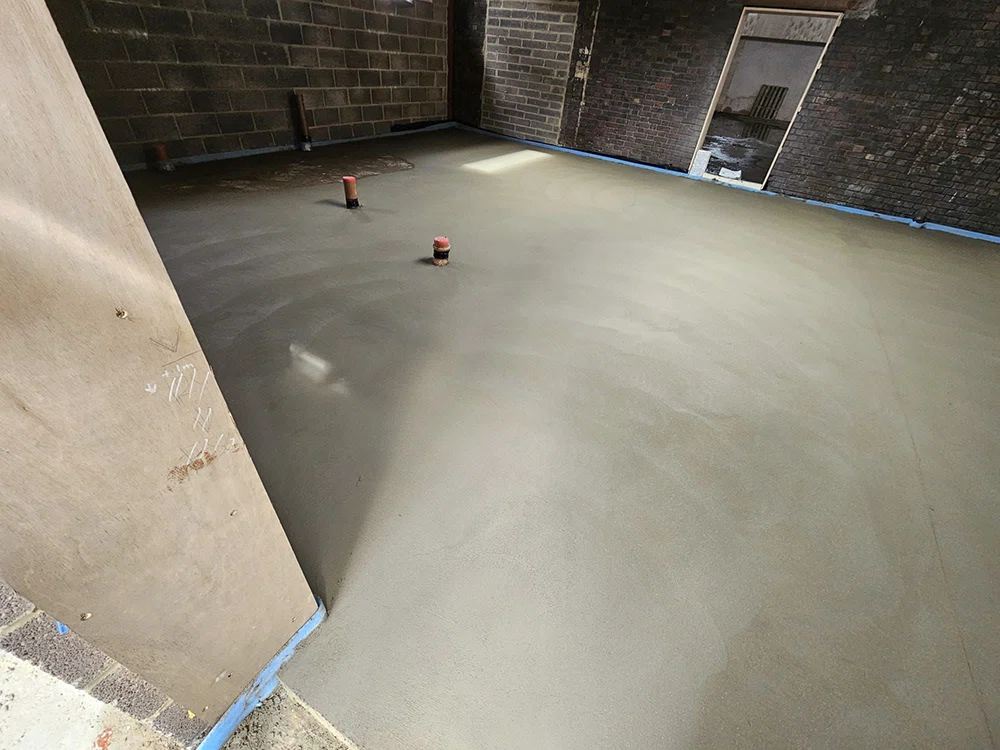
K & B Screeding’s own team, led by director Donatas Bardisevicius. Founded 2019, company 12298780.
See what customers say in our Google reviews and on our testimonials page.
Anhydrite & Flow Screed from Slough to Epsom
As the crow flies, our yard in Slough is about 21.3 miles from Epsom, which lies to the south-east. Postcodes here include KT19 and KT18, and Ewell (1.4 miles), Leatherhead (3.8 miles), Kingston upon Thames (4.1 miles) and Sutton (4.7 miles) are close by.
More on anhydrite screed, part of our screeding services.