
Liquid screed in Epsom's interwar extensions and new homes
An interwar house with a new extension is the classic case for liquid screed. The old back room and the new space become one floor, and pouring it in one go avoids the slight changes of level that come from laying it in sections.
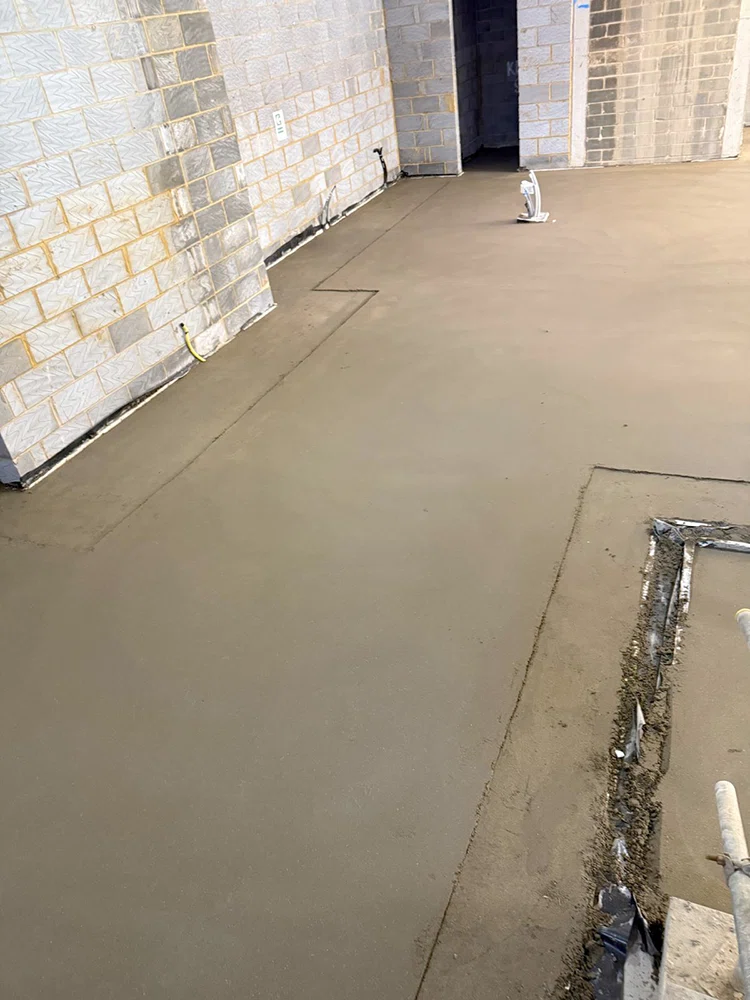
Why pumped rather than hand-laid? The screed arrives mixed, runs through a hose into the room and is levelled while still fluid. It settles flat enough to meet SR1 or SR2 without fuss, the kind of base LVT and big tiles ask for. It shrinks little, so bays can be large, and it encapsulates heating pipes without voids.
A house floor floated on insulation can be poured from about 35mm thick; a commercial one starts at about 40mm. Over underfloor heating, at least 25mm of cover is needed above the pipes, which puts the total at 45 to 50mm.
Epsom has newer homes to consider as well. Around 16% of its homes were built between 2000 and 2014, and at Horton the former hospital land now carries new build houses alongside conversions. New build plots often use a flowing screed, either calcium sulphate or cement based. Which one suits depends on the rooms: calcium sulphate for dry areas, cement based where the floor may get wet. What the calcium sulphate grades mean is on the Epsom anhydrite screed page, and if you are still deciding between pumped and hand-laid, our side-by-side screed comparison may help.
Pumping screed to Epsom houses and upper floor flats
Everything on a liquid pour depends on getting the hose to the room. We park the mixer and pump in the road or on your drive, then run the hose through the house or down the side to the back extension. A driveway makes that simple. Where the street has parking controls, or the only route is through a terraced house, tell us when you ask for a price so the plan is agreed.
Flats are a large part of Epsom's housing, at 33% of homes. A hose can climb a stairwell to an upper floor, so a flat being stripped back and rebuilt can take a pumped screed with no barrowing. The managing agent will usually want to approve the route and the protection of common parts first.
The pour is quick, and the room is walkable within 24 to 48 hours. Drying takes far longer: count on roughly 40 days to dry the first 40mm, then more beyond that. As for cost, the published 2026 range for liquid screed is £24 to £31 per square metre.
Builders who only need a pump and crew can use our screed pumping for contractors. The same pumped floors are laid in nearby Ewell.
Liquid Screed prices in Epsom
Liquid screed: £24 to £31 per m² supplied and laid (MyJobQuote, August 2026), so £960 to £1,240 for 40 m². MyJobQuote does not say whether these figures include VAT. See our floor screeding cost guide or screed calculator.
Who lays your liquid screed in Epsom
K & B Screeding’s own team, led by director Donatas Bardisevicius. Founded 2019, company 12298780.
See what customers say in our Google reviews and on our testimonials page.
Liquid Screed from Slough to Epsom
As the crow flies, our yard in Slough is about 21.3 miles from Epsom, which lies to the south-east. Postcodes here include KT19 and KT18, and Ewell (1.4 miles), Leatherhead (3.8 miles), Kingston upon Thames (4.1 miles) and Sutton (4.7 miles) are close by.
More on liquid screed, part of our screeding services.