
Latex over mixed floors in Epsom's interwar homes
Homes built between 1919 and 1944 make up 23% of Epsom, and a house of that age has usually been refitted more than once. When the kitchen or bathroom comes out, the floor underneath can be a mixture: tiles in one corner, a patch of concrete where something was once taken out, boards in a back room. A thin sheet finish laid over that would show every edge within weeks.
Latex screed is the trade's answer. It comes in two parts, a cement based powder and a latex liquid that is used instead of water, and it goes down a few millimetres thick. It hides joints, patches and small ridges, giving sheet vinyl, LVT, lino, rubber or carpet a smooth face. It adds no strength to a weak floor and is not a screed in the structural sense.
Each part of that mixed floor is judged on its own. Timber is acceptable only after it has been screwed down and overlaid with flooring grade plywood, because latex spread on bare boards cracks as they move. Concrete must be sound, clean and dry. Old tiles can stay if every one is firmly bonded, and thin adhesive that still grips can usually be left.
Where a base carries ridges, paint or a sealer, grinding the floor back clears it before priming. Each surface then takes a primer suited to it, and any calcium sulphate screed has its laitance sanded away and is always primed.
When latex will not do in Epsom homes
Some floors need more than a thin coat, and it is better to know before the flooring is ordered.
Damp is the first check. Near the centre, some older Epsom homes were built on solid floors without a damp proof membrane, and latex does nothing to hold back moisture from below. A damp floor is dug out and relaid instead, as our Epsom sand and cement page explains.
Movement is the second. Boards that bounce are refixed and stiffened first, because no thin coat survives a moving floor. The third is a room badly out of level: a few millimetres cannot take out a fall across the floor, so low areas are screeded first, with screed repairs for broken patches.
Converted flats alone are 5% of Epsom's homes, and on an upper floor a product mixed on site in small batches is easy to carry up the stairs. At Horton, where former hospital buildings have been turned into homes, the same checks come before any smoothing layer.
For how compound compares with a new screed, and how flat your covering needs the floor, see our Epsom floor levelling page. Latex smoothing is also offered in Reigate.
How we price latex screed in Epsom
A fixed written price within 24 hours, once we know the area and the base. See our floor screeding cost guide.
Who lays your latex screed in Epsom
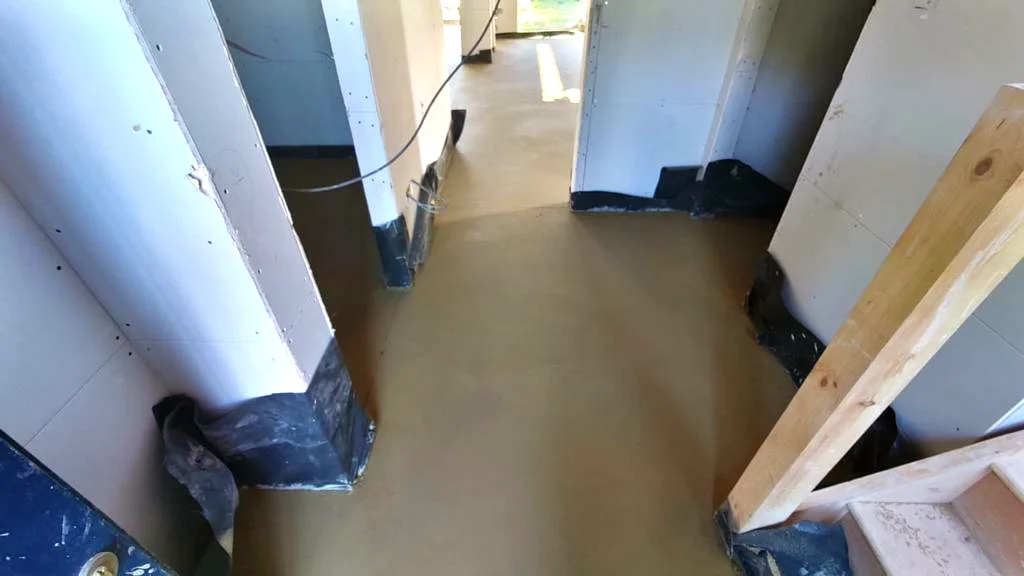
K & B Screeding’s own team, led by director Donatas Bardisevicius. Founded 2019, company 12298780.
See what customers say in our Google reviews and on our testimonials page.
Latex Screed from Slough to Epsom
As the crow flies, our yard in Slough is about 21.3 miles from Epsom, which lies to the south-east. Postcodes here include KT19 and KT18, and Ewell (1.4 miles), Leatherhead (3.8 miles), Kingston upon Thames (4.1 miles) and Sutton (4.7 miles) are close by.
More on latex screed, part of our screeding services.
