
Latex for refits in Merton's semis and terraces
Semi-detached houses make up 19% of Merton's homes. In houses like these, and in the borough's Victorian terraces, a kitchen or bathroom refit rarely hands the flooring fitter a clean slab. Lift the old covering and you may find plywood laid by a previous owner, a patchwork of quarry tiles and concrete, or a slab pitted where fittings were taken out.
Latex is made for mixed bases like that. The powder is cement based, but the liquid it is mixed with is latex, not water, and that gives the set layer a touch of flexibility and a firm grip on surfaces such as ply and glazed tile. Spread a few millimetres thick, it hides joints, grout lines and small hollows so that a thin covering lies flat.
Timber floors need care. Where an older house keeps its suspended timber floor, the boards are fixed down firmly and covered in screwed flooring grade plywood first; latex never goes straight onto bare boards, because the gaps and seasonal movement would crack it. The plywood is primed, then the latex spread across it.
Tiles can often stay. Old quarry or ceramic tiles that are still firmly stuck are cleaned, any hollow ones lifted and filled, and the surface primed with a product meant for tiles. That avoids breaking out a floor that is otherwise sound, which is welcome in a small bathroom where demolition dust would travel through the house. If old adhesive needs stripping first, see Merton floor grinding.
Checking a floor in Raynes Park or Mitcham first
Whether the house is in Raynes Park, Merton Park, Mitcham or West Barnes, the base is tested before latex is suggested, because a thin layer only performs as well as what lies under it.
Spring is the first test. A floor that bounces will crack the latex along the joists, so loose or weak boards are fixed and overboarded before anything else. Moisture is the second. Where a Victorian terrace in the borough gains a kitchen extension, a membrane is often needed underneath, and damp coming up through an unprotected slab will lift any compound and the flooring with it. Latex does not stop damp; a membrane and new screed do. Level is the third. If a floor drops away across the room by more than a few millimetres, a screed or a deeper levelling product must go down first.
A primer goes on before the latex every time, picked to suit the base. Any calcium sulphate screed must have its laitance sanded off and be primed, otherwise the latex will not hold.
If your question is really about flatness classes and whether compound or screed suits a floor, our Merton floor levelling page covers it. Damaged areas are put right through screed repairs, and for a job over the border, see latex screed in Sutton.
How we price latex screed in Merton
A fixed written price within 24 hours, once we know the area and the base. See our floor screeding cost guide.
Who lays your latex screed in Merton
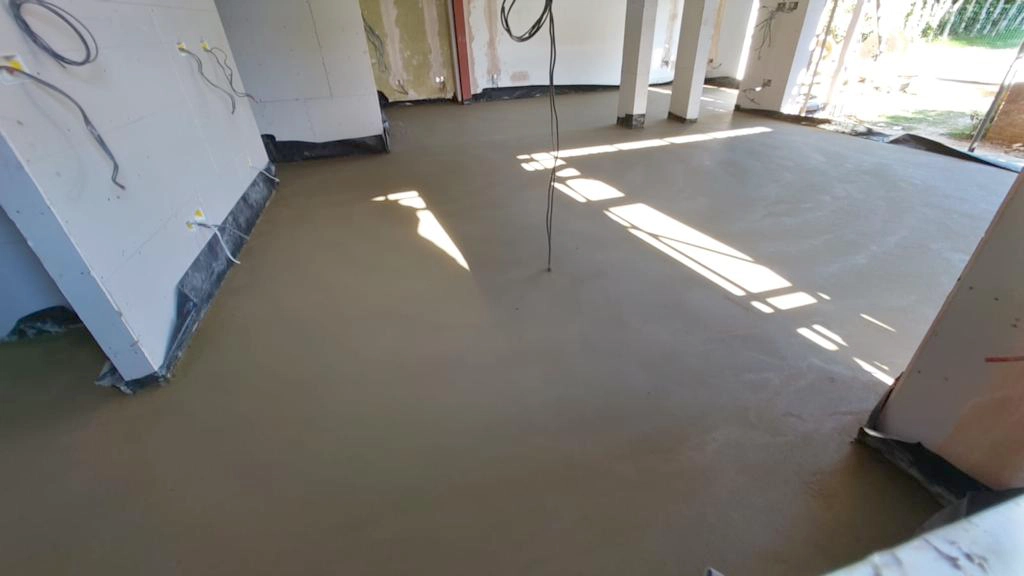
K & B Screeding’s own team, led by director Donatas Bardisevicius. Founded 2019, company 12298780.
See what customers say in our Google reviews and on our testimonials page.
Latex Screed from Slough to Merton
Merton is about 20.6 miles east-south-east of our Slough base as the crow flies, with postcodes including SW20, SW19, SM4 and CR4. The nearest towns to it are Wandsworth (2.8 miles), Kingston upon Thames (3.4 miles), Sutton (3.7 miles) and Ewell (4.5 miles).
More on latex screed, part of our screeding services.
