
Latex over plywood in Wandsworth flat conversions
When a house is split into flats, the upper floors are usually timber, and the new kitchens and bathrooms need a smooth base for vinyl, LVT or lino. Those floors also have to meet sound insulation rules between the flats, so the acoustic build-up is designed first and any latex goes on as the very last layer.
The order of work never changes. Loose boards are fixed so nothing creaks or flexes. Flooring grade plywood is then screwed across the whole area at close centres, with the joints staggered. Bare floorboards are never latexed directly, because they move with the seasons and the compound would crack along every joint.
Once the ply is down and primed, the latex is mixed. It is a cement based powder blended with latex liquid in place of water, and it flows out to a few millimetres, burying screw heads and sheet edges. A thin finish laid over it shows nothing of the timber beneath.
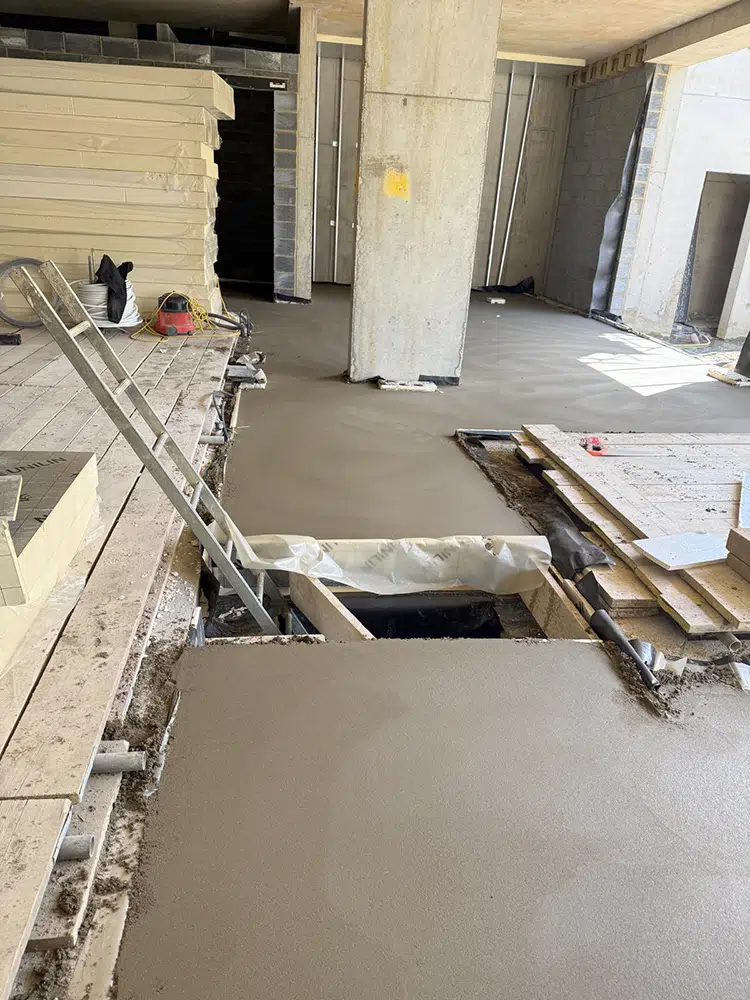
This is a finishing layer, so it relies on what is below. If a joist has dropped or the floor sags across the room, the structure or the boarding is put right first. If a section of floor is being rebuilt anyway, a screed repair may be the more sensible step.
Shops have a similar need. Retail around Clapham Junction and units at New Covent Garden Market may take safety flooring or sheet vinyl after a refit, and latex over sound concrete or firmly fixed tiles gives that finish the smooth face its maker asks for.
Sound bases and failing ones in Wandsworth homes
Latex works over a short list of bases, and each one is checked before it is used. Old quarry or ceramic tiles must be stuck fast: tap them, and any hollow note means that area comes up. Old concrete must be hard and free of dust, and old adhesive must be thin, sound and well bonded. Every base gets the primer intended for it, and a calcium sulphate screed has its laitance sanded off before priming.
Damp is the main reason to stop. Ground floors in pre-1919 houses often lack a membrane, and a thin compound will not keep rising moisture out of a new floor. Those floors usually need a full rebuild with membrane, insulation and sand and cement screed, and latex has no place in that fix.
The second reason is level. Latex smooths texture; it does not take out a hollow or a slope. Where an extension floor and an original floor finish at different heights, a self levelling compound for the join or new screed comes first, with latex kept for the final few millimetres if the finish needs it.
Basements are worth a mention too. Even when dry today, a floor below ground needs its waterproofing checked before any thin finishing layer goes down. Just over the boundary? See latex screed in Merton.
How we price latex screed in Wandsworth
A fixed written price within 24 hours, once we know the area and the base. See our floor screeding cost guide.
Who lays your latex screed in Wandsworth
K & B Screeding’s own team, led by director Donatas Bardisevicius. Founded 2019, company 12298780.
See what customers say in our Google reviews and on our testimonials page.
Latex Screed from Slough to Wandsworth
On the map, Wandsworth sits east-south-east of Slough, about 20.8 miles from our base in a straight line (postcodes including SW12, SW11, SW4 and SW18), next to Merton (2.8 miles), Lambeth (2.9 miles), Hammersmith and Fulham (3.7 miles) and Kensington and Chelsea (3.8 miles).
More on latex screed, part of our screeding services.
