
Latex over plywood and tiles in Lambeth conversions
Latex screed takes its name from the liquid. Instead of stirring the powder into water, the fitter mixes it with a latex additive, and the result cures with a little flexibility that ordinary compound lacks. That small amount of give is why it is chosen for bases that move very slightly or that a water mixed product would not grip well.
Upper floors in the borough's converted houses are normally timber. Bare floorboards are never a base for latex: they flex, they shrink across their width and the gaps let compound run straight through. The right order is to screw flooring grade plywood down over the boards, prime it and then spread latex across the sheets and their joints. Done that way, a kitchen or bathroom in a flat above a neighbour gets a smooth, slightly flexible skin that sheet vinyl or LVT can be glued to.
Ground floors bring different problems. In Lambeth, 14% of homes date from 1919 to 1944, and kitchens and hallways in houses of that age and older can hide quarry or ceramic tiles under later lino. When those tiles are firmly stuck, latex can go over them after cleaning and the correct primer, which saves breaking out a floor that is still doing its job. Any tile that sounds hollow is lifted first and the hole filled.
Old adhesive left behind when carpet or vinyl comes up can sometimes stay, if it is thin, hard and well bonded. Thick or soft residue has to be taken off by machine, as our concrete floor grinding page explains.
Checks before latex in Stockwell, Clapham and Streatham
Latex is a finishing layer, not a cure. Before any is mixed, the base under it gets three checks, wherever the flat or house sits, from Stockwell and Clapham down to Streatham Hill and Streatham Vale.
The first is movement. If boards bounce underfoot, latex will crack along the joists within months, so the floor is fixed and overboarded before anything thin goes on. The second is damp. A ground floor slab with no membrane, a known weakness of the borough's older houses, pushes moisture into the compound and the covering above it. Latex does nothing to stop that, and the floor may need a membrane and a rebuilt sand and cement floor instead. The third is level. Because latex is laid only a few millimetres thick, a floor that falls badly across the room needs a new screed, not extra compound.
Primer comes next, and it depends on the base. Plywood, tiles and concrete each take their own, and any calcium sulphate screed must have its laitance sanded off and be primed before latex goes near it.
If your floor is sound but simply uneven and the real question is flatness, the Lambeth floor levelling page is the better read. Over the border, see latex work in Southwark.
How we price latex screed in Lambeth
A fixed written price within 24 hours, once we know the area and the base. See our floor screeding cost guide.
Who lays your latex screed in Lambeth
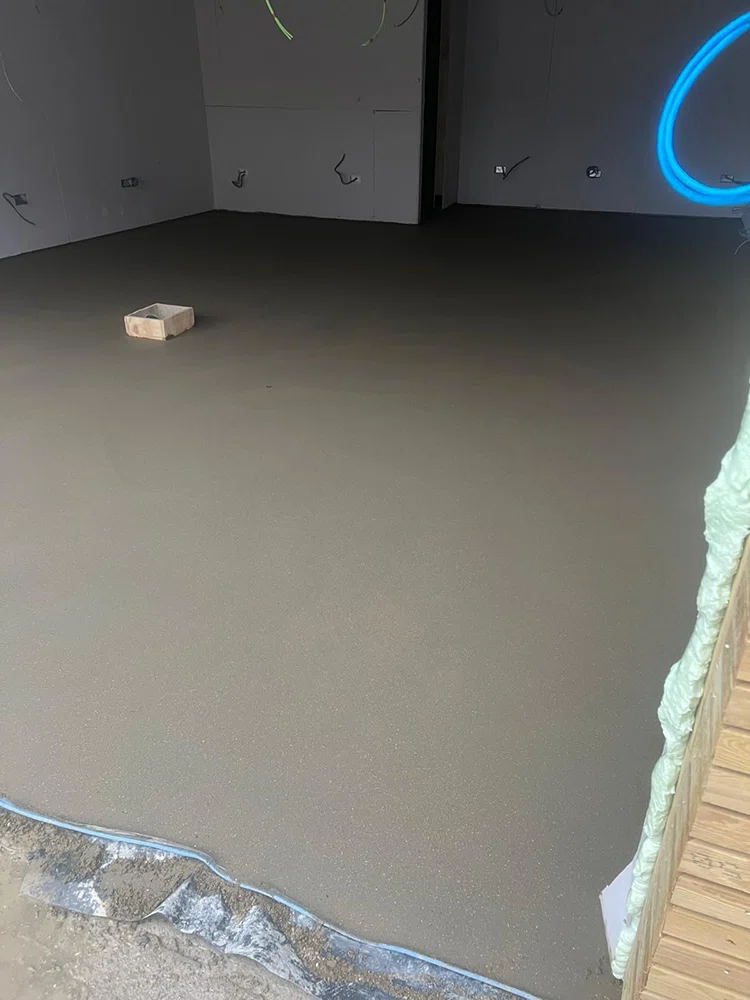
K & B Screeding’s own team, led by director Donatas Bardisevicius. Founded 2019, company 12298780.
See what customers say in our Google reviews and on our testimonials page.
Latex Screed from Slough to Lambeth
Lambeth is about 23.3 miles east-south-east of our Slough base as the crow flies, with postcodes including SW9, SE24, SW4 and SW8. The nearest towns to it are Southwark (2.1 miles), Wandsworth (2.9 miles), Lewisham (4.2 miles) and Westminster (4.3 miles).
More on latex screed, part of our screeding services.