
Heated floors in Vauxhall towers and Brixton conversions
Underfloor heating and acoustic floors come up together in Lambeth because so many homes stack above one another. The screed over the pipes sits on insulation and a sound-reducing layer, and every part of that build-up has to be right for the heating to work and the neighbour below to stay quiet.
In a newer block, the floor is usually designed around the system from the start. Roughly 10% of Lambeth's housing went up between 2000 and 2014, and homes from those years were often designed with room in the floor for insulation, pipes and a liquid screed. Poured liquid wraps every pipe with no gaps of trapped air, so warmth travels evenly through the floor and it heats up sooner.
Conversions are harder. In a Victorian house split into flats, floor height is often tight, especially where a new floor meets old skirting, doors and stairs. Over the pipes, liquid screed must be 25mm deep at a minimum, giving a total of about 45 to 50mm. Sand and cement, packed by hand, needs roughly 45mm over the pipework, making the whole build-up deeper. Where height is short, the thinner liquid option is often the only one that fits.
Your heating firm puts the pipes in and pressure tests them before we arrive. We then check the edge strip, membrane and insulation, which we can supply through our insulation and membranes service, before the pour.
Switching the heating on in a Lambeth flat
A new screed has to dry before the heating is used hard, and the timing depends on the material. A calcium sulphate pour will usually take gentle heat after about 7 days. With sand and cement, nothing should run through the pipes for 21 days.
Begin with a low flow temperature and lift it by a few degrees each day, keeping to the manufacturer's warm-up schedule. The warm-up helps drive moisture out and lets the screed adjust gradually. Turn the thermostat right up on the first day and the screed may crack. Write down each day's temperature, as whoever fits the flooring may want to see the record.
Flooring waits for a moisture test and only goes down once the reading passes. Tiles, LVT and engineered boards all have limits, and the screed type affects which limit applies. Our guide to screed drying times explains what slows or speeds this stage.
Only 8% of Lambeth homes date from 2015 or later, so most heating projects here start from an existing floor. If you are weighing the pumped option for one of those, the liquid screed page for Lambeth covers access and flatness. Lewisham, about 4.2 miles away, has its own page on heated screed.
Underfloor Heating Screed prices in Lambeth
Liquid screed over underfloor heating: £20 to £35 per m² supplied and laid (trade2base, June 2026), so £700 to £1,230 for 35 m². trade2base gives these figures excluding VAT. See our floor screeding cost guide or screed calculator.
Who lays your underfloor heating screed in Lambeth
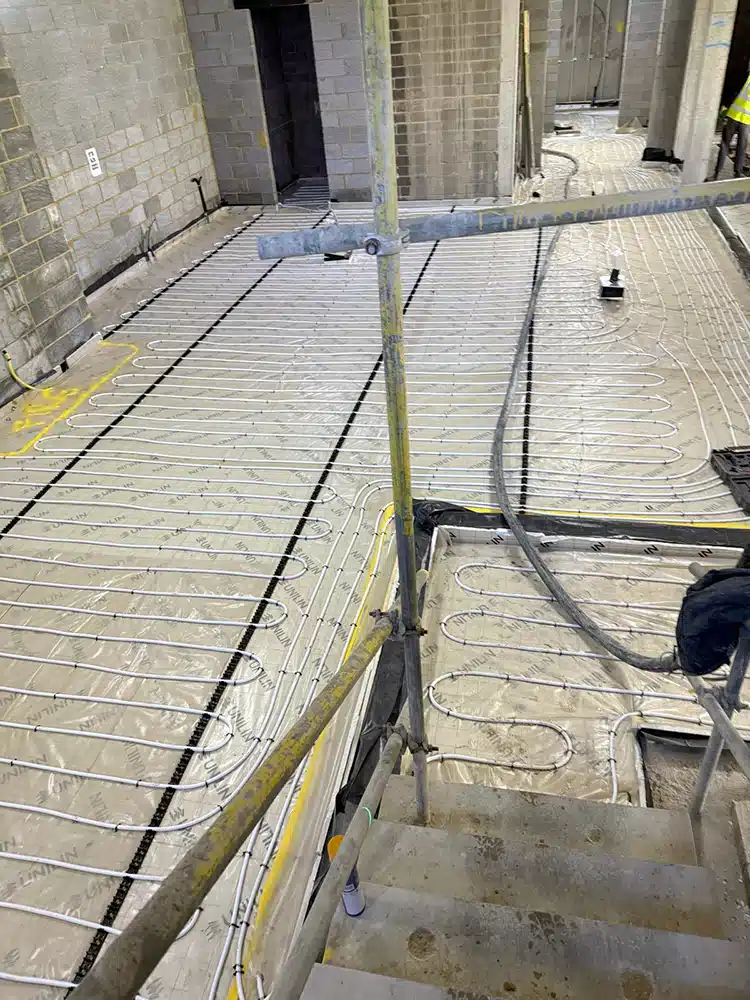
K & B Screeding’s own team, led by director Donatas Bardisevicius. Founded 2019, company 12298780.
See what customers say in our Google reviews and on our testimonials page.
Underfloor Heating Screed from Slough to Lambeth
Lambeth is about 23.3 miles east-south-east of our Slough base as the crow flies, with postcodes including SW9, SE24, SW4 and SW8. The nearest towns to it are Southwark (2.1 miles), Wandsworth (2.9 miles), Lewisham (4.2 miles) and Westminster (4.3 miles).
More on underfloor heating screed, part of our screeding services.
