
Adding heated floors to Downham and inter-war Lewisham homes
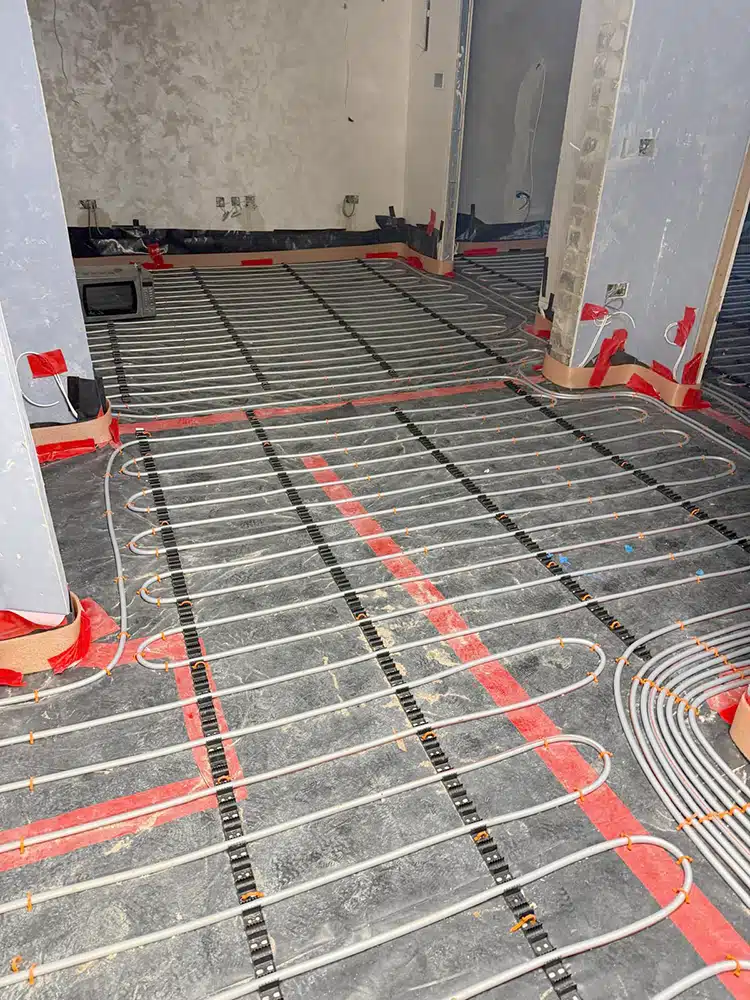
When a suspended timber floor is taken out and replaced with an insulated solid floor, the new build-up has room for heating pipes. On the inter-war Downham cottage homes, where replaced suspended floors and extensions are common jobs, that is a sensible point to consider adding underfloor heating. Some 18% of Lewisham's homes date from 1919 to 1944, so the question comes up well beyond Downham.
First, how much height have you got? Pipes need a minimum of 25mm of liquid screed on top, for a finished depth around 45 to 50mm; with sand and cement the cover rises to about 45mm, and the floor gets thicker to match. In a retrofit where the finished floor has to meet existing doors and stairs, those millimetres decide the method, and the thinner liquid option often fits where sand and cement would not.
Full encapsulation is the second. Any air pocket around a pipe slows heat transfer and can leave cold patches. Liquid finds its way into every gap around the pipework on its own; hand-laid screed only gets there if it is packed in with care.
Once your heating engineer has the pipes down and pressure tested, we look over the edge strip, membrane and insulation, or put them in ourselves through our insulation and membrane fitting, and then screed. For the pumped option in more detail, see liquid screed in Lewisham.
Commissioning heating in new Catford flats
At Convoys Wharf, Lewisham Gateway and Catford, new flats and townhouses go up with heating pipes under a liquid screed and acoustic insulation separating one unit from the next. In those buildings the screed and heating are part of the design, but the commissioning still has to be done properly.
Timing depends on the screed. Under calcium sulphate liquid screed, the heating can normally be switched on from around day 7 after the pour; under sand and cement, give it 21 days or more. Either way, the water should run cool at first and climb by a few degrees daily, as the screed manufacturer's schedule sets out. Rushing it risks cracks.
Only 9% of Lewisham homes were built from 2015 onwards, so the same process matters just as much in older houses fitted with new systems. Record the heat-up dates and temperatures, because a flooring fitter may ask for them before laying tiles or wood.
Flooring waits for a moisture test, and the limit depends on the covering and the screed type. What speeds drying up or slows it down is covered in how long screed takes to dry. If your project is over in Bromley, see heated floor screeding in Bromley.
Underfloor Heating Screed prices in Lewisham
Liquid screed over underfloor heating: £20 to £35 per m² supplied and laid (trade2base, June 2026), so £700 to £1,230 for 35 m². trade2base gives these figures excluding VAT. See our floor screeding cost guide or screed calculator.
Who lays your underfloor heating screed in Lewisham
K & B Screeding’s own team, led by director Donatas Bardisevicius. Founded 2019, company 12298780.
See what customers say in our Google reviews and on our testimonials page.
Underfloor Heating Screed from Slough to Lewisham
As the crow flies, our yard in Slough is about 27.5 miles from Lewisham, which lies to the east. Postcodes here include SE26, SE6, SE3 and SE4, and Southwark (3.2 miles), Lambeth (4.2 miles), Greenwich (4.3 miles) and Tower Hamlets (4.9 miles) are close by.
More on underfloor heating screed, part of our screeding services.
