
Rebuilding Victorian floors from Brockley to Hither Green
About 35% of Lewisham's homes were built before 1919, and in many of them the original ground floor was never designed to keep damp out. When a knock through or extension opens up the floor in a Brockley or Hither Green terrace, it often turns out to have no membrane at all. Putting that right means breaking out the old floor, adding a sub-base if the ground calls for it, then insulation, a damp proof membrane and finally the screed.
Hand-laid sand and cement handles that job well. It copes with small back rooms, chimney breasts and narrow doorways, and it can be laid in sections as the building work allows, room by room if the family is still living in the house. It also gives a cement based surface for adhesives that need one, and it takes foot traffic sooner than it can take flooring.
The thickness comes from what is underneath. Sitting loose on insulation in a home, it needs roughly 65mm; bonded to a sound slab that has been prepared for it, 25 to 40mm is possible. In any period house, the finished floor level is often fixed by original doors and thresholds, which limits the depth available.
If you would rather not source the insulation and membrane yourself, we can provide and lay them as part of our insulation and DPM work; the guide to screed depths goes into thickness in more detail.
Wet rooms, garages and drying times in Lewisham
Anywhere that gets wet, cement is what you want underneath. For a walk-in shower with no step, we can lay it sloping gently to a floor drain, and it puts up with moisture that a calcium sulphate screed cannot. That makes it the standard choice for wet rooms and utility floors.
It also suits a Lewisham garage that is becoming a bedroom or a study. The garage slab tends to sit below the level of the house, and insulation topped with sand and cement lifts it to line up with the rest of the ground floor. Our guide to garage conversion floors walks through each layer of that build-up.
Mixing in fibres adds £1 to £3 per m², and when fibre reinforcement is worth it is covered separately. Without them, a plain hand-laid floor costs between £18 and £25 per m² on 2026 UK figures.
The main drawback is drying. Drying runs at about 1mm a day to begin with, then slows past 40mm, so a 65mm floor in a Lewisham extension needs several weeks before most coverings can go on. Only a moisture test tells you for certain it is ready. Southwark, about 3.2 miles off, has its own sand and cement page.
Sand and Cement Screed prices in Lewisham
Sand and cement screed: £18 to £25 per m² supplied and laid (MyJobQuote, August 2026), so £450 to £630 for 25 m². MyJobQuote does not say whether these figures include VAT. See our floor screeding cost guide or screed calculator.
Who lays your sand and cement screed in Lewisham
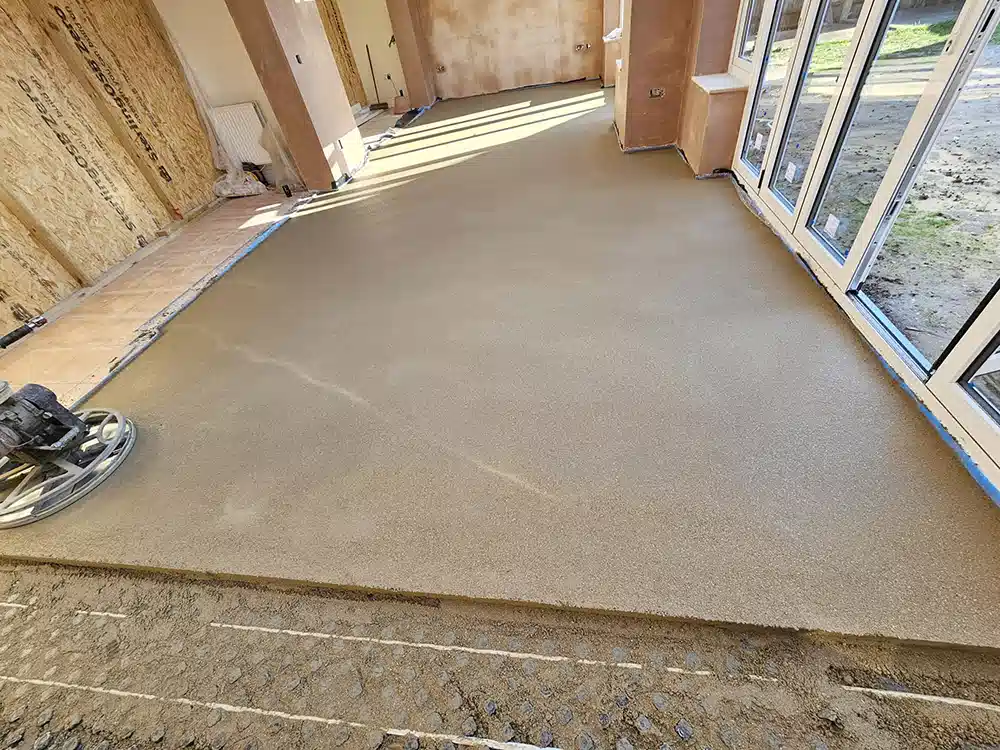
K & B Screeding’s own team, led by director Donatas Bardisevicius. Founded 2019, company 12298780.
See what customers say in our Google reviews and on our testimonials page.
Sand and Cement Screed from Slough to Lewisham
As the crow flies, our yard in Slough is about 27.5 miles from Lewisham, which lies to the east. Postcodes here include SE26, SE6, SE3 and SE4, and Southwark (3.2 miles), Lambeth (4.2 miles), Greenwich (4.3 miles) and Tower Hamlets (4.9 miles) are close by.
More on sand & cement screed, part of our screeding services.
