
Relaying solid floors in Erith and Northumberland Heath
Old solid floors give out in familiar ways: cracking, sinking, or never having had proper damp protection in the first place. For the older terraces around Erith and Northumberland Heath, the remedy is to lift the floor, dig down as far as the new build-up needs and rebuild it with hardcore where necessary, insulation, a damp proof membrane and a new screed on top. If the ground floor is suspended timber instead, swapping it for an insulated solid floor follows the same order, with the screed finished to meet the thresholds of the neighbouring rooms.
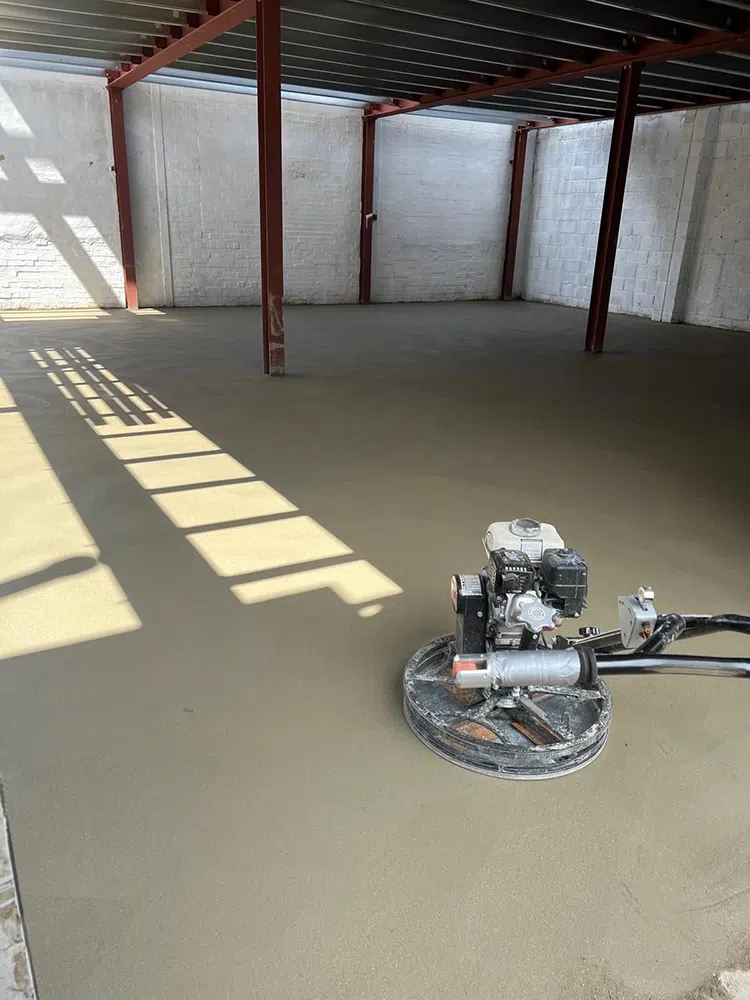
For a job like that, nothing beats a sand and cement mix for practicality. We mix it on site to suit each room, barrow it through narrow hallways with no pump outside, then compact and finish it to a dense, level surface. It can be bonded to a sound base, laid unbonded on a membrane or float over insulation.
The build decides the depth. Floating on insulation, a house or flat takes about 65mm and a commercial floor 75mm. Bonded to sound concrete, 25mm to 40mm is possible, and our bonded screed work covers that thinner route. Matching an old doorway height is covered in how thick a screed should be, which shows how we work out the depth.
If the floor is just uneven and not actually failing, it may not need digging out, and levelling a Bexley floor describes the lighter option.
Garages, wet rooms and small Bexley jobs
Any floor that might get wet should be cement based. Water weakens calcium sulphate, so bathrooms, walk-in showers and utility rooms take a cement screed, and because it is laid by hand we can build in the fall to the drain as we go.
On Bexley's suburban streets, garage conversions come up too. The garage slab usually sits below the house floor, so making it a room calls for insulation, a membrane and enough screed to lift it level. Our guide to garage floor screeds shows that build-up layer by layer.
The mix can be tuned. Fibres improve crack resistance and add £1 to £3 per m², while rapid drying additives cut the wait before flooring. If the floor has to carry loads early on, sand and cement copes better than a flowing screed.
Drying is the cost. Cement screed loses moisture at about a day for every millimetre through the first 40mm, then more slowly, so after a 65mm pour plan the flooring weeks ahead, not days. Budget £18 to £25 per m² for the screed itself, the 2026 UK price band for sand and cement.
Sand and Cement Screed prices in Bexley
Sand and cement screed: £18 to £25 per m² supplied and laid (MyJobQuote, August 2026), so £450 to £630 for 25 m². MyJobQuote does not say whether these figures include VAT. See our floor screeding cost guide or screed calculator.
Who lays your sand and cement screed in Bexley
K & B Screeding’s own team, led by director Donatas Bardisevicius. Founded 2019, company 12298780.
See what customers say in our Google reviews and on our testimonials page.
Sand and Cement Screed from Slough to Bexley
As the crow flies, our yard in Slough is about 34.3 miles from Bexley, which lies to the east. Postcodes here include DA7, DA1, DA15 and DA5, and Greenwich (3.6 miles), Swanley (4.4 miles), Dartford (4.5 miles) and Swanscombe (6.2 miles) are close by.
More on sand & cement screed, part of our screeding services.